Back
Prokaryotic Cell Structure and Function Study Guide
Study Guide - Smart Notes
 Tailored notes based on your materials, expanded with key definitions, examples, and context.
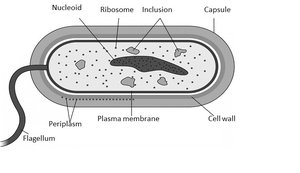
Q1. Capsule: Describe the structure and/or function of the capsule in prokaryotic cells.
Background
Topic: Prokaryotic Cell Surface Structures
This question tests your understanding of the capsule, a common external structure in many bacteria, and its role in cell protection and interaction with the environment.
Key Terms and Concepts:
Capsule: A well-organized, dense layer outside the cell wall, usually composed of polysaccharides or sometimes polypeptides.
Step-by-Step Guidance
Recall that the capsule is an external structure found in some bacteria, located outside the cell wall.
Think about the chemical composition of the capsule (mainly polysaccharides, sometimes polypeptides).
Consider the main functions of the capsule, such as protection from desiccation, evasion of the host immune system, and aiding in adherence to surfaces.
Summarize these points in a brief description, focusing on both structure and function.
Try solving on your own before revealing the answer!
Final Answer:
The capsule is a well-organized, dense layer composed mainly of polysaccharides (sometimes polypeptides) that surrounds the cell wall. It protects the cell from desiccation, helps evade phagocytosis by host immune cells, and aids in adherence to surfaces.
Q2. Cell wall: Describe the structure and/or function of the cell wall in prokaryotic cells.
Background
Topic: Prokaryotic Cell Envelope
This question focuses on the cell wall, a critical structure for maintaining cell shape and integrity in bacteria.
Key Terms and Concepts:
Cell wall: A rigid layer outside the plasma membrane, primarily composed of peptidoglycan in bacteria.
Step-by-Step Guidance
Recall the main chemical component of bacterial cell walls (peptidoglycan).
Think about the differences between Gram-positive and Gram-negative cell walls (thickness, complexity, presence of outer membrane).
Consider the main functions: providing structural support, maintaining cell shape, and protecting against osmotic lysis.
Summarize these points in a concise description.
Try solving on your own before revealing the answer!
Final Answer:
The cell wall is a rigid structure composed mainly of peptidoglycan that surrounds the plasma membrane. It provides structural support, maintains cell shape, and protects the cell from osmotic lysis.
Q3. Flagellum: Describe the structure and/or function of the flagellum in prokaryotic cells.
Background
Topic: Bacterial Motility
This question examines your knowledge of the flagellum, a structure responsible for bacterial movement.
Key Terms and Concepts:
Flagellum: A long, whip-like appendage used for locomotion, composed of the protein flagellin.
Step-by-Step Guidance
Recall the three main parts of the bacterial flagellum: filament, hook, and basal body.
Think about the composition of the filament (flagellin protein) and its function in movement.
Consider how the flagellum is anchored in the cell envelope and powered by a proton or sodium gradient.
Summarize the structure and function in a brief description.
Try solving on your own before revealing the answer!
Final Answer:
The flagellum is a long, whip-like structure made of flagellin protein, consisting of a filament, hook, and basal body. It enables bacterial motility by rotating, powered by a proton or sodium gradient across the membrane.
Q4. Inclusion: Describe the structure and/or function of inclusions in prokaryotic cells.
Background
Topic: Cytoplasmic Structures in Bacteria
This question tests your understanding of inclusions, which are storage granules found in the cytoplasm of prokaryotic cells.
Key Terms and Concepts:
Inclusion: Cytoplasmic structures that store nutrients or other substances, such as glycogen, polyphosphate, or sulfur granules.
Step-by-Step Guidance
Recall that inclusions are not membrane-bound organelles but are visible storage granules in the cytoplasm.
Think about the types of substances stored in inclusions (e.g., carbon, phosphate, sulfur).
Consider the function of inclusions in helping bacteria survive fluctuating environmental conditions.
Summarize these points in a brief description.
Try solving on your own before revealing the answer!
Final Answer:
Inclusions are cytoplasmic storage granules that contain nutrients or other substances, such as glycogen, polyphosphate, or sulfur, allowing bacteria to store resources for later use.
Q5. Nucleoid: Describe the structure and/or function of the nucleoid in prokaryotic cells.
Background
Topic: Genetic Material in Prokaryotes
This question focuses on the nucleoid, the region where the bacterial chromosome is located.
Key Terms and Concepts:
Nucleoid: An irregularly shaped region in the cytoplasm containing the bacterial chromosome (DNA), not surrounded by a membrane.
Step-by-Step Guidance
Recall that prokaryotes lack a true nucleus; instead, their DNA is found in the nucleoid region.
Think about the structure: a single, circular, double-stranded DNA molecule.
Consider the function: storage and expression of genetic information.
Summarize these points in a brief description.
Try solving on your own before revealing the answer!
Final Answer:
The nucleoid is an irregularly shaped region in the cytoplasm that contains the bacterial chromosome (a single, circular, double-stranded DNA molecule), responsible for storing and expressing genetic information.
Q6. Periplasm: Describe the structure and/or function of the periplasm in prokaryotic cells.
Background
Topic: Cell Envelope Compartments
This question examines your understanding of the periplasm, a space found in Gram-negative bacteria.
Key Terms and Concepts:
Periplasm: The space between the inner (plasma) membrane and the outer membrane in Gram-negative bacteria, containing various enzymes and proteins.
Step-by-Step Guidance
Recall that the periplasm is present in Gram-negative bacteria, located between the plasma membrane and the outer membrane.
Think about the types of molecules found in the periplasm (enzymes, transport proteins).
Consider the functions: nutrient acquisition, electron transport, and peptidoglycan synthesis.
Summarize these points in a brief description.
Try solving on your own before revealing the answer!
Final Answer:
The periplasm is the space between the plasma membrane and the outer membrane in Gram-negative bacteria, containing enzymes and proteins involved in nutrient acquisition, electron transport, and cell wall synthesis.
Q7. Plasma membrane: Describe the structure and/or function of the plasma membrane in prokaryotic cells.
Background
Topic: Cell Membrane Structure and Function
This question tests your knowledge of the plasma membrane, a fundamental structure in all cells.
Key Terms and Concepts:
Plasma membrane: A phospholipid bilayer with embedded proteins that surrounds the cytoplasm and controls the movement of substances in and out of the cell.
Step-by-Step Guidance
Recall the basic structure: a phospholipid bilayer with embedded proteins.
Think about the amphipathic nature of phospholipids and the fluid mosaic model.
Consider the main functions: selective permeability, transport, energy generation, and cell signaling.
Summarize these points in a brief description.
Try solving on your own before revealing the answer!
Final Answer:
The plasma membrane is a phospholipid bilayer with embedded proteins that surrounds the cytoplasm, controlling the movement of substances in and out of the cell and playing roles in energy generation and cell signaling.
Q8. Ribosome: Describe the structure and/or function of ribosomes in prokaryotic cells.
Background
Topic: Protein Synthesis in Prokaryotes
This question focuses on ribosomes, the molecular machines responsible for protein synthesis.
Key Terms and Concepts:
Ribosome: A complex of RNA and protein that synthesizes proteins by translating messenger RNA (mRNA).
Step-by-Step Guidance
Recall that prokaryotic ribosomes are 70S, composed of a 50S large subunit and a 30S small subunit.
Think about the function: translating mRNA into polypeptides (proteins).
Consider the importance of ribosomes in all living cells for gene expression.
Summarize these points in a brief description.
Try solving on your own before revealing the answer!
Final Answer:
Ribosomes are 70S complexes made of RNA and protein, composed of 50S and 30S subunits, responsible for synthesizing proteins by translating mRNA.