 Back
Prokaryotic Genome Structure, DNA Organization, and Replication: Microbiology Study Notes
Study Guide - Smart Notes
 Tailored notes based on your materials, expanded with key definitions, examples, and context.
The Historical Discovery of DNA and Genetic Material
Early Experiments and Key Figures
The identification of DNA as the hereditary material was a result of numerous experiments and discoveries by pioneering scientists. These studies laid the foundation for modern molecular genetics and microbiology.
Mendel (1860s): Established the basic patterns of inheritance using pea plants.
Miescher (1860s): Isolated 'nuclein' from white blood cells, identifying a phosphorus-rich substance later known as nucleic acid
.
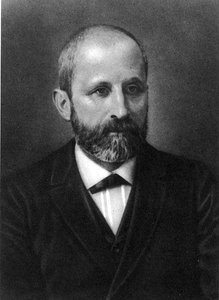
Altman (1880s): Determined the acidic nature of nuclein, coining the term 'nucleic acids'.
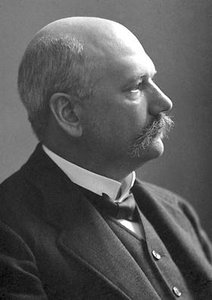
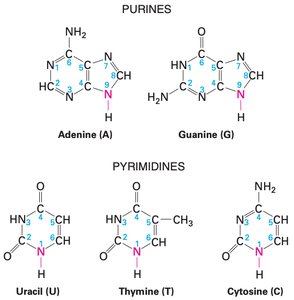
Kossel (1900s): Characterized the five nucleotide bases: adenine (A), thymine (T), guanine (G), cytosine (C), and uracil (U).
Microbes as Model Organisms
Microorganisms are ideal for genetic research due to their rapid growth, ease of manipulation, and reproducibility. The principle "What is true for E. coli is also true for the elephant" (Jacques Monod) highlights their universal applicability in biology.
Classic Experiments in Genetic Research
Hämmerling’s Acetabularia Experiment
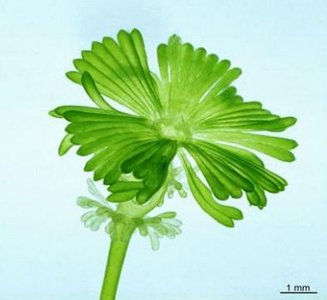
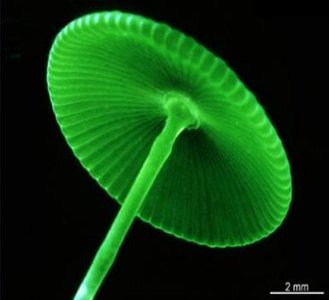
Joachim Hämmerling used the unicellular alga Acetabularia to demonstrate that the nucleus contains genetic material responsible for cellular characteristics.
Cap Regeneration: Removing the cap allowed regeneration, but removing the foot (nucleus) prevented it.
Grafting: The regenerated cap reflected the species of the grafted foot, confirming the nucleus's role.
Beadle and Tatum – One Gene One Enzyme Hypothesis (1941)
Beadle and Tatum used Neurospora crassa to show that genes control specific metabolic steps via enzymes.
Auxotroph Mutants: Mutants unable to grow on minimal media were identified and tested for metabolic blocks.
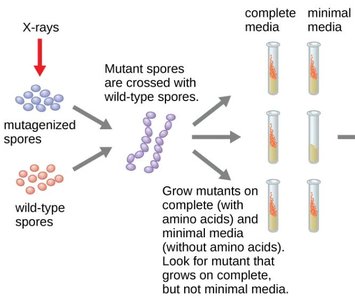
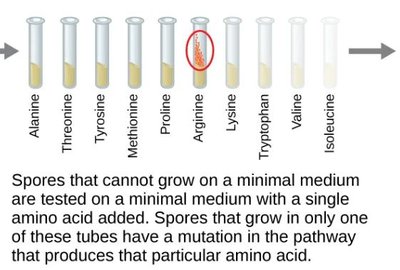
Metabolic Pathway Analysis: Mutants defective in different steps of arginine biosynthesis confirmed the "one gene – one enzyme" hypothesis.
Bread Mold | Minimal Medium (MM) | MM + Ornithine | MM + Citrulline | MM + Arginine |
|---|---|---|---|---|
Wild type | grew | grew | grew | grew |
Mutant 1 | did not grow | grew | grew | grew |
Mutant 2 | did not grow | did not grow | grew | grew |
Mutant 3 | did not grow | did not grow | did not grow | grew |
Griffith’s Transformation Principle (1928)
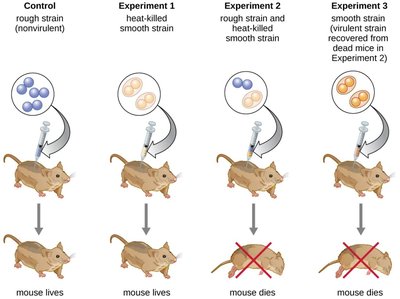
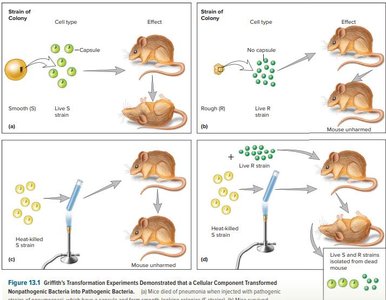
Griffith demonstrated that a "transforming principle" from heat-killed virulent Streptococcus pneumoniae could convert non-virulent bacteria into virulent forms.
S-strain: Smooth, virulent
R-strain: Rough, non-virulent
Transformation: Heat-killed S-strain mixed with live R-strain caused mice to die, indicating genetic transformation.
Avery–MacLeod–McCarty (1944)
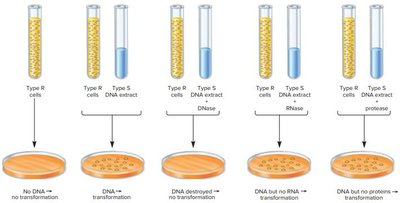
These scientists fractionated S-strain extracts and treated them with enzymes to identify the transforming agent. Only DNAse treatment abolished transformation, confirming DNA as the hereditary material.
Hershey-Chase Blender Experiment (1952)
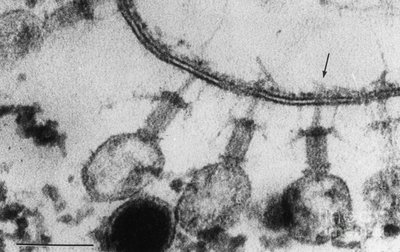
Using bacteriophage T2 and radioactive isotopes, Hershey and Chase showed that DNA, not protein, is the heritable material injected into E. coli.
Nucleic Acids: Structure and Properties
DNA Primary Structure
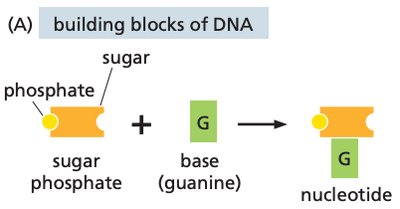
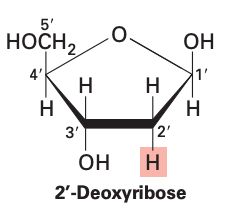
DNA is a polymer of nucleotides, each consisting of a deoxyribose sugar, a phosphate group, and a nitrogenous base. The backbone is formed by phosphodiester bonds, creating polarity (5' to 3' direction).
Purines: Adenine (A), Guanine (G)
Pyrimidines: Thymine (T), Cytosine (C)
Base Pairing: A-T and G-C via hydrogen bonds
Double Helix Features
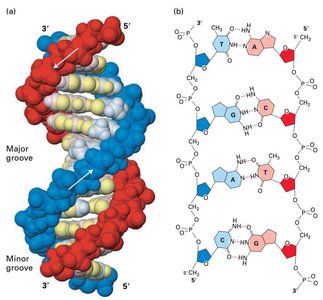
The DNA double helix consists of two antiparallel strands wound together, forming major and minor grooves. The structure is stabilized by hydrogen bonds and base stacking interactions.
Antiparallel: Strands run in opposite directions (5' to 3' and 3' to 5')
Complementary: Base pairing ensures accurate replication
Right-handed helix: Most common form (B-DNA)
Denaturation and Renaturation
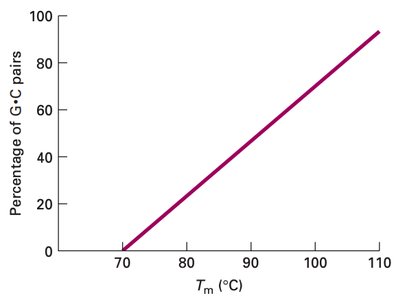
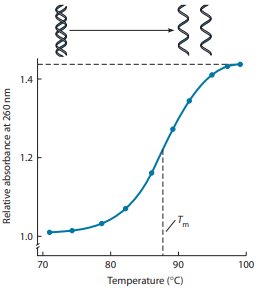
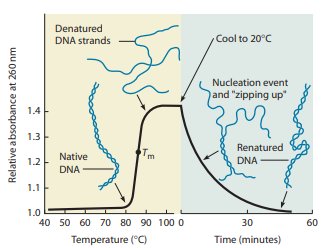
DNA strands can be separated (denatured) by heat, with melting temperature (Tm) dependent on G-C content. Denaturation is reversible, allowing renaturation under suitable conditions.
Ribonucleic Acid (RNA)
RNA differs from DNA by having ribose sugar and uracil instead of thymine. It is usually single-stranded and can form secondary structures via intramolecular base pairing. Some viruses use RNA as hereditary material.
Types: mRNA, tRNA, rRNA
Hereditary Role: RNA viruses
Prokaryotic Genomes: Structure and Organization
Prokaryotic Chromosomes
Prokaryotes typically have a single, circular, double-stranded DNA chromosome located in the nucleoid region. Chromosome size varies among species.
Shape: Circular dsDNA, haploid
Attachment: OriC region at cytoplasmic membrane
Packaging: Nucleoid-Associated Proteins (NAPs) organize DNA
Topology: Supercoiling (negative in bacteria, positive in some archaea)
Topoisomerases
Type I: Cuts one strand, relieves supercoiling, no ATP required
Type II: Cuts both strands, introduces supercoiling, ATP dependent (e.g., DNA gyrase)
Plasmids
Plasmids are extrachromosomal, self-replicating DNA molecules that can carry genes for antibiotic resistance, virulence, and other functions. They are usually circular and much smaller than chromosomes.
Types: R-plasmids (resistance), virulence plasmids, conjugative plasmids, dissimilation plasmids
Replication: Bidirectional or rolling-circle
Transposons – Mobile Genetic Elements
Transposons are DNA sequences that can move within the genome, either by cut-and-paste (conservative) or copy-and-paste (replicative) mechanisms. They may carry additional genes, such as those for antibiotic resistance.
Central Dogma: Flow of Genetic Information
Overview
The central dogma describes the flow of genetic information from DNA to RNA to protein.
Replication: DNA is duplicated by DNA polymerase
Transcription: DNA is transcribed to RNA by RNA polymerase
Translation: RNA is translated into protein by ribosomes
DNA Replication: Mechanism and Enzymes
Semiconservative, Bidirectional, and Semi-discontinuous Replication
DNA replication produces two double helices, each with one parental and one new strand. Replication proceeds bidirectionally from the origin, with continuous synthesis on the leading strand and discontinuous synthesis (Okazaki fragments) on the lagging strand.
Key Enzymes
DNA Polymerase III: Main enzyme for DNA synthesis, with proofreading (3'→5' exonuclease)
DNA Polymerase I: Removes RNA primers and fills gaps (5'→3' exonuclease and polymerase)
Helicase: Unwinds DNA
Primase: Synthesizes RNA primers
Ligase: Seals nicks in DNA
Gyrase: Relieves supercoiling
SSB Proteins: Stabilize single-stranded DNA
Replication Steps
Initiation: Begins at oriC, involves DnaA, DnaB (helicase), and DnaG (primase)
Elongation: Leading strand synthesized continuously; lagging strand synthesized in fragments
Termination: Tus proteins recognize ter site; topoisomerase IV decatenates chromosomes
Replisome and Fidelity
The replisome is a complex coordinating all replication proteins. Proofreading by DNA polymerase ensures high fidelity.
Differences: Prokaryotic vs Eukaryotic Replication
Prokaryotes: Single origin, circular chromosomes
Eukaryotes: Multiple origins, linear chromosomes, telomeres, telomerase, regulation by methylation
Rolling Circle Replication
Some plasmids and viruses replicate via rolling circle mechanism, producing single-stranded DNA intermediates.
Key Terms and Concepts
Gene: Unit of heredity
Genome: Total genetic material in a cell
Chromosome: Main genetic element in prokaryotes
Plasmid: Extrachromosomal DNA
Transposon: Mobile genetic element
Semiconservative Replication: Each new DNA molecule contains one old and one new strand
Okazaki Fragments: Short DNA fragments synthesized on the lagging strand
Summary Table: DNA Replication Enzymes
Enzyme | Function |
|---|---|
DNA Polymerase III | Main DNA synthesis, proofreading |
DNA Polymerase I | Removes RNA primers, fills gaps |
Helicase | Unwinds DNA |
Primase | Synthesizes RNA primers |
Ligase | Seals nicks |
Gyrase | Relieves supercoiling |
SSB Proteins | Stabilize ssDNA |
Important Equations
Chargaff's Rule:
Phosphodiester Bond Formation:
Additional info: These notes expand on the original slides and lecture content, providing context and definitions for key terms and processes in prokaryotic genome structure and DNA replication.
