 Back
BackChapter Eight: Recombinant DNA Technology
Study Guide - Smart Notes
 Tailored notes based on your materials, expanded with key definitions, examples, and context.
Recombinant DNA Technology
Introduction to Recombinant DNA Technology
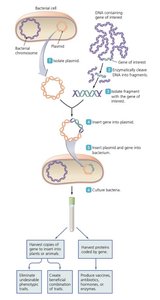
Recombinant DNA technology is a cornerstone of modern biotechnology, enabling scientists to intentionally modify the genomes of organisms for practical purposes. The main goals are to eliminate undesirable traits, combine beneficial traits from different organisms, and create organisms that synthesize products needed by humans.
Biotechnology: The use of microorganisms to make practical products.
Recombinant DNA Technology: The deliberate modification of genetic material to achieve specific outcomes.
Main Goals:
Eliminate undesirable phenotypic traits
Combine beneficial traits from multiple organisms
Create organisms that synthesize useful products
Overview of Recombinant DNA Technology Process
The process typically involves isolating a gene of interest, inserting it into a vector, and introducing the recombinant vector into a host cell for expression or replication.
Tools of Recombinant DNA Technology
Mutagens
Mutagens are physical or chemical agents that induce mutations in DNA. Scientists use mutagens to create genetic diversity and select for beneficial traits.
Purpose: To generate genetic variation for selection and study.
Application: Isolating mutated genes for further analysis or use.
Reverse Transcriptase and cDNA Synthesis
Reverse transcriptase, an enzyme from retroviruses, synthesizes complementary DNA (cDNA) from an RNA template. This is especially useful for cloning eukaryotic genes in prokaryotes, as cDNA lacks introns.
cDNA: A DNA copy of an mRNA molecule, free of introns.
Application: Allows expression of eukaryotic genes in prokaryotic systems.
Synthetic Nucleic Acids
Synthetic nucleic acids are artificially created DNA or RNA molecules. They are used for elucidating genetic codes, creating genes, synthesizing probes, and designing PCR primers.
Applications:
Studying gene function
Locating specific nucleotide sequences
Producing antisense molecules
Restriction Enzymes
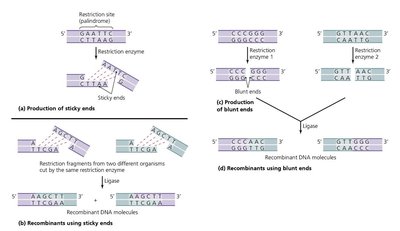
Restriction enzymes are bacterial proteins that cut DNA at specific sequences called restriction sites, often palindromic. They are essential for creating recombinant DNA molecules.
Sticky Ends: Overhanging single-stranded ends that facilitate ligation.
Blunt Ends: Straight cuts with no overhangs; less efficient for ligation but allow joining of fragments from different enzymes.
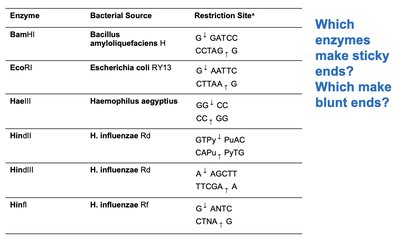
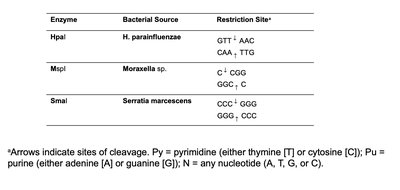
Representative restriction enzymes and their properties:
Enzyme | Bacterial Source | Restriction Site |
|---|---|---|
BamHI | Bacillus amyloliquefaciens H | G^GATCC |
EcoRI | Escherichia coli RY13 | G^AATTC |
HaeIII | Haemophilus aegyptius | GG^CC |
HindIII | H. influenzae Rd | A^AGCTT |
HinfI | H. influenzae Rf | G^ANTC |
Vectors
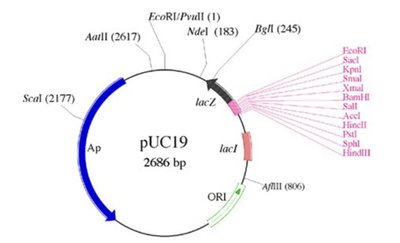
Vectors are DNA molecules used to deliver foreign genes into host cells. Common vectors include plasmids, viral genomes, and transposons. Ideal vectors are small, stable, and contain selectable markers.
Properties: Small size, survivability in host, selectable markers, and gene expression elements.
Example: pUC19 plasmid vector.
CRISPR-Cas System
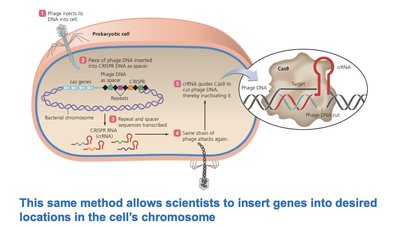
CRISPR is a prokaryotic immune system adapted for genome editing. It uses a guide RNA to direct the Cas9 enzyme to a specific DNA sequence, allowing for precise gene inactivation or replacement.
Applications: Gene editing, functional genomics, and potential gene therapy.
Gene Libraries
A gene library is a collection of clones, each containing a fragment of an organism's genome. Libraries can represent all genes from a chromosome or a set of cDNA molecules.
Purpose: To provide a resource for isolating and studying individual genes.

Techniques of Recombinant DNA Technology
Polymerase Chain Reaction (PCR)
PCR is a method for amplifying specific DNA sequences in vitro. It involves cycles of denaturation, primer annealing, and extension, doubling the target DNA with each cycle.
Components: Target DNA, primers, Taq polymerase, dNTPs, buffer.
Steps:
Denaturation (95°C): DNA strands separate.
Annealing (37–65°C): Primers bind to target sequences.
Extension (70–75°C): Taq polymerase synthesizes new DNA.
Applications: Diagnostics, forensics, research, and epidemiology.
Gel Electrophoresis
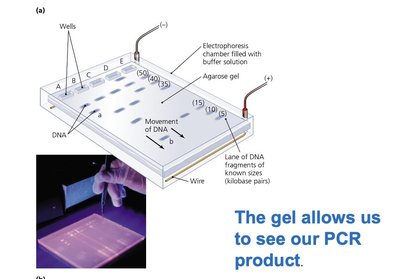
Gel electrophoresis separates DNA fragments by size using an electric field. DNA moves toward the positive electrode, with smaller fragments migrating faster.
Southern Blot
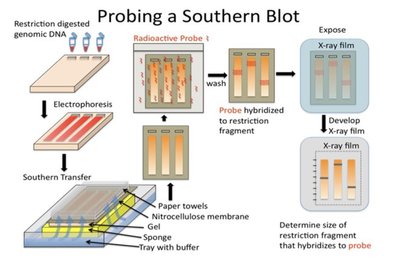
Southern blotting transfers DNA from a gel to a membrane, where labeled probes can detect specific sequences. This technique is essential for identifying genes and mutations.
DNA Microarrays
DNA microarrays consist of immobilized single-stranded DNA sequences. Fluorescently labeled DNA binds to complementary spots, allowing for the analysis of gene expression, mutation detection, and organism identification.
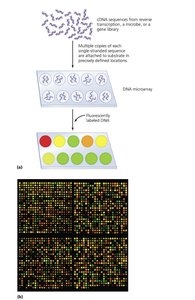
Inserting DNA into Cells
Introducing recombinant DNA into cells can be achieved by natural methods (transformation, transduction, conjugation) or artificial methods (electroporation, protoplast fusion, gene gun, microinjection, heat shock).
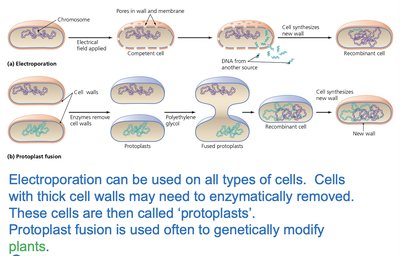
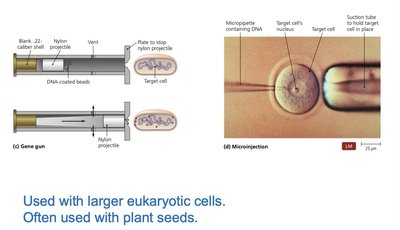
Applications of Recombinant DNA Technology
Genetic Mapping and Genomics
Genetic mapping locates genes on chromosomes, providing insights into metabolism, growth, and evolutionary relationships. Genomics involves sequencing and analyzing entire genomes, aiding in drug and vaccine development.
Pharmaceutical and Therapeutic Applications
Protein Synthesis: Bacteria and yeast produce proteins like insulin and interferon.
Vaccine Production: Subunit vaccines and edible vaccines in plants.
Genetic Screening: DNA microarrays detect mutations and inherited diseases.
Gene Therapy: Replacing defective genes with functional copies.
Medical Diagnosis: Detecting pathogen-specific gene sequences in patient samples.
Xenotransplants and Animal Models: Using animal tissues or genetically modified animals for research and therapy.
Agricultural Applications
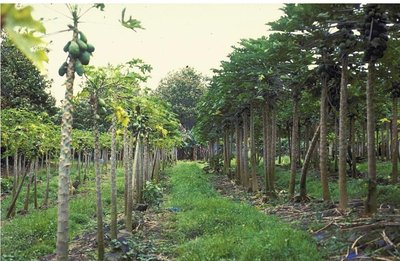
Transgenic Organisms (GMOs): Plants and animals with genes from other species.
Herbicide and Pest Resistance: Genes for glyphosate resistance and Bt toxin.
Salt and Freeze Tolerance: Genes for stress resistance in crops.
Improved Nutrition and Yield: Golden rice with β-carotene, BGH in cattle.
Ethics and Safety of Recombinant DNA Technology
The long-term effects of recombinant DNA technology are not fully known. Concerns include gene transfer to non-target organisms, allergenicity, and the creation of biological weapons. Ethical issues involve genetic privacy, screening, and the patenting of genetically modified organisms.
Potential risks to health and environment are closely monitored.
Strict standards are imposed on laboratories using recombinant DNA technology.
Ongoing debates address genetic privacy, access, and the extent of permissible genetic modifications.
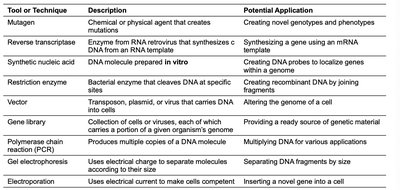
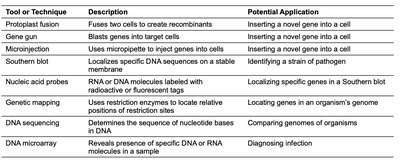
Summary Table: Tools and Techniques of Recombinant DNA Technology
Tool or Technique | Description | Potential Application |
|---|---|---|
Mutagen | Chemical or physical agent that creates mutations | Creating novel genotypes and phenotypes |
Reverse transcriptase | Enzyme from RNA retrovirus that synthesizes cDNA from an RNA template | Synthesizing a gene using an mRNA template |
Synthetic nucleic acid | DNA molecule prepared in vitro | Creating DNA probes to localize genes within a genome |
Restriction enzyme | Bacterial enzyme that cleaves DNA at specific sites | Creating recombinant DNA by joining fragments |
Vector | Transposon, plasmid, or virus that carries DNA into cells | Altering the genome of a cell |
Gene library | Collection of cells or viruses, each carrying a portion of a given organism's genome | Providing a ready source of genetic material |
Polymerase chain reaction (PCR) | Produces multiple copies of a DNA molecule | Multiplying DNA for various applications |
Gel electrophoresis | Uses electrical charge to separate molecules according to their size | Separating DNA fragments by size |
Electroporation | Uses electrical current to make cells competent | Inserting a novel gene into a cell |
Protoplast fusion | Fuses two cells to create recombinants | Inserting a novel gene into a cell |
Gene gun | Blasts genes into target cells | Inserting a novel gene into a cell |
Microinjection | Uses micropipette to inject genes into cells | Inserting a novel gene into a cell |
Southern blot | Localizes specific DNA sequences on a stable membrane | Identifying a strain of pathogen |
Nucleic acid probes | RNA or DNA molecules labeled with radioactive or fluorescent tags | Localizing specific genes in a Southern blot |
Genetic mapping | Uses restriction enzymes to locate relative positions of restriction sites | Locating genes in an organism's genome |
DNA sequencing | Determines the sequence of nucleotide bases in DNA | Comparing genomes of organisms |
DNA microarray | Reveals presence of specific DNA or RNA molecules in a sample | Diagnosing infection |
