 Back
BackRecombinant DNA Technology: Tools, Techniques, Applications, and Ethics
Study Guide - Smart Notes
 Tailored notes based on your materials, expanded with key definitions, examples, and context.
Recombinant DNA Technology
Role of Recombinant DNA Technology in Biotechnology
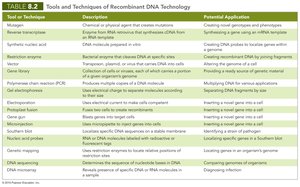
Biotechnology is the use of microorganisms to produce practical products, a practice dating back to the production of bread, cheese, and alcoholic beverages. Recombinant DNA technology (also known as genetic engineering) involves the intentional modification of an organism's genome for practical purposes. The main goals are to eliminate undesirable traits, combine beneficial traits, and create organisms that synthesize products needed by humans. This technology encompasses a collection of tools and techniques, including mutagens, reverse transcriptase, synthetic nucleic acids, restriction enzymes, and vectors.
Gene isolation and manipulation: Scientists can isolate a gene from one cell, manipulate it in vitro, and insert it into another organism.
Gene libraries: These techniques are used to create collections of cloned genes for further study or application.
Tools of Recombinant DNA Technology
Mutagens
Mutagens are physical or chemical agents that induce mutations in DNA. Scientists use mutagens to create genetic diversity and select for beneficial traits, such as increased antibiotic production in Penicillium species. Mutated genes can be isolated and studied independently of the organism.
Reverse Transcriptase
Reverse transcriptase is an enzyme that synthesizes complementary DNA (cDNA) from an RNA template. This is especially useful for expressing eukaryotic genes in prokaryotes, as cDNA lacks introns and can be directly inserted into bacterial cells for protein production.
Synthetic Nucleic Acids
Synthetic nucleic acids are artificially created DNA or RNA molecules. They are used to elucidate the genetic code, create genes for specific proteins, and synthesize probes for locating nucleotide sequences. Probes are labeled nucleic acids that help identify specific DNA or RNA sequences.
Restriction Enzymes
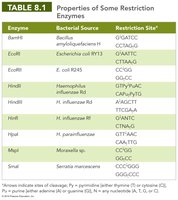
Restriction enzymes are bacterial enzymes that cut DNA at specific sequences known as restriction sites, which are often palindromic. They are categorized by the type of cut they produce:
Sticky ends: Facilitate the joining of DNA from different sources.
Blunt ends: More versatile but harder to use for recombinant DNA formation.
Restriction enzymes are essential for creating recombinant DNA molecules by cutting and joining DNA fragments from different organisms.
Vectors
Vectors are nucleic acid molecules (such as plasmids, viral genomes, or transposons) used to deliver genes into cells. They must be small, able to survive inside cells, contain recognizable markers, and ensure gene expression. The process involves cutting both the vector and the gene of interest, splicing them together, and introducing them into host cells, which are then selected for successful incorporation.
Gene Libraries
Gene libraries are collections of cloned genes, often representing the entire genome or all expressed genes (cDNA library) of an organism. They are created by fragmenting DNA, inserting fragments into vectors, and culturing the recombinant clones.
Techniques of Recombinant DNA Technology
Polymerase Chain Reaction (PCR)
PCR is a technique that amplifies specific DNA sequences in vitro, producing millions of copies. It is crucial for identifying pathogens, analyzing genetic material, and forensic investigations. The process involves three steps:
Denaturation: Heating separates DNA strands.
Priming: Primers bind to target sequences.
Extension: DNA polymerase synthesizes new DNA strands.
PCR is automated using a thermocycler.
Gel Electrophoresis
Gel electrophoresis separates DNA fragments by size, charge, and shape using an electric field in an agarose gel. Smaller fragments migrate faster, allowing for size estimation and isolation of specific DNA fragments for further analysis.
Southern and Northern Blotting
Southern blotting transfers DNA from a gel to a membrane, where labeled probes can detect specific sequences. Northern blotting is a similar technique for RNA. These methods are used for genetic fingerprinting, disease diagnosis, and detecting unculturable organisms.
DNA Microarrays
DNA microarrays consist of thousands of immobilized single-stranded DNA sequences. Labeled DNA samples hybridize to complementary sequences, allowing for monitoring gene expression, diagnosing infections, and identifying organisms in environmental samples.
DNA Insertion Methods
Natural methods: Transformation, transduction, and conjugation (horizontal gene transfer).
Artificial methods: Electroporation (electric current), protoplast fusion (fusion of cell wall-less cells), and microinjection/gene gun (direct DNA injection).
Applications of Recombinant DNA Technology
Genetic Mapping and Genomics
Genetic mapping locates genes on DNA molecules, aiding in understanding metabolism, growth, and evolutionary relationships. Genomics involves sequencing and analyzing entire genomes, which has become faster and more comprehensive with modern technology. Applications include pathogen identification and studying microbial diversity.
Pharmaceutical and Medical Applications
Protein synthesis: Production of human proteins (e.g., insulin, interferon) in bacteria or yeast.
Vaccines: Creation of safer subunit vaccines and novel delivery methods (e.g., edible vaccines, DNA vaccines).
Genetic screening: Use of DNA microarrays to detect inherited diseases or pathogens.
DNA fingerprinting: Identification of individuals based on unique DNA patterns (forensics, paternity testing).
Gene therapy: Replacement of defective genes to treat diseases (e.g., SCID, choroideremia).
Medical diagnosis: Detection of pathogen-specific DNA in patient samples.
Xenotransplantation: Use of animal tissues or organs in humans (e.g., pig heart valves).
Agricultural Applications
Transgenic organisms: Plants and animals with genes from other species for improved traits.
Herbicide tolerance: Crops resistant to herbicides (e.g., glyphosate resistance from Agrobacterium tumefaciens).
Salt and freeze tolerance: Genes for salt and cold resistance introduced into crops.
Pest resistance: Bt toxin gene in crops for insect resistance; resistance to pathogens like Phytophthora infestans and ringspot virus.
Improved nutrition and yield: Enhanced shelf life, increased milk production, and biofortification (e.g., β-carotene in rice).
Ethics and Safety of Recombinant DNA Technology
The long-term effects of transgenic organisms are not fully known, and concerns include gene transfer to non-target species, allergenicity, and the creation of new pathogens. There is also potential for misuse in biological warfare. Regulatory standards and international treaties aim to prevent accidental release and misuse, but ethical questions remain regarding genetic privacy, mandatory screening, and profit from genetically modified organisms.
Ethical issues: Genetic privacy, access to screening, profit motives, and government regulation.
Safety: Laboratory standards and international treaties to prevent misuse.
Example: The use of Bacillus anthracis in bioterrorism highlights the dual-use nature of recombinant DNA technology.
