 Back
BackRegulation of Gene Expression in Bacteria
Study Guide - Smart Notes
 Tailored notes based on your materials, expanded with key definitions, examples, and context.
Regulation of Gene Expression in Bacteria
Overview of Gene Expression
Gene expression in bacteria is tightly regulated to ensure that RNA and protein synthesis only occur when necessary, conserving cellular resources. Genes can be classified as constitutive (always expressed) or regulated (expressed only under certain conditions). Regulation can occur at multiple levels, but in bacteria, the most common control point is transcription initiation.
Constitutive genes: Expressed continuously, regardless of environmental conditions.
Regulated genes: Expressed only when needed, often in response to environmental signals.
Regulation mechanisms: Transcriptional (initiation, elongation, termination), translational, post-transcriptional, and post-translational.
Transcriptional Regulation
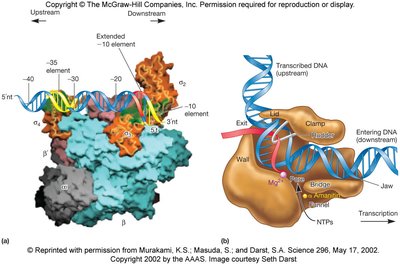
Transcriptional regulation involves proteins called transcription factors that bind DNA and influence RNA polymerase activity. These include activators (increase transcription) and repressors (decrease transcription).
Activators: Bind to DNA near promoters, enhance RNA polymerase binding, and increase transcription frequency (positive regulation).
Repressors: Bind to operators near promoters, block RNA polymerase, and decrease transcription frequency (negative regulation).
Regulation at the lac Operon
Introduction to the lac Operon
The lac operon in Escherichia coli is a classic model for understanding gene regulation. It encodes proteins required for lactose metabolism and is subject to both negative and positive regulation.
Negative regulation: LacI repressor prevents transcription in the absence of lactose.
Positive regulation: CAP (catabolite activator protein) enhances transcription in the absence of glucose.
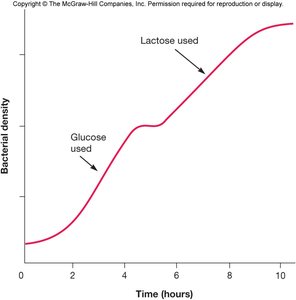
Inducible operon: The lac operon is only expressed when lactose is present and glucose is absent.
Structure of the lac Operon
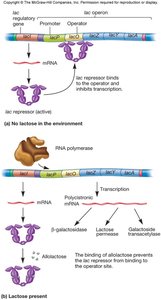
The lac operon consists of regulatory elements and structural genes required for lactose uptake and catabolism.
lacZ: Encodes β-galactosidase (breaks down lactose).
lacY: Encodes lactose permease (transports lactose into the cell).
lacA: Encodes thiogalactoside transacetylase.
Operator: Binding site for the LacI repressor.
CAP site: Binding site for the CAP activator.

Lactose Metabolism and Induction
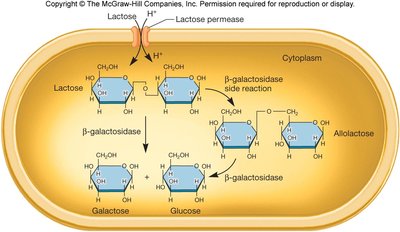
When lactose is present, it is transported into the cell and converted to allolactose, which acts as an inducer by inactivating the LacI repressor.
β-galactosidase: Converts lactose to glucose, galactose, and allolactose.
Allolactose: Binds LacI repressor, causing it to release from the operator and allowing transcription.
Negative Regulation by LacI Repressor
In the absence of lactose, the LacI repressor binds the operator, blocking RNA polymerase and preventing transcription. When lactose is present, allolactose binds LacI, causing it to dissociate from the operator and allowing transcription to proceed.
Positive Regulation by CAP/cAMP
Efficient expression of the lac operon requires the CAP activator, which binds DNA only when complexed with cAMP (produced when glucose is low). This ensures the operon is highly expressed only when glucose is absent.
High glucose: Low cAMP, CAP does not bind, low transcription.
Low glucose: High cAMP, CAP-cAMP binds, high transcription.
Summary Table: Regulation of the lac Operon
Sugar Present | LacI Bound? | CAP Bound? | Transcription Level |
|---|---|---|---|
Glucose only | Yes | No | Basal (very low) |
Lactose only | No | Yes | High |
Glucose + Lactose | No | No | Low |
No glucose, no lactose | Yes | Yes | None |
Regulation at the trp Operon
Introduction to the trp Operon
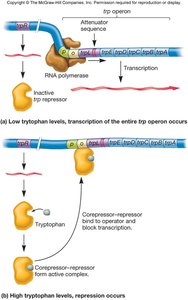
The trp operon encodes enzymes for tryptophan biosynthesis. It is a repressible operon, turned off when tryptophan is abundant.
Negative regulation: TrpR repressor binds operator in presence of tryptophan (corepressor).
Attenuation: Premature termination of transcription when tryptophan is plentiful.
Negative Regulation by TrpR Repressor
When tryptophan is absent, the TrpR repressor is inactive and cannot bind the operator, allowing transcription. When tryptophan is present, it binds TrpR, activating it to bind the operator and block transcription.
Transcriptional Attenuation
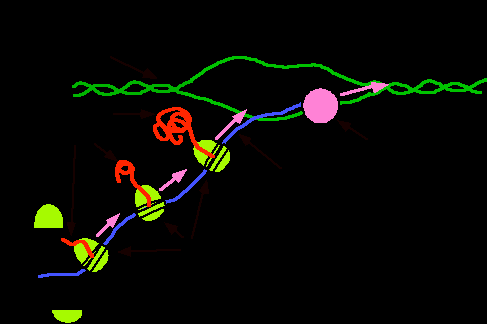
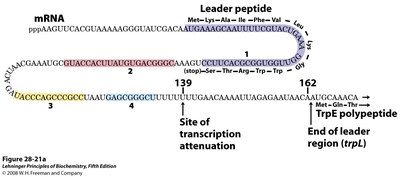
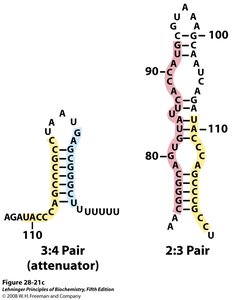
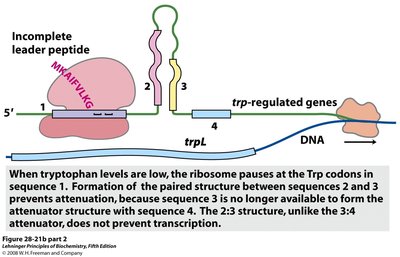
Attenuation is a regulatory mechanism that causes premature termination of transcription in response to high tryptophan levels. It relies on the coupling of transcription and translation in prokaryotes and the formation of alternative mRNA secondary structures (attenuator and anti-terminator).
High tryptophan: Ribosome quickly translates leader peptide, allowing formation of the 3:4 attenuator hairpin, causing transcription termination.
Low tryptophan: Ribosome stalls at Trp codons, allowing formation of the 2:3 anti-terminator hairpin, permitting transcription to continue.
Two-Component Signal Transduction Systems
Environmental Sensing and Gene Regulation
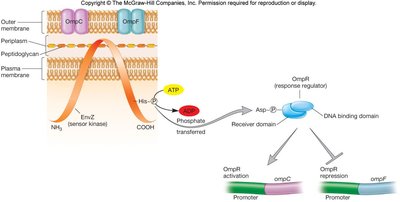
Bacteria use two-component systems to sense and respond to environmental changes. These systems consist of a sensor kinase (e.g., EnvZ) and a response regulator (e.g., OmpR) that modulate gene expression, such as porin protein levels in response to osmolarity.
Sensor kinase: Detects environmental signals and autophosphorylates.
Response regulator: Receives phosphate group, binds DNA, and regulates transcription.
Regulation at the Level of Translation
Antisense RNA Regulation
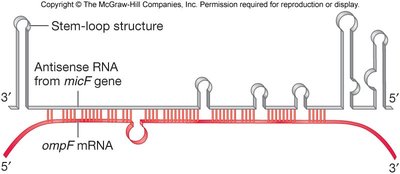
Antisense RNAs are small RNAs that bind complementary mRNA sequences, blocking translation. For example, micF RNA inhibits translation of ompF mRNA under high osmotic pressure.
Riboswitches
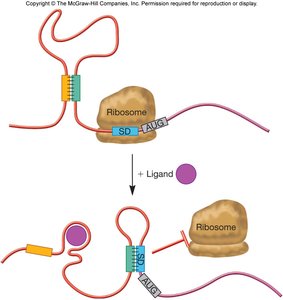
Riboswitches are regulatory segments of mRNA that bind small molecules, causing structural changes that affect translation initiation. For example, the thiamine riboswitch turns off thiamine biosynthetic genes when thiamine is present.
Summary
Bacterial gene expression is regulated at multiple levels, with transcriptional control being most common.
Operons such as lac and trp illustrate inducible and repressible systems, respectively.
Additional regulatory mechanisms include two-component systems, antisense RNAs, and riboswitches.
