 Back
BackSelective and Differential Media in Microbiology
Study Guide - Smart Notes
 Tailored notes based on your materials, expanded with key definitions, examples, and context.
Selective and Differential Media
Overview
Selective and differential media are essential tools in microbiology for isolating and identifying specific groups of microorganisms. These media contain components that either inhibit the growth of certain microbes (selective) or allow differentiation based on metabolic properties (differential).
EMB (Eosin Methylene Blue Agar)
EMB agar is a selective and differential medium used primarily for the isolation and differentiation of Gram-negative bacteria, especially coliforms.
Selective For: Gram-negative bacteria
Inhibits: Most Gram-positive bacteria via dyes eosin and methylene blue
Differential By:
Lactose fermentation (E. coli produces a metallic green sheen)
pH Indicator: Eosin & methylene blue
Importance: Detects coliforms in water, food, and clinical samples
Example: Escherichia coli forms colonies with a distinctive metallic green sheen, indicating lactose fermentation.
MAC (MacConkey Agar)
MacConkey agar is a selective and differential medium designed to isolate Gram-negative enteric bacteria and differentiate them based on lactose fermentation.
Selective For: Gram-negative enterics
Inhibits: Gram-positives via bile salts and crystal violet
Differential By:
Lactose fermentation (pink = lactose fermenter, colorless = non-fermenter)
pH Indicator: Neutral red
Importance: Differentiates coliforms (E. coli) from intestinal pathogens (Salmonella, Shigella)
Example: E. coli produces pink colonies, while Salmonella and Shigella produce colorless colonies.
MSA (Mannitol Salt Agar)
Mannitol Salt Agar is a selective and differential medium used to identify Staphylococcus species, particularly Staphylococcus aureus.
Selective For: Staphylococcus species
Inhibits: Most bacteria via 7.5% NaCl
Differential By:
Mannitol fermentation (yellow = fermenter, red/pink = non-fermenter)
pH Indicator: Phenol red
Importance: Identifies Staphylococcus aureus (mannitol +) vs. non-pathogenic staphylococci
Example: Staphylococcus aureus ferments mannitol, turning the medium yellow, while other staphylococci do not.
Comparison Table
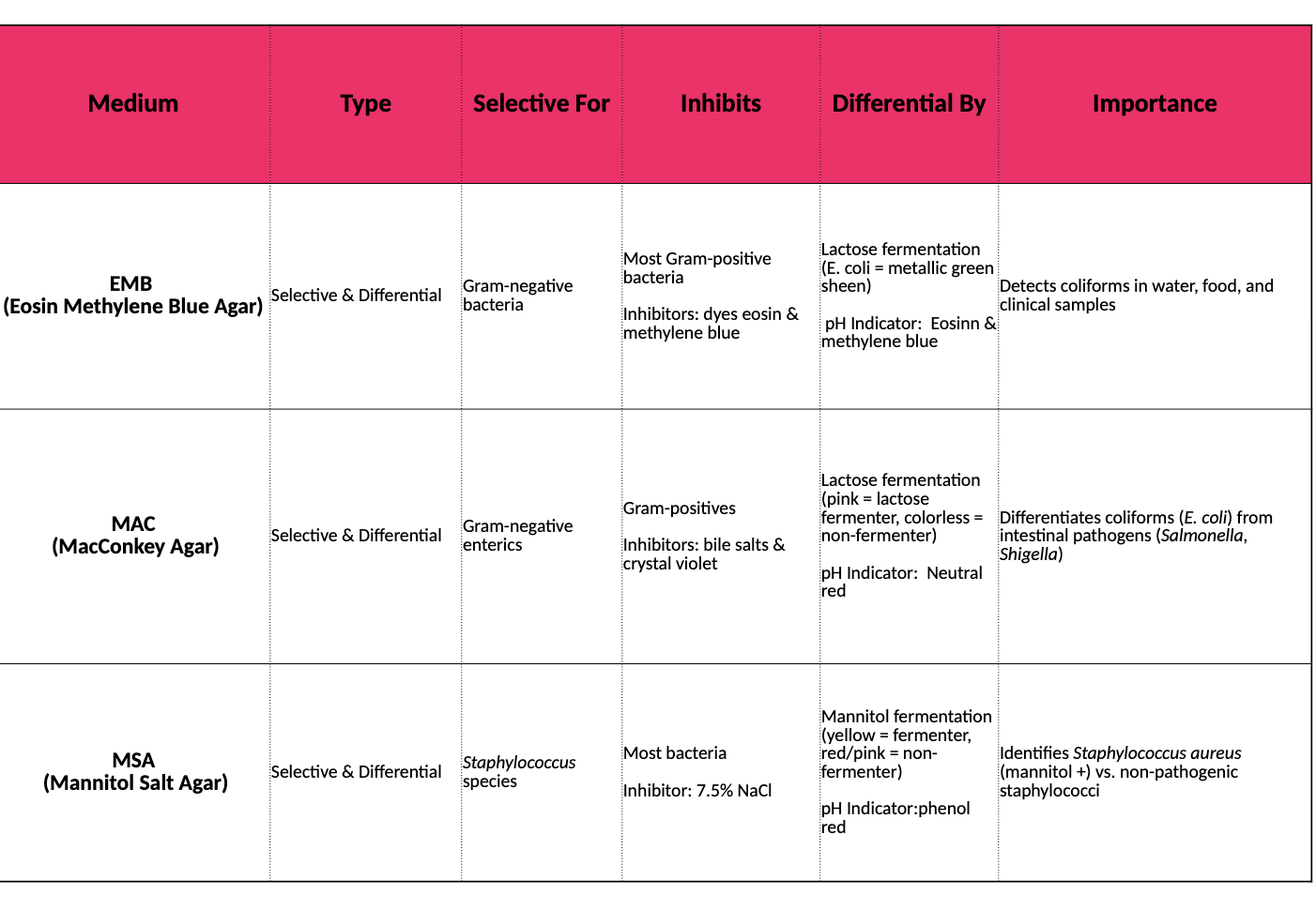
The following table summarizes the properties of EMB, MAC, and MSA media:
Medium | Type | Selective For | Inhibits | Differential By | Importance |
|---|---|---|---|---|---|
EMB (Eosin Methylene Blue Agar) | Selective & Differential | Gram-negative bacteria | Most Gram-positive bacteria Inhibitors: dyes eosin & methylene blue | Lactose fermentation (E. coli = metallic green sheen) pH Indicator: Eosin & methylene blue | Detects coliforms in water, food, and clinical samples |
MAC (MacConkey Agar) | Selective & Differential | Gram-negative enterics | Gram-positives Inhibitors: bile salts & crystal violet | Lactose fermentation (pink = lactose fermenter, colorless = non-fermenter) pH Indicator: Neutral red | Differentiates coliforms (E. coli) from intestinal pathogens (Salmonella, Shigella) |
MSA (Mannitol Salt Agar) | Selective & Differential | Staphylococcus species | Most bacteria Inhibitor: 7.5% NaCl | Mannitol fermentation (yellow = fermenter, red/pink = non-fermenter) pH Indicator: phenol red | Identifies Staphylococcus aureus (mannitol +) vs. non-pathogenic staphylococci |
Key Terms
Selective Media: Media that inhibit the growth of certain microorganisms while allowing others to grow.
Differential Media: Media that distinguish between microorganisms based on their metabolic properties.
Coliforms: A group of Gram-negative, lactose-fermenting bacteria commonly used as indicators of sanitary quality.
Pathogens: Microorganisms capable of causing disease.
Applications
Water and food safety testing
Clinical diagnostics for intestinal and skin pathogens
Microbial identification in laboratory research
----------------------------------------
