Back
BackSelective and Differential Media in Microbiology: Principles and Applications
Study Guide - Smart Notes
 Tailored notes based on your materials, expanded with key definitions, examples, and context.
Selective and Differential Media
Introduction to Selective and Differential Media
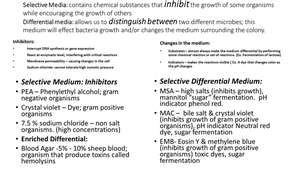
Selective and differential media are essential tools in microbiology for isolating, identifying, and differentiating bacterial species based on their growth characteristics and metabolic activities. These media contain specific chemical substances that either inhibit or promote the growth of certain organisms, and may include indicators that reveal metabolic differences.
Selective Media: Contains inhibitors that suppress the growth of unwanted organisms while allowing target organisms to grow.
Differential Media: Formulated to distinguish between different microbes based on observable changes in the medium, such as color shifts due to metabolic activity.
Key Definitions
Selective Medium: A medium that contains an inhibitor to prevent or slow the growth of undesired organisms.
Differential Medium: A medium that is formulated so that differences in the biochemical/physiology between organisms will be detected.
Enteric: Refers to any gut bacterium, but usually to members of the Enterobacteriaceae, which are Gram-negative rods that ferment glucose and share other traits in common.
Coliform: A member of the Enterobacteriaceae that produces acid and gas from lactose fermentation.
Noncoliform: A member of the Enterobacteriaceae that does not ferment lactose.

Types of Selective and Differential Media
Phenylethyl Alcohol Agar (PEA)
Phenylethyl Alcohol Agar is an undefined, selective medium used to inhibit the growth of Gram-negative organisms by interfering with DNA synthesis.
Inhibitor: Phenylethyl alcohol
Purpose: Selective for Gram-positive bacteria
Mechanism: Disrupts DNA synthesis in Gram-negative bacteria, preventing their growth.

Eosin Methylene Blue Agar (EMB)
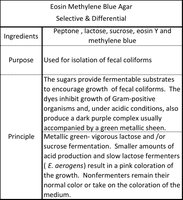
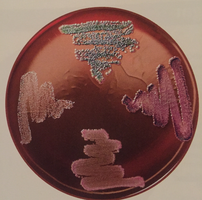
EMB agar is both selective and differential, used primarily for the isolation of fecal coliforms.
Ingredients: Peptone, lactose, sucrose, eosin Y, methylene blue
Selectivity: Eosin and methylene blue inhibit Gram-positive bacteria
Differentiation: Based on lactose fermentation; acid production causes color changes
Indicators: Eosin and methylene blue
Results:
Strong fermenters (e.g., E. coli): Metallic green sheen
Slow fermenters (e.g., Enterobacter aerogenes): Pink/brown colonies
Non-fermenters: Colorless colonies
Mannitol Salt Agar (MSA)
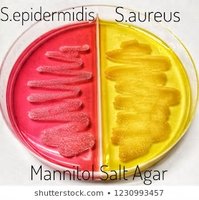
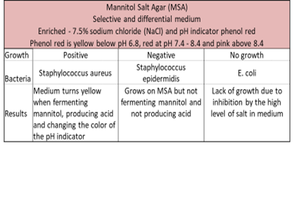
Mannitol Salt Agar is a selective and differential medium used to differentiate Staphylococcus species.
Ingredients: 7.5% sodium chloride, mannitol, phenol red
Selectivity: High salt concentration inhibits most bacteria except staphylococci
Differentiation: Based on mannitol fermentation; acid production changes phenol red indicator
Results:
S. aureus: Grows and ferments mannitol, turning medium yellow
S. epidermidis: Grows but does not ferment mannitol, medium remains red
E. coli: Growth inhibited by high salt
MacConkey Agar (MAC)
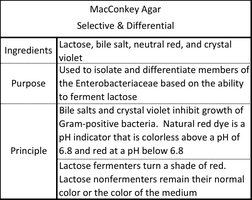
MacConkey Agar is a selective and differential medium used to isolate and differentiate members of the Enterobacteriaceae based on their ability to ferment lactose.
Ingredients: Lactose, bile salt, neutral red, crystal violet
Selectivity: Bile salts and crystal violet inhibit Gram-positive bacteria
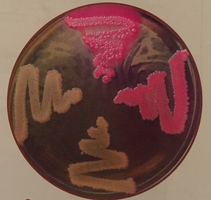
Differentiation: Lactose fermentation; acid production turns neutral red indicator pink/red
Results:
Lactose fermenters (e.g., E. coli): Pink/red colonies
Non-fermenters (e.g., Proteus mirabilis): Colorless colonies
Blood Agar
Principles and Applications
Blood agar is an enriched and differential medium used to detect bacterial pathogens and assess hemolytic properties.
Ingredients: General nutrients and 5–10% sheep’s blood
Purpose: Supports growth of fastidious organisms and allows observation of hemolysis
Differentiation: Based on hemolysis (breakdown of red blood cells)
Hemolysis Types:
Beta hemolysis: Complete destruction of red blood cells (e.g., Streptococcus pyogenes)
Alpha hemolysis: Partial destruction (e.g., Streptococcus pneumoniae, Streptococcus sanguis)
Gamma hemolysis: No destruction (e.g., Streptococcus faecalis)
Stabbing the agar: Detects oxygen-sensitive hemolysins by providing a reduced-oxygen environment.
Summary Table: Selective and Differential Media
Medium | Selective Agent | Differential Agent | Indicator | Purpose |
|---|---|---|---|---|
PEA | Phenylethyl alcohol | None | None | Gram-positive selection |
EMB | Eosin, methylene blue | Lactose | Eosin, methylene blue | Fecal coliform isolation |
MSA | NaCl (7.5%) | Mannitol | Phenol red | Staphylococcus differentiation |
MAC | Bile salts, crystal violet | Lactose | Neutral red | Enterobacteriaceae differentiation |
Blood Agar | None | Red blood cells | Hemolysis | Hemolytic property detection |
Conclusion
Selective and differential media are fundamental in microbiology for isolating and identifying bacteria based on their growth and metabolic properties. Understanding the principles and applications of these media is crucial for laboratory diagnostics and research.