 Back
BackSelective and Differential Media in Microbiology
Study Guide - Smart Notes
 Tailored notes based on your materials, expanded with key definitions, examples, and context.
Selective and Differential Media
Overview of Media Types
Microbiologists use a variety of culture media to isolate, identify, and study microorganisms. Selective media encourage the growth of specific microorganisms while inhibiting others, whereas differential media allow for visual distinction between different microorganisms based on their biochemical properties. Complex media are nutrient-rich but contain at least one ingredient that is not chemically defined, such as plant or animal extracts.
Selective media: Promote the growth of target organisms and suppress others.
Differential media: Contain indicators (such as dyes or chemicals) that reveal differences between organisms, often through color changes.
Complex media: Support a wide range of microbial growth but have undefined components.
MacConkey Agar
Composition and Function
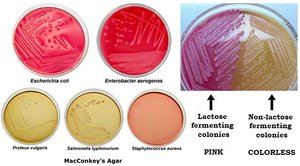
MacConkey Agar is both selective and differential, designed to isolate and differentiate members of the Enterobacteriaceae family and other gram-negative rods based on their ability to ferment lactose.
Key ingredients: Lactose, bile salts, neutral red (pH indicator), and crystal violet.
Selective action: Bile salts and crystal violet inhibit gram-positive bacteria, allowing gram-negative bacteria to grow.
Differential action: Neutral red turns red at pH < 6.8. Lactose fermenters produce acid, lowering the pH and turning colonies pink/red. Non-fermenters remain colorless or take on the medium's color.
Application: Useful for isolating gut bacteria and differentiating lactose fermenters from non-fermenters.
Eosin Methylene Blue (EMB) Agar
Composition and Function
Eosin Methylene Blue Agar is a complex, selective, and differential medium used to isolate gram-negative enteric bacteria and differentiate them based on lactose fermentation.
Key ingredients: Gelatin (nutrient source), lactose, eosin Y, and methylene blue dyes.
Selective action: Dyes inhibit most gram-positive organisms.
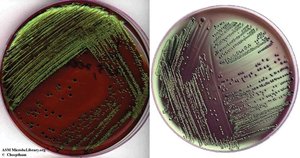
Differential action: Lactose fermenters (e.g., Escherichia coli) produce acid, causing colonies to appear dark purple/black, often with a green metallic sheen. Less aggressive fermenters (e.g., Enterobacter, Klebsiella) produce pink to purple colonies. Non-fermenters retain their normal color or the color of the medium.
Coliforms: Gram-negative, non-spore forming bacilli capable of fermenting lactose to acid and gas.
Mannitol Salt Agar (MSA)
Composition and Function
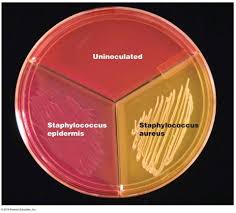
Mannitol Salt Agar is a selective and differential medium primarily used to isolate Staphylococcus species. Its high salt concentration inhibits most gram-negative bacteria, while the presence of mannitol and a pH indicator allows differentiation based on mannitol fermentation.
Key ingredients: High salt (7.5% NaCl), mannitol, and a pH indicator (phenol red).
Selective action: High salt inhibits most bacteria except staphylococci.
Differential action: Mannitol fermenters (e.g., Staphylococcus aureus) produce acid, turning the medium yellow. Non-fermenters (e.g., Staphylococcus epidermidis) do not change the color.
Phenylethyl Alcohol Agar (PEA)
Composition and Function
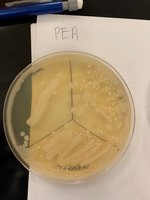
Phenylethyl Alcohol Agar is a selective medium that supports the growth of gram-positive bacteria while inhibiting gram-negative bacteria. The active ingredient, phenylethyl alcohol, disrupts the cell membrane of gram-negative organisms, making it useful for isolating Staphylococcus species.
Key ingredient: Phenylethyl alcohol (bacteriostatic agent).
Selective action: Inhibits gram-negative bacteria, allowing gram-positive bacteria to grow.
Application: Commonly used to isolate Staphylococcus species from mixed cultures.
Summary Table: Selective and Differential Media
Medium | Selective For | Differentiates | Key Indicator(s) |
|---|---|---|---|
MacConkey Agar | Gram-negative rods | Lactose fermenters vs. non-fermenters | Neutral red (pink/red colonies for fermenters) |
EMB Agar | Gram-negative enterics | Lactose fermenters (green sheen/dark colonies) | Eosin Y, methylene blue |
Mannitol Salt Agar | Staphylococci | Mannitol fermenters (yellow color) | Phenol red |
PEA Agar | Gram-positive bacteria | Not differential | None |
