 Back
Selective and Differential Media in Microbiology
Study Guide - Smart Notes
 Tailored notes based on your materials, expanded with key definitions, examples, and context.
Selective and Differential Media
Overview of Media Types
Selective and differential media are essential tools in microbiology for isolating and identifying microorganisms based on their growth characteristics and biochemical properties.
Selective media: Encourages the growth of specific microorganisms while inhibiting others, often through the inclusion of inhibitory chemicals or dyes.
Differential media: Allows visual distinction between different microorganisms on the same plate, typically by including indicators that react to microbial metabolic products.
Complex media: Nutrient-rich mixtures containing at least one ingredient that is not chemically definable, such as plant or animal extracts.
MacConkey Agar
Composition and Function
MacConkey Agar is a selective and differential medium used primarily to isolate and differentiate gram-negative bacteria, especially members of the Enterobacteriaceae family.
Key ingredients: Lactose, bile salts, neutral red (pH indicator), and crystal violet.
Selective action: Bile salts and crystal violet inhibit gram-positive bacteria, favoring gram-negative rods.
Differential action: Neutral red dye indicates pH changes. Colonies that ferment lactose produce acid, lowering the pH and turning colonies pink to red.
Application: Useful for distinguishing lactose fermenters (e.g., Escherichia coli, Enterobacter aerogenes) from non-fermenters (e.g., Proteus vulgaris, Salmonella typhimurium).
Example: On MacConkey Agar, lactose fermenting colonies appear pink/red, while non-lactose fermenters remain colorless. 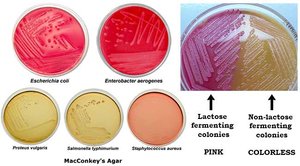
Variations and Additional Uses
Some formulations omit crystal violet, allowing growth of Enterococcus and Staphylococcus species.
Eosin Methylene Blue (EMB) Agar
Composition and Function
EMB Agar is a complex, selective, and differential medium used to isolate gram-negative bacteria and differentiate coliforms based on lactose fermentation.
Key ingredients: Gelatin (nitrogen and carbon source), lactose, eosin Y, and methylene blue dyes.
Selective action: Eosin Y and methylene blue inhibit most gram-positive organisms.
Differential action: Dyes react with acid produced by vigorous lactose fermenters, turning colonies dark purple or black, often with a green metallic sheen (typical of E. coli).
Less aggressive fermenters: Colonies range from pink to dark purple (e.g., Enterobacter, Klebsiella).
Lactose non-fermenters: Colonies retain their normal color or take on the color of the medium.
Example: E. coli produces a green metallic sheen on EMB agar, indicating vigorous lactose fermentation. 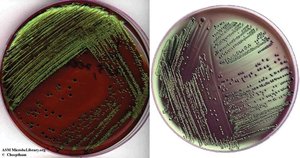
Blood Agar
Composition and Hemolysis Types
Blood Agar is a differential medium used to detect hemolytic activity of bacteria, especially gram-positive cocci.
Key ingredients: 5% sheep blood in a tryptic soy agar base.
Hemolysins: Exotoxins produced by bacteria that destroy red blood cells and hemoglobin.
Types of hemolysis:
Beta hemolysis: Complete destruction; clear zone around colonies.
Alpha hemolysis: Partial destruction; green discoloration around colonies.
Gamma hemolysis: No hemolysis; regular growth without color change.
Example: Blood agar plates can show beta, alpha, or gamma hemolysis, aiding in identification of streptococci and other bacteria. 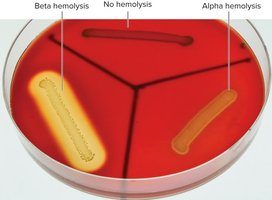
Streptolysins and Streak-Stab Technique
Streptolysins: Hemolysins produced by streptococci; type O (oxygen labile) and type S (oxygen stable).
Streak-stab technique: Streak and stab with a loop to encourage streptolysin activity in reduced oxygen environments, revealing different hemolysis types.
Summary Table: Media Types and Their Properties
Medium | Selective For | Differential For | Key Indicator | Example Result |
|---|---|---|---|---|
MacConkey Agar | Gram-negative rods | Lactose fermentation | Neutral red | Pink colonies = lactose fermenters |
EMB Agar | Gram-negative bacteria | Lactose fermentation | Eosin Y, Methylene blue | Green sheen = vigorous fermenters |
Blood Agar | None (complex) | Hemolysis type | Blood (hemolysis) | Clear, green, or no change |
Key Terms and Definitions
Selective media: Media that favors the growth of certain microbes while inhibiting others.
Differential media: Media that distinguishes between microbes based on observable reactions.
Hemolysis: The destruction of red blood cells, visible as changes in blood agar.
Coliforms: Gram-negative, non-spore forming bacilli capable of fermenting lactose.
Applications in Microbiology
Identification and isolation of pathogens from clinical samples.
Differentiation of bacteria based on metabolic properties.
Assessment of hemolytic activity for diagnostic purposes.
----------------------------------------
