 Back
BackSerial Dilution and Agar Plating for Quantitation of Viable Cells
Study Guide - Smart Notes
 Tailored notes based on your materials, expanded with key definitions, examples, and context.
Serial Dilution and Agar Plating
Principle of Serial Dilution
Serial dilution is a fundamental technique in microbiology used to systematically reduce the concentration of bacteria in a sample. This process involves transferring a fixed volume of the original culture into a series of dilution blanks, each containing a known volume of sterile diluent. The purpose is to obtain a dilution that allows for the accurate quantification and observation of bacterial colonies.
Serial dilution enables the estimation of bacterial cell numbers in various samples, such as environmental sources, body fluids, food, beverages, and water.
Undiluted samples often produce a lawn growth on agar plates, obscuring individual colony morphology.
Diluting the sample allows for the observation of distinct colonies, which is essential for bacterial identification based on morphology (shape, size, color, edge).
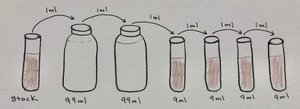
Procedure for Serial Dilution and Agar Plating
The following steps outline the standard procedure for performing serial dilution and agar plating to quantitate viable cells:
Label all tubes and plates before starting the experiment.
Pipette 1 ml of the original culture into the first 99 ml dilution bottle. Shake the bottle vigorously (20 times) to ensure thorough mixing.
Transfer 1 ml from the first 99 ml bottle into the second 99 ml bottle using a new sterile pipette. Seal and agitate.
Pipette 1 ml from the second 99 ml bottle into the first 9 ml dilution tube. Agitate each 9 ml tube using tapping or flicking for 30 seconds. Repeat for subsequent 9 ml tubes.
Pipette aliquots of designated dilutions onto appropriately labeled Petri plates, starting with the highest dilution plate and ending with the lowest.
Pour melted agar gently into each plate and swirl in a figure 8 pattern to distribute the agar evenly. Allow plates to solidify without moving.
Tape plates together in a stack, place them "bottoms up" in a tray, and incubate for 24 to 48 hours.
Quantitation of Viable Cells
After incubation, colonies are counted to estimate the number of viable bacteria in the original sample. Each colony arises from a single bacterium, referred to as a colony forming unit (CFU). The CFU count is used to calculate the concentration of bacteria in the sample.
A statistically valid plate contains between 30 and 300 colonies.
Fewer than 30 colonies: Too Few To Count (TFTC)
More than 300 colonies: Too Many To Count (TMTC)
CFU Calculation Formula
The concentration of bacteria is calculated using the following formula:
Tube dilution: The dilution factor of the tube from which the sample was plated.
Volume plated: The volume of diluted sample plated onto the agar.
Interpretation of Results
Plates with colony counts within the 30–300 range are used for accurate quantitation. Plates outside this range are not considered reliable for CFU calculation.
TFTC: Indicates insufficient colonies for statistical accuracy.
TMTC: Indicates excessive colonies, making individual counting impossible.
Example Table: Plate Dilutions and Volumes
The following table summarizes typical plate labeling, dilution factors, and volumes used in serial dilution experiments:
Plate | Dilution Factor | Volume Plated (ml) |
|---|---|---|
1A | 10-6 | 0.1 |
1B | 10-6 | 1 |
2A | 10-7 | 0.1 |
2B | 10-7 | 0.1 |
3A | 10-8 | 1 |
3B | 10-8 | 1 |
Additional info: The table above is inferred from the provided plate labels and dilution factors. Actual experimental setups may vary.
Applications
Serial dilution and agar plating are used in environmental monitoring, clinical diagnostics, and quality control in food and beverage industries.
Colony morphology observed after dilution aids in bacterial identification and classification.
