 Back
BackSix Classes of Enzymes: Structure, Function, and Examples
Study Guide - Smart Notes
 Tailored notes based on your materials, expanded with key definitions, examples, and context.
Six Classes of Enzymes
Overview of Enzyme Classification
Enzymes are biological catalysts that accelerate chemical reactions in living organisms. They are classified into six major groups based on the type of reaction they catalyze. Understanding these classes is fundamental in microbiology, as enzymes play crucial roles in microbial metabolism and cellular processes.
1. Oxidoreductases
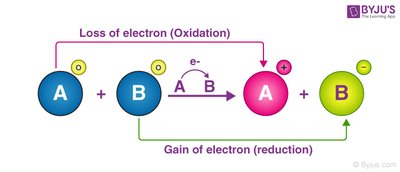
Oxidoreductases catalyze oxidation-reduction (redox) reactions, where electrons are transferred from one molecule (the reductant) to another (the oxidant). These enzymes are essential in energy production and metabolic pathways.
Definition: Catalyze the transfer of hydrogen and oxygen atoms or electrons between substrates.
Examples: Dehydrogenases, oxidases, peroxidases, reductases.
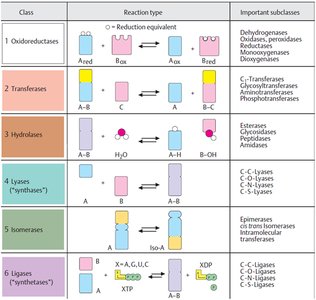
Key Reaction:
Application: Cellular respiration, photosynthesis.
2. Transferases
Transferases are enzymes that catalyze the transfer of a specific functional group (such as a phosphate or methyl group) from one molecule to another. They are vital in biosynthetic and regulatory pathways.
Definition: Transfer of a functional group from one substrate to another.
Examples: Aminotransferases, phosphotransferases, glycosyltransferases.
Key Reaction:
Application: Amino acid metabolism, signal transduction.
3. Hydrolases
Hydrolases catalyze the hydrolysis of chemical bonds, breaking molecules into smaller units by adding water. These enzymes are important in digestion and cellular recycling.
Definition: Catalyze the hydrolysis of a substrate.
Examples: Esterases, proteases, glycosidases.
Key Reaction:
Application: Protein digestion, nucleic acid degradation.
4. Lyases
Lyases catalyze the nonhydrolytic removal or addition of groups to substrates, often forming double bonds or rings. They are involved in metabolic pathways that require the formation or breaking of chemical bonds without water.
Definition: Nonhydrolytic removal or addition of a group to a substrate.
Examples: Decarboxylases, aldolases, synthases.
Key Reaction:
Application: Glycolysis, citric acid cycle.
5. Isomerases
Isomerases catalyze the rearrangement of atoms within a molecule, converting one isomer into another. These enzymes are crucial for maintaining metabolic flexibility.
Definition: Change the molecular form of the substrate.
Examples: Epimerases, racemases, mutases.
Key Reaction:
Application: Carbohydrate metabolism, amino acid interconversion.
6. Ligases (Synthetases)
Ligases catalyze the joining of two molecules by forming new chemical bonds, often using energy from ATP or another nucleotide. They are essential in DNA replication and repair.
Definition: Joining of two molecules by the formation of new bonds.
Examples: DNA ligase, RNA ligase, C-C ligases.
Key Reaction:
Application: DNA synthesis, metabolic regulation.
Summary Table: Enzyme Classes and Their Functions
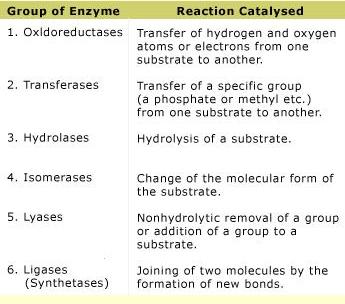
Group of Enzyme | Reaction Catalysed |
|---|---|
Oxidoreductases | Transfer of hydrogen and oxygen atoms or electrons from one substrate to another. |
Transferases | Transfer of a specific group (a phosphate or methyl etc.) from one substrate to another. |
Hydrolases | Hydrolysis of a substrate. |
Isomerases | Change of the molecular form of the substrate. |
Lyases | Nonhydrolytic removal of a group or addition of a group to a substrate. |
Ligases (Synthetases) | Joining of two molecules by the formation of new bonds. |
Additional info: Enzyme classification is based on the Enzyme Commission (EC) numbering system, which provides a standardized nomenclature for enzyme-catalyzed reactions. This classification is widely used in microbiology, biochemistry, and molecular biology to describe enzyme functions and their roles in metabolic pathways.
