 Back
BackStudy Guide: Pathogenic Gram-Positive and Gram-Negative Bacteria
Study Guide - Smart Notes
 Tailored notes based on your materials, expanded with key definitions, examples, and context.
Gram-Positive Bacteria
Staphylococcus
Staphylococcus species are Gram-positive, spherical bacteria that form clusters resembling grapes. They are normal members of the human microbiota but can become opportunistic pathogens, causing a range of diseases from minor skin infections to life-threatening systemic illnesses.
Structure and Physiology: Gram-positive, anaerobic, salt-tolerant, and resistant to radiation, heat, and desiccation.
Pathogenicity: Pathogenicity is due to evasion of phagocytosis, enzyme production, and toxin production.
Structural Defenses: Protein A inhibits opsonization and complement cascade; coagulase forms blood clots to hide bacteria; capsules inhibit chemotaxis.
Enzymes: Coagulase (S. aureus only), hyaluronidase, staphylokinase, lipase, and penicillinase.
Toxins: Cytotoxic toxins (alpha, beta, gamma, delta, leukocidin), exfoliative toxins, toxic shock syndrome toxin, and enterotoxins.
Epidemiology: S. epidermidis is ubiquitous on skin; S. aureus is more common in skin folds. Both are transmitted via direct contact and fomites.
Diseases: Food poisoning, cutaneous diseases (scalded skin syndrome, impetigo, folliculitis), systemic diseases (toxic shock syndrome, bacteremia, endocarditis, pneumonia, osteomyelitis).
Diagnosis and Treatment: Coagulase test distinguishes S. aureus from S. epidermidis. MRSA treated with vancomycin. Prevention relies on hygiene.
Streptococcus
Streptococcus species are Gram-positive cocci arranged in pairs or chains. They are classified by Lancefield antigens, hemolysis type, and other properties.
Group A (S. pyogenes): Possess M proteins, hyaluronic acid capsule, C5A peptidase, and secrete pyrogenic toxins and streptolysins.
Epidemiology: Infects larynx and skin, spreads via respiratory droplets, sensitive to penicillins.
Diseases: Pharyngitis, scarlet fever, rheumatic fever, pyoderma, erysipelas, cellulitis, toxic shock syndrome, necrotizing fasciitis, glomerulonephritis.
Diagnosis and Treatment: Rapid strep tests, penicillin, erythromycin, cephalosporin. Prevention includes hygiene and treating underlying infections.
Group B (S. agalactiae): Pathogenic in newborns, causes neonatal bacteremia, meningitis, pneumonia. Diagnosed by ELISA, treated with penicillin/ampicillin.
Other Streptococci: S. equisimilis and S. anginosus cause pharyngitis; viridians group causes dental caries and endocarditis.
S. pneumoniae: Causes pneumonia, sinusitis, otitis media, bacteremia, endocarditis, meningitis. Diagnosed by Quellung reaction and bile solubility.
Enterococcus
Enterococcus species are spherical, non-capsulated bacteria living in the intestines. They are opportunistic pathogens causing HAIs, bacteremia, endocarditis, and wound infections.
Structure: Short chains and pairs, grow in harsh conditions.
Treatment: Lactams, aminoglycosides, vancomycin.
Prevention: Hygiene and aseptic techniques.
Bacillus
Bacillus species are rod-shaped, endospore-forming bacteria found in soil. Pathogenic strains cause anthrax via toxins interfering with cellular metabolism.
Disease: Anthrax (cutaneous, GI, inhalation).
Treatment: Antimicrobial drugs do not neutralize accumulated toxin.
Clostridium
Clostridium species are anaerobic, endospore-forming bacilli producing potent exotoxins.
Disease: Minor (self-limiting diarrhea), serious (pseudomembranous colitis).
Treatment: Discontinue causative drug, metronidazole or vancomycin.
Listeria
Listeria is transmitted via contaminated food/drink, causing listeriosis and meningitis in immunocompromised patients. Tolerant of cold temperatures.
Mycoplasma, Corynebacterium, Propionibacterium, Nocardia, Actinomyces
These genera include opportunistic pathogens causing diseases such as diphtheria, acne, and actinomycosis. Corynebacterium diphtheriae produces diphtheria toxin, diagnosed by Elek test and treated with antitoxin and antibiotics.
Gram-Negative Bacteria
Intro to Gram-Negative Bacteria
Gram-negative bacteria are diverse and include many human pathogens. Their cell wall contains Lipid A, an endotoxin responsible for fever, vasodilation, shock, and disseminated intravascular coagulation (DIC).
Classification: Grouped by DNA similarities, shape, oxygen requirements, and biochemical characteristics.
Clinical Organization: Gram-negative cocci, facultatively anaerobic bacilli, aerobic bacilli, strictly anaerobic bacilli.
Neisseria
Neisseria is the only genus of Gram-negative cocci commonly causing human disease. Two major pathogenic species: Neisseria gonorrhoeae (gonorrhea) and Neisseria meningitidis (meningitis).
Structure: Gram-negative diplococci, coffee bean shape, nonmotile, aerobic, oxidase positive.
Virulence: Fimbriae, polysaccharide capsule, lipooligosaccharide (LOS).
Lab Characteristics: Fastidious, require chocolate agar, moist environment, 5% CO2.
Diseases: Gonorrhea (urethritis, PID, neonatal eye infection), meningitis, septicemia.
Treatment: Ceftriaxone plus azithromycin or doxycycline for gonorrhea; cephalosporins for meningitis.
Prevention: Hygiene, vaccination, prophylactic antibiotics.
Facultatively Anaerobic Bacilli: Enterobacteriaceae & Pasteurellaceae
These families contain most Gram-negative human pathogens. Enterobacteriaceae are oxidase negative; Pasteurellaceae are oxidase positive.
Virulence Factors: LPS (Lipid A), capsules, fimbriae, adhesins, exotoxins, siderophores, hemolysins, type III secretion system, drug resistance enzymes.
Diagnosis: Selective and differential media (EMB, MacConkey), urinalysis, Kirby Bauer testing.
Prevention: Hygiene, prophylaxis, sewage control.
Coliform Opportunists
Coliforms are Gram-negative rods that ferment lactose. Common genera: Escherichia, Klebsiella, Serratia, Enterobacter, Hafnia, Citrobacter.
E. coli: Causes gastroenteritis, UTIs, septicemia, neonatal meningitis, pneumonia. EHEC produces shiga-like toxin.
Klebsiella: Nonmotile, large capsule, causes pneumonia, UTIs, bacteremia.
Serratia: Motile, red pigment, opportunistic HAIs.
NonColiform Opportunists
Do not ferment lactose. Key genera: Proteus, Morganella, Providencia, Edwardsiella.
Proteus: Causes UTIs, produces urease, forms infection stones.
True Pathogens
Key genera: Salmonella, Shigella, Yersinia. All use type III secretion systems.
Salmonella: Causes salmonellosis and typhoid fever.
Shigella: Causes shigellosis; S. dysenteriae produces shiga toxin.
Yersinia: Causes enteric illness and plague (bubonic, pneumonic).
Pasteurellaceae
Oxidase positive, require heme/cytochromes. Key genera: Pasteurella, Haemophilus.
Pasteurella: Causes local inflammation, bacteremia.
Haemophilus influenzae type b (Hib): Causes meningitis, cellulitis, arthritis, epiglottitis.
Pathogenic Gram-Negative Anaerobic Bacilli
Bacteroides and Prevotella are dominant microbiota in the GI, urinary, reproductive, and lower respiratory tracts. They become pathogenic when moved to new sites.
Bacteroides: Bile tolerant, main species B. fragilis causes GI disease.
Prevotella: Bile sensitive, causes ear, periodontal, gynecological, brain, and abdominal infections.
Lipid A Endotoxin Effects
Lipid A is a component of the outer membrane of Gram-negative bacteria and is responsible for many of the toxic effects seen in infections.
Fever: Induced by cytokines such as TNF and interleukin 1.
Disseminated Intravascular Coagulation (DIC): Platelet activating factor and blood-clotting reactions lead to DIC.
Inflammation and Shock: Complement activation and cytokine release cause inflammation and shock.
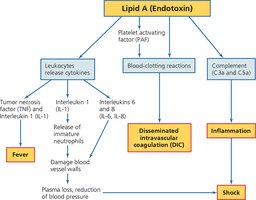
Additional info: The image above illustrates the pathways by which Lipid A endotoxin triggers fever, DIC, inflammation, and shock through cytokine release, platelet activation, and complement activation.
Summary Table: Gram-Positive vs Gram-Negative Pathogens
Feature | Gram-Positive | Gram-Negative |
|---|---|---|
Cell Wall | Thick peptidoglycan, teichoic acids | Thin peptidoglycan, outer membrane with Lipid A |
Major Genera | Staphylococcus, Streptococcus, Bacillus, Clostridium, Corynebacterium | Neisseria, Enterobacteriaceae, Pasteurellaceae, Bacteroides, Prevotella |
Virulence Factors | Protein A, capsules, exotoxins, enzymes | Lipid A, capsules, fimbriae, type III secretion system, exotoxins |
Diseases | Skin infections, pneumonia, meningitis, endocarditis, anthrax, diphtheria | Gonorrhea, meningitis, gastroenteritis, UTIs, plague, meningitis, cellulitis |
Diagnosis | Gram stain, culture, serology, rapid tests | Gram stain, culture, selective media, genetic probes |
Treatment | Penicillins, vancomycin, erythromycin | Cephalosporins, azithromycin, doxycycline, metronidazole |
