 Back
Study Notes: Eukaryotic Microorganisms – Protists and Fungi
Study Guide - Smart Notes
 Tailored notes based on your materials, expanded with key definitions, examples, and context.
Characterizing and Classifying Eukaryotes
Introduction to Eukaryotic Microorganisms
Eukaryotic microorganisms include a diverse group of organisms such as protists (protozoa and algae) and fungi. These organisms are characterized by the presence of membrane-bound organelles, including a nucleus. Their classification has evolved over time as new molecular and morphological data have become available.
Historical and Modern Classification of Eukaryotes
The classification of eukaryotic microorganisms has changed significantly from the 18th century to the present. Early systems recognized only two kingdoms (Plantae and Animalia), but later systems added Fungi and Protista. Modern classification divides eukaryotes into multiple supergroups based on genetic and ultrastructural evidence.
Era | Kingdoms/Supergroups |
|---|---|
Late 18th Century (Linnaeus) | Plantae, Animalia |
Late 20th Century | Fungi, Protista, Plantae, Animalia |
Early 21st Century | Fungi, Parabasalids, Diplomonadida, Euglenozoa, Alveolata, Rhizaria, Amoebozoa, Stramenopila, Rhodophyta, Plantae, Animalia |
Key Point: Modern classification reflects evolutionary relationships and is based on molecular phylogeny.
Characterizing Protists
Overview of Protists
Protists are a diverse group of eukaryotic microorganisms that are not classified as plants, animals, or fungi. They include protozoa and algae, which can be free-living or parasitic. Protists exhibit a wide range of morphologies and life cycles.
Representative Protists and Their Structures
Protists display various cellular structures that aid in their identification and classification. Some have flagella for movement, contractile vacuoles for osmoregulation, and specialized organelles for photosynthesis or energy storage.
Flagellates: Possess one or more flagella for locomotion (e.g., Euglena).
Amoeboids: Move and feed using pseudopodia.
Ciliates: Covered with cilia for movement and feeding (e.g., Paramecium).
Apicomplexans: Parasitic, with complex life cycles (e.g., Plasmodium).
Key Structures in Protists
Flagellum: A whip-like structure used for movement.
Contractile Vacuole: Regulates water balance by expelling excess water.
Nucleus: Contains genetic material.
Chloroplasts: Present in photosynthetic protists.
Reproduction in Protists
Schizogony (Multiple Fission)
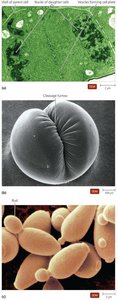
Some protists, especially apicomplexans, reproduce asexually by schizogony. This process involves multiple rounds of nuclear division before the cell divides into many daughter cells.
Schizont: The multinucleate cell formed during schizogony.
Cytokinesis: The division of the cytoplasm to produce daughter cells.
Example: Plasmodium species (malaria parasites) reproduce by schizogony in human liver and red blood cells.
Fungi and Yeasts
Overview of Fungi
Fungi are eukaryotic organisms that include yeasts, molds, and mushrooms. They are heterotrophic and obtain nutrients by absorption. Yeasts are unicellular fungi, while molds are multicellular and form hyphae.
Yeasts: Unicellular, reproduce by budding or fission (e.g., Saccharomyces cerevisiae).
Molds: Multicellular, form filamentous hyphae.
Summary Table: Key Features of Major Eukaryotic Microorganisms
Group | Key Features | Example |
|---|---|---|
Flagellates | Flagella, photosynthetic or heterotrophic | Euglena |
Ciliates | Cilia, contractile vacuole, complex cortex | Paramecium |
Amoeboids | Pseudopodia, phagocytosis | Amoeba |
Apicomplexans | Parasitic, complex life cycle, schizogony | Plasmodium |
Yeasts | Unicellular, budding/fission | Saccharomyces |
Molds | Multicellular, hyphae | Rhizopus |
Additional info: The images and content are consistent with topics from Ch. 12 (Characterizing and Classifying Eukaryotes) and Ch. 23 (Parasitic Protozoa, Helminths, and Arthropod Vectors) of a college-level microbiology course.
