 Back
BackThe Adaptive Immune Response: Mechanisms and Components
Study Guide - Smart Notes
 Tailored notes based on your materials, expanded with key definitions, examples, and context.
The Adaptive Immune Response
Overview of Adaptive Immunity
The adaptive immune response is a highly specific defense mechanism that protects the body against foreign invaders. It can be acquired either naturally or artificially and is characterized by specificity and memory, allowing for a stronger response upon re-exposure to the same pathogen.
Natural Adaptive Immunity: Occurs when an organism or toxin enters the body, triggering an immune response.
Artificial Adaptive Immunity: Induced by immunization with a vaccine.
Specificity: The immune response targets a particular pathogen and does not confer protection against unrelated diseases, except in cases of closely related organisms (e.g., smallpox and cowpox).
Memory: The immune system "remembers" previous encounters, resulting in a faster and more robust response upon subsequent exposures.
Types of Adaptive Immune Responses
Antibody-Mediated (Humoral) Response: Involves antibodies (immunoglobulins) that specifically bind and inactivate foreign particles such as cells, toxins, and pollen.
Cell-Mediated Response: Involves the activation of lymphocytes that recognize and destroy abnormal or infected host cells, including tumor cells.
Antigens and Antibodies
Antigens and Epitopes
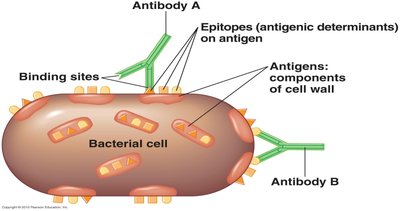
Antigen: Any foreign particle that enters the body and elicits an immune response. Antigens can be broken down into smaller regions called epitopes, which are the specific parts recognized by antibodies.
Epitope: The precise portion of the antigen that is recognized and bound by an antibody.
Structure and Function of Antibodies
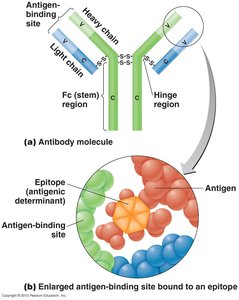
Antibodies, also known as immunoglobulins (Ig), are proteins produced in response to antigens. They bind specifically to antigens in a lock-and-key manner.
Composed of four polypeptide chains: two identical heavy chains and two identical light chains, held together by covalent bonds.
Each antibody has two identical antigen-binding sites (Fab), each specific for one epitope.
The constant fragment (Fc) binds complement proteins and phagocytes, facilitating immune functions.
Classes of Antibodies
IgG: Most common; found in blood and tissues, crosses placenta, provides passive immunity to fetus, binds antigens tightly.
IgM: Pentameric structure, remains in blood, first antibody produced during infection, effective at agglutinating antigens.
IgA: Dimeric, found in secretions (saliva, mucous, tears, milk), protects mucosal surfaces and newborn gastrointestinal tract.
IgD: Function largely unknown, located on B cell surfaces.
IgE: Found on mast cells and basophils, triggers histamine release upon antigen binding, involved in allergic responses.
Functions of Antibodies
Agglutination: Clumping of antigens, reducing the number of infectious units.
Neutralization: Binding and inactivation of toxins, bacteria, and viruses.
Complement Activation: Initiates the complement pathway, leading to pathogen lysis.
Opsonization: Marks antigens for destruction by phagocytes.
Cells of the Adaptive Immune System
Lymphocytes
B Lymphocytes (B cells): Produced in bone marrow, responsible for antibody production (humoral response).
T Lymphocytes (T cells): Produced in bone marrow, mature in thymus. Two main types:
Helper T Cells (TH): Assist B and cytotoxic T cells, involved in both humoral and cell-mediated immunity.
Cytotoxic T Cells (TC): Destroy infected or abnormal host cells, part of cell-mediated response.
Antigen Presenting Cells (APCs)
Include macrophages, B cells, and dendritic cells.
Engulf foreign material, process antigens, and present them with self-antigens (MHC) to T helper cells.
Ensures immune response targets foreign, not self, antigens.
Antibody Production
Stages of Antibody Production
Antibody production involves a series of steps beginning with antigen entry and culminating in the generation of plasma and memory cells.
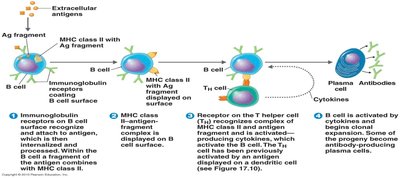
Antigen enters the body and is phagocytized by a B cell.
Antigen fragments are presented on the B cell surface with MHC proteins.
T helper cell recognizes the antigen-MHC complex and delivers cytokines to stimulate B cell clonal expansion.
Clonal Expansion and Differentiation
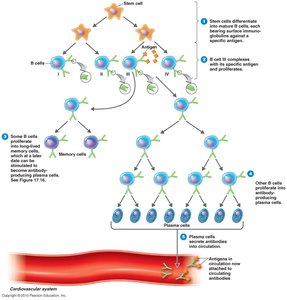
Plasma Cells: Short-lived cells that produce large quantities of antibodies.
Memory Cells: Long-lived cells that circulate in the blood and rapidly respond to future exposures to the same antigen.
Primary vs. Secondary Immune Response
Primary Response: First exposure to antigen; slow (5-7 days), low antibody levels, IgM produced first, followed by IgG and IgA. Builds immunological memory.
Secondary Response: Subsequent exposures; rapid (1-2 days), high antibody levels, memory cells quickly differentiate into plasma cells, infection is rapidly controlled.
Cell-Mediated Immune Response
Mechanism of Cell-Mediated Immunity
This response targets cells infected with pathogens, cancer cells, or foreign cells (e.g., transplants). It involves antigen presentation, T cell activation, and destruction of abnormal cells.
Abnormal host cells display endogenous antigens with MHC I molecules.
Cytotoxic T cells recognize these complexes and release perforins, which create pores in the target cell membrane, leading to cell death.
Active and Passive Immunization
Active Immunization
The body generates its own antibodies or cytotoxic T cells after exposure to an antigen.
Can be natural (environmental exposure) or artificial (vaccination).
Passive Immunization
Ready-made antibodies are provided to the individual; does not result in long-term immunity.
Can be natural (maternal antibodies via placenta or milk) or artificial (injection of pre-formed antibodies, e.g., anti-toxin for snake venom).
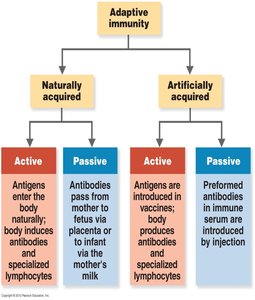
Summary Table: Types of Adaptive Immunity
Type | Natural | Artificial |
|---|---|---|
Active | Antigens enter the body naturally; body induces antibodies and specialized lymphocytes | Antigens introduced in vaccines; body produces antibodies and specialized lymphocytes |
Passive | Antibodies pass from mother to fetus via placenta or to infant via mother’s milk | Preformed antibodies in immune serum are introduced by injection |
