 Back
BackThe Chemistry of Microbiology: Essential Concepts and Macromolecules
Study Guide - Smart Notes
 Tailored notes based on your materials, expanded with key definitions, examples, and context.
The Chemistry of Microbiology
Introduction
Chemistry forms the foundation of microbiology by explaining the interactions and structures of atoms and molecules that compose living organisms. Understanding atomic structure, chemical bonds, and macromolecules is essential for grasping microbial physiology and metabolism.
Atomic Structure and Elements
Structure of Atoms
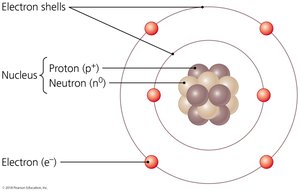
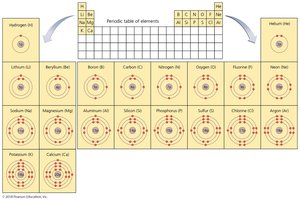
Atoms are the smallest units of matter, consisting of a nucleus (containing protons and neutrons) surrounded by electrons in shells. The arrangement of these subatomic particles determines the chemical properties of each element.
Protons: Positively charged particles in the nucleus.
Neutrons: Uncharged particles in the nucleus.
Electrons: Negatively charged particles orbiting the nucleus in shells.
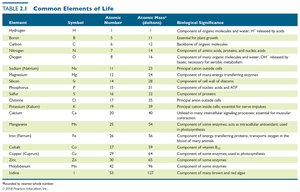
Common Elements of Life
Living organisms are primarily composed of a few key elements, each with specific biological roles. The atomic number (number of protons) and atomic mass (sum of protons, neutrons, and electrons) define each element.
Element | Symbol | Atomic Number | Biological Significance |
|---|---|---|---|
Hydrogen | H | 1 | Component of organic molecules and water; H+ released by acids |
Carbon | C | 6 | Backbone of organic molecules |
Nitrogen | N | 7 | Component of amino acids, proteins, and nucleic acids |
Oxygen | O | 8 | Component of water, many organic molecules; O2 needed for aerobic metabolism |
Isotopes
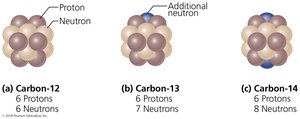
Isotopes are atoms of the same element with different numbers of neutrons. Some isotopes are stable, while others are radioactive and release energy during decay, which can be used in biological research and medical applications.
Stable isotopes: Do not change over time.
Radioactive isotopes: Unstable, decay over time, releasing energy.
Electron Configuration
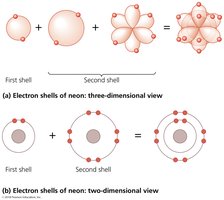
Electrons occupy shells around the nucleus, and only the outermost (valence) electrons participate in chemical reactions. The arrangement of electrons determines an atom’s chemical behavior.
Valence electrons: Electrons in the outermost shell, responsible for bonding.
Chemical Bonds
Types of Chemical Bonds
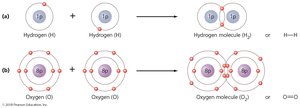
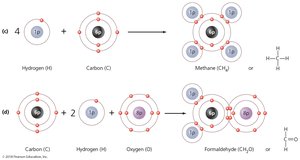
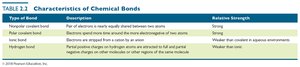
Atoms combine by sharing or transferring valence electrons, forming molecules and compounds. The main types of chemical bonds are covalent, ionic, and hydrogen bonds.
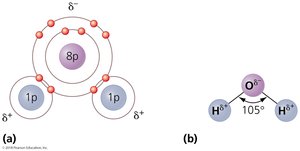
Covalent bonds: Atoms share pairs of electrons. Can be nonpolar (equal sharing) or polar (unequal sharing).
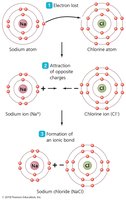
Ionic bonds: Electrons are transferred from one atom to another, creating charged ions (cations and anions) that attract each other.
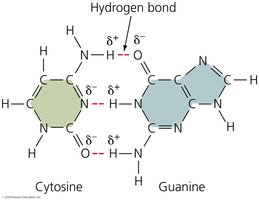
Hydrogen bonds: Weak attractions between partially charged hydrogen and other electronegative atoms.
Type of Bond | Description | Relative Strength |
|---|---|---|
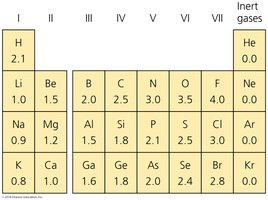
Nonpolar covalent | Pair of electrons is nearly equally shared | Strong |
Polar covalent | Electrons spend more time near one atom | Weaker than nonpolar |
Ionic | Electrons are expelled from a valence shell | Weaker than covalent in aqueous environments |
Hydrogen | Partial positive charges on hydrogen atoms are attracted to full/partial negative charges | Weaker than ionic |
Chemical Reactions
Types of Chemical Reactions
Chemical reactions involve the making or breaking of chemical bonds, transforming reactants into products. In living organisms, these reactions are essential for metabolism.
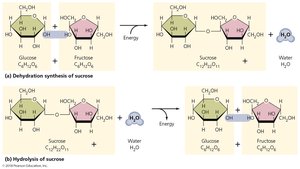
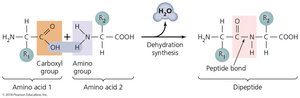
Synthesis reactions: Build larger molecules from smaller ones; require energy (endothermic). Example: dehydration synthesis.
Decomposition reactions: Break down larger molecules into smaller ones; release energy (exothermic). Example: hydrolysis.
Exchange reactions: Involve both breaking and forming bonds, with atoms moving between molecules.


Metabolism is the sum of all chemical reactions in an organism, including both anabolism (building up) and catabolism (breaking down).
Water, Acids, Bases, and Salts
Properties of Water
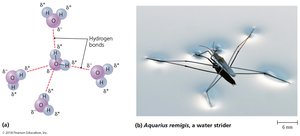
Water is the most abundant substance in organisms and has unique properties due to its polar covalent bonds. It is cohesive, an excellent solvent, and participates in many chemical reactions.
Cohesion: Water molecules stick together, generating surface tension.
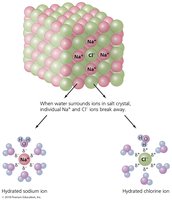
Solvent: Dissolves many substances, facilitating biochemical reactions.
Acids and Bases
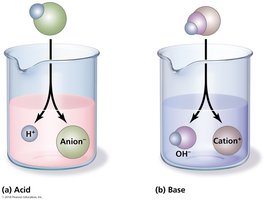
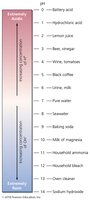
Acids and bases dissociate in water to release ions. The concentration of hydrogen ions (H+) is measured by the pH scale, which is crucial for maintaining metabolic balance.
Acid: Releases H+ ions in solution.
Base: Binds H+ or releases OH– ions.
Buffer: Prevents drastic changes in pH.
Salts
Salts dissociate in water to form ions other than H+ and OH–. These ions are electrolytes, essential for electrical signaling, enzyme function, and maintaining cellular environments.
Organic Macromolecules
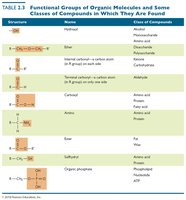
Functional Groups
Organic molecules contain carbon and hydrogen and often feature functional groups that determine their chemical behavior. Macromolecules are large, complex molecules essential for life.
Lipids
Carbohydrates
Proteins
Nucleic acids
Structure | Name | Class of Compounds |
|---|---|---|
Hydroxyl (-OH) | Alcohol | Monosaccharides |
Carboxyl (-COOH) | Carboxylic acid | Amino acids, proteins |
Amino (-NH2) | Amino | Amino acids, proteins |
Phosphate (-PO4) | Phosphate | Nucleic acids, ATP |
Lipids
Lipids are hydrophobic molecules that include fats, phospholipids, waxes, and steroids. They are essential for energy storage, membrane structure, and signaling.
Fats (triglycerides): Composed of glycerol and three fatty acids.
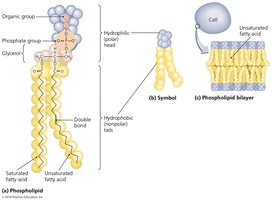
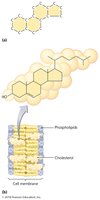
Phospholipids: Major component of cell membranes, with hydrophilic heads and hydrophobic tails.
Waxes: Long-chain fatty acids linked to alcohols; insoluble in water.
Steroids: Four-ring structure; includes cholesterol, important for membrane fluidity.
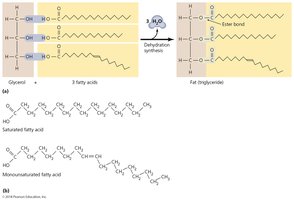
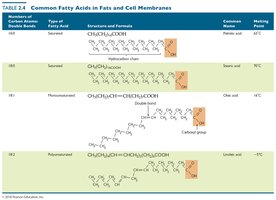
Type of Fatty Acid | Structure | Melting Point |
|---|---|---|
Saturated | No double bonds | High |
Monounsaturated | One double bond | Medium |
Polyunsaturated | Multiple double bonds | Low |
Carbohydrates
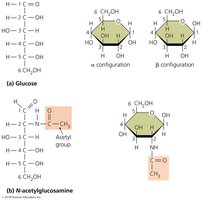
Carbohydrates are organic molecules composed of carbon, hydrogen, and oxygen. They serve as energy sources, structural components, and are involved in cell signaling.
Monosaccharides: Simple sugars (e.g., glucose, deoxyribose).
Disaccharides: Two monosaccharides joined by dehydration synthesis (e.g., sucrose).
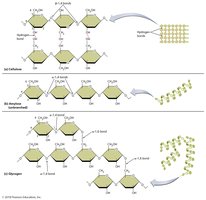
Polysaccharides: Long chains of monosaccharides (e.g., starch, glycogen, cellulose).
Proteins
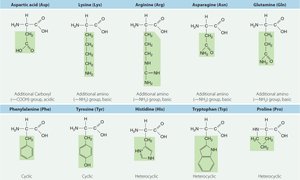
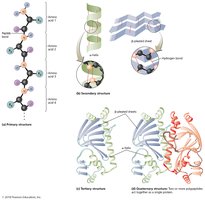
Proteins are polymers of amino acids and perform a wide range of functions, including catalysis, regulation, transport, and defense. The structure of proteins is determined by the sequence and interactions of their amino acids.
Amino acids: Monomers of proteins; 21 types used in protein synthesis.
Peptide bonds: Covalent bonds linking amino acids.
Levels of structure: Primary, secondary, tertiary, and quaternary.
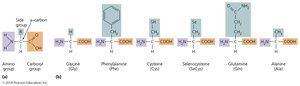
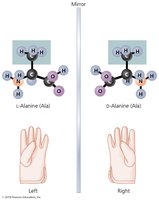
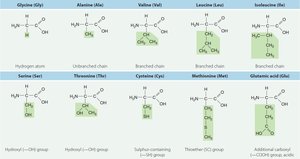
Amino Acid | Abbreviation | R Group |
|---|---|---|
Glycine | Gly | H |
Alanine | Ala | CH3 |
Cysteine | Cys | Contains sulfur |
Nucleic Acids and Nucleotides
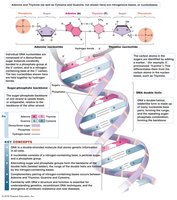
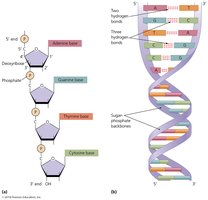
Nucleic acids (DNA and RNA) are polymers of nucleotides and serve as the genetic material of cells and viruses. They store and transmit genetic information and participate in protein synthesis.
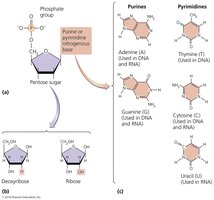
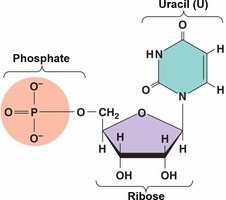
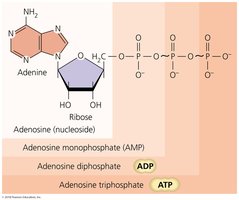
Nucleotide: Monomer consisting of a phosphate group, pentose sugar (deoxyribose or ribose), and a nitrogenous base.
DNA: Double-stranded, contains deoxyribose, bases A, T, C, G.
RNA: Single-stranded, contains ribose, bases A, U, C, G.
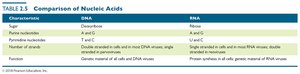
Characteristic | DNA | RNA |
|---|---|---|
Sugar | Deoxyribose | Ribose |
Pyrimidine bases | T, C | U, C |
Number of strands | Double | Single |
Function | Genetic material | Protein synthesis |
Conclusion
The chemistry of microbiology provides the essential framework for understanding the molecular basis of life. Mastery of atomic structure, chemical bonds, and macromolecules is crucial for further study in microbial physiology, genetics, and metabolism.
