 Back
BackThe Chemistry of Microbiology: Structured Study Notes Ch2 - 1
Study Guide - Smart Notes
 Tailored notes based on your materials, expanded with key definitions, examples, and context.
The Chemistry of Microbiology
Atoms and Atomic Structure
The foundation of chemistry in microbiology begins with understanding atoms, the smallest units of matter. Atoms are composed of subatomic particles: protons, neutrons, and electrons. The arrangement and behavior of these particles determine the properties of elements and their interactions.
Matter: Anything that takes up space and has mass.
Atoms: Smallest chemical units of matter.
Atomic Structure:
Electrons: Negatively charged particles circling the nucleus.
Nucleus: Contains protons (positive) and neutrons (neutral).
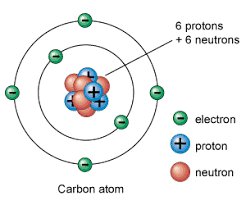

Elements, Atomic Number, and Atomic Mass
Elements are defined by their atomic number, which is the number of protons in the nucleus. Atomic mass is the sum of protons, neutrons, and electrons, though electrons contribute minimally to mass.
Element: Substance composed of a single type of atom.
Atomic Number: Number of protons in the nucleus.
Atomic Mass: Sum of masses of protons, neutrons, and electrons.
Common Elements of Life
Biological systems rely on a variety of elements, each with specific roles in cellular processes.
Element | Symbol | Atomic Number | Biological Significance |
|---|---|---|---|
Hydrogen | H | 1 | Component of organic molecules and water; H+ released by acids |
Carbon | C | 6 | Backbone of organic molecules |
Nitrogen | N | 7 | Component of amino acids, proteins, and nucleic acids |
Oxygen | O | 8 | Component of many organic molecules and water; necessary for aerobic metabolism |
Phosphorus | P | 15 | Component of nucleic acids and ATP |
Sulfur | S | 16 | Component of proteins |
Iron | Fe | 26 | Component of energy-transferring proteins; transports oxygen in blood |
Zinc | Zn | 30 | Component of some enzymes |
Iodine | I | 53 | Component of many brown and red algae |
Isotopes
Isotopes are atoms of the same element with different numbers of neutrons. Some isotopes are stable, while others are radioactive and release energy during decay.
Stable Isotopes: Do not change over time.
Radioactive Isotopes: Unstable, release energy during radioactive decay.

Electron Configuration and Valence
Electrons occupy shells around the nucleus. The outermost shell, containing valence electrons, determines an atom's chemical reactivity and bonding behavior.
Valence Electrons: Electrons in the outermost shell; interact with other atoms.
Electron Shells: Levels where electrons reside; filled shells confer stability.

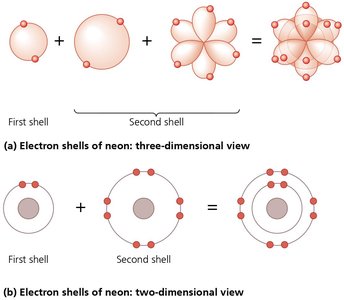
Chemical Bonds
Chemical bonds form when atoms share or transfer valence electrons. The type of bond affects the properties of molecules and compounds.
Covalent Bonds: Sharing of electron pairs between atoms.
Nonpolar Covalent: Electrons shared equally; no charge separation.
Polar Covalent: Electrons shared unequally; partial charges develop.
Ionic Bonds: Electrons transferred from one atom to another, forming charged ions (cations and anions) that attract each other.
Hydrogen Bonds: Weak electrical attraction between partially charged hydrogen and other atoms; important for stabilizing large molecules.


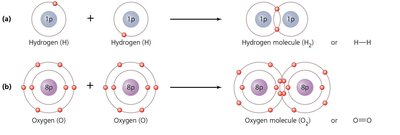


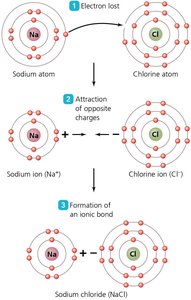

Comparison of Chemical Bonds
Type of Bond | Description | Relative Strength |
|---|---|---|
Nonpolar Covalent | Electrons shared equally | Strong |
Polar Covalent | Electrons shared unequally | Strong |
Ionic | Electrons transferred; ions attract | Weaker than covalent in aqueous environments |
Hydrogen | Partial positive charges on hydrogen attracted to negative charges | Weaker than ionic |
Chemical Reactions
Chemical reactions involve the making or breaking of chemical bonds, transforming reactants into products. Biochemistry studies these reactions in living organisms.
Reactants: Starting substances in a reaction.
Products: Substances formed as a result of a reaction.
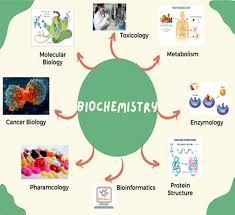
Biochemistry: The study of chemical reactions in living things.
Additional info:
Understanding atomic structure and chemical bonding is essential for grasping microbial metabolism, genetics, and cellular processes.
Knowledge of elements and their roles in biological systems underpins topics such as microbial nutrition, growth, and metabolism.
