 Back
BackThe Control of Microbial Growth: Methods and Principles
Study Guide - Smart Notes
 Tailored notes based on your materials, expanded with key definitions, examples, and context.
Chapter 7: The Control of Microbial Growth
Terminology and Definitions
Understanding the terminology related to microbial control is essential for microbiology students. These terms describe various methods and outcomes of controlling microbial populations.
Sterilization: Removal of all forms of microbial life, including endospores and viruses.
Disinfection: Destruction of pathogenic microbes, usually referring to vegetative forms.
Sanitization: Reduction of microbial counts on objects (e.g., eating utensils) to safe public health levels.
Germicide: An agent that kills microbes.
Bacteriostasis: Inhibition of microbial growth without killing.
Factors Affecting the Effectiveness of Antimicrobial Treatments
The effectiveness of antimicrobial treatments depends on several key factors. These determine how quickly and thoroughly microbes are eliminated.
Number of microbes: Higher initial populations require longer treatment times.
Time of exposure: Longer exposure increases effectiveness.
Microbial environment: Presence of organic matter (e.g., biofilms) can inhibit chemical antimicrobials.
Microbial characteristics: Some microbes are inherently more resistant due to structural or physiological traits.
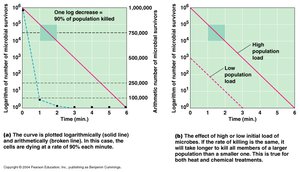
Example: The rate of microbial death is often plotted logarithmically, showing that a constant percentage of cells die per unit time. High population loads require longer treatment times.
Biofilm Formation and Its Impact on Microbial Control
Biofilms are communities of microbes attached to surfaces and encased in a protective matrix. They significantly impact the effectiveness of antimicrobial agents.
Attachment: Microbes adhere to surfaces.
Colonization: Microbes multiply and form a matrix.
Growth: Biofilm matures, increasing resistance to antimicrobials.
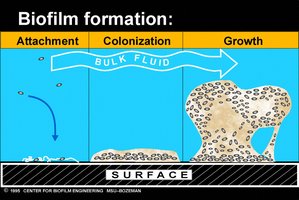
Example: Biofilms on medical devices or surfaces can protect pathogens from disinfectants, making infections harder to treat.
Microbial Resistance to Control Methods
Microbes vary in their resistance to physical and chemical control methods. Understanding this hierarchy is crucial for selecting appropriate treatments.
Most resistant: Prions, endospores of bacteria, mycobacteria.
Moderately resistant: Cysts of protozoa, vegetative protozoa, gram-negative bacteria.
Least resistant: Viruses with lipid envelopes, gram-positive bacteria.
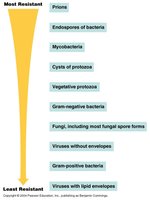
Example: Endospores require rigorous sterilization methods, while enveloped viruses are easily inactivated by detergents.
Actions of Microbial Control Agents
Antimicrobial agents act by targeting essential cellular structures and functions.
Alteration of membrane permeability: Leads to cytosol leakage and cell death.
Damage to proteins: Disrupts ionic, hydrogen, and covalent bonds, denaturing enzymes.
Damage to nucleic acids: Prevents protein synthesis and replication.
Physical Methods of Microbial Growth Control
Physical methods are widely used to control microbial growth in laboratory and clinical settings.
Heat: Most common method; includes moist and dry heat.
Pasteurization: Limited heat treatment to reduce spoilage and eliminate pathogens.
Moist heat: Denatures proteins; autoclaving uses steam under pressure for sterilization.
Dry heat: Includes flaming and hot-air sterilization.
Radiation: Damages DNA, causing lethal mutations; includes ionizing and non-ionizing radiation.
Filtration: Removes microbes from heat-sensitive solutions.
Low temperature: Inhibits growth (bacteriostatic effect).
Dehydration and osmotic pressure: Prevent metabolism and cause plasmolysis.
Pasteurization
Pasteurization reduces spoilage organisms and eliminates pathogens without sterilizing the product. Heat-tolerant microbes survive but do not cause disease or significant spoilage.
Moist Heat: Autoclaving
Autoclaving uses steam under pressure to achieve temperatures above 100°C, effectively sterilizing materials.
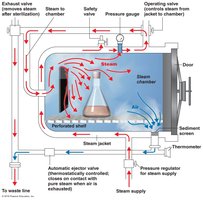
Example: Autoclaves are used to sterilize laboratory media, surgical instruments, and waste.
Radiation
Radiation methods include ionizing (gamma rays, X-rays) and non-ionizing (UV light). Ionizing radiation is highly effective for sterilization.
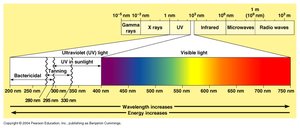
Example: UV light is used for surface sterilization, while gamma rays are used for medical equipment.
Chemical Methods of Microbial Control
Chemical agents are used to disinfect, sanitize, and sterilize surfaces and instruments. The choice of agent depends on the target microbe and application.
Phenolics (e.g., Triclosan): Disrupt lipids in the plasma membrane.
Halogens (Iodine, Chlorine): Oxidizing agents; disrupt cell membranes.
Alcohols (Ethanol, Isopropanol): Dissolve lipids and denature proteins.
Heavy metals (Ag, Hg, Cu, Zn): Denature proteins.
Surface-active agents (Surfactants/Quats): Denature proteins and disrupt membranes.
Historical Context: Joseph Lister
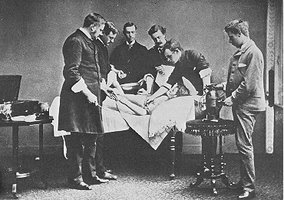
Joseph Lister performed the first aseptic surgery in 1865 using phenol, revolutionizing surgical practice and reducing infection rates.
Evaluating Disinfectants: Disk-Diffusion Method
The disk-diffusion method is used to evaluate the effectiveness of disinfectants. Disinfectant-soaked filter paper disks are placed on inoculated agar, and zones of inhibition are measured after incubation.
Zone of inhibition: Area where microbial growth is prevented, indicating effectiveness.
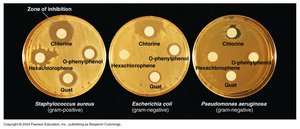
Example: Larger zones indicate greater effectiveness against the tested microbe.
Summary Table: Types of Disinfectants and Their Actions
Type | Action | Example |
|---|---|---|
Phenolics | Disrupt lipids in PM | Triclosan |
Halogens | Oxidize, disrupt membranes | Chlorine, Iodine |
Alcohols | Dissolve lipids, denature proteins | Ethanol, Isopropanol |
Heavy Metals | Denature proteins | Silver, Mercury |
Surfactants/Quats | Disrupt membranes, denature proteins | Quaternary ammonium compounds |
Additional info: No single disinfectant is effective in all circumstances; selection depends on microbial characteristics and environmental factors.
