 Back
BackThe Control of Microbial Growth: Principles, Methods, and Applications
Study Guide - Smart Notes
 Tailored notes based on your materials, expanded with key definitions, examples, and context.
The Control of Microbial Growth
Terminology of Microbial Control
Understanding the terminology of microbial control is essential for distinguishing between various methods used to manage microbial populations in clinical, laboratory, and industrial settings.
Sepsis: Refers to bacterial contamination, often associated with infection.
Asepsis: The absence of significant contamination; critical in surgical procedures.
Aseptic Techniques: Procedures that prevent microbial contamination of wounds during surgery.
Term | Definition | Method | Example |
|---|---|---|---|
Sterilization | Complete destruction of all microorganisms, including endospores | Heat (pressure) | Autoclave |
Disinfection | Destruction of most vegetative forms on fomites | Chemical treatment of inert surfaces | Bleach |
Antisepsis | Destruction of most vegetative forms on skin | Chemical treatment of living tissue | Iodine |
Sanitization | Reduction of microbial numbers on eating utensils/dishes | Moist heat and chemical disinfecting | Dishwasher |
Biocide (germicide): Treatments that kill microbes.
Bacteriostasis: Inhibiting, but not killing, microbes.
The Rate of Microbial Death
Bacterial populations die at a constant logarithmic rate when exposed to antimicrobial treatments. The effectiveness of these treatments depends on several factors.
Number of microbes: Higher populations require longer treatment times.
Environment: Presence of organic matter, temperature, and biofilms can affect efficacy.
Time of exposure: Longer exposure increases effectiveness.
Microbial characteristics: Endospores and cell wall composition influence resistance.
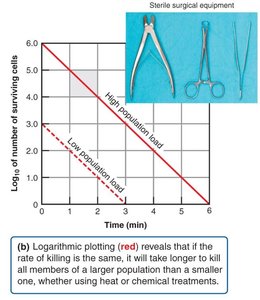
Example: Logarithmic plotting reveals that if the rate of killing is the same, it will take longer to kill all members of a larger population than a smaller one, whether using heat or chemical treatments.
Actions of Microbial Control Agents
Microbial control agents act by damaging essential cellular components, thereby inhibiting growth or causing cell death.
Damage to plasma membrane: Causes leakage of cellular contents and interferes with cell growth.
Damage to proteins (enzymes): Denaturation leads to loss of function.
Damage to nucleic acids: Prevents replication and transcription.
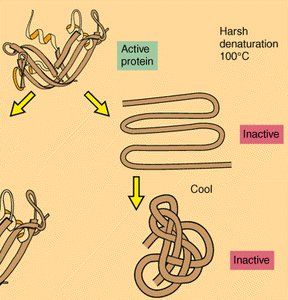
Example: Heat can denature proteins, rendering them inactive and unable to perform their biological functions.
Physical Methods of Microbial Control
Physical methods are widely used to control microbial growth, especially in healthcare and laboratory settings.
Heat: Denatures enzymes and proteins.
Thermal Death Point (TDP): Lowest temperature at which all cells in a liquid culture are killed in 10 minutes.
Thermal Death Time (TDT): Minimal time for all bacteria in a liquid culture to be killed at a particular temperature.
Moist Heat Sterilization
Moist heat coagulates and denatures proteins, effectively killing most vegetative cells.
Boiling: Usually 10 minutes for vegetative cells; less effective against viruses and spores.
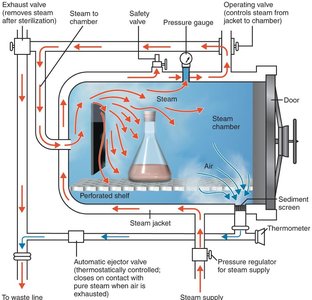
Autoclave: Steam under pressure (121ºC at 15 psi for 15 min) kills all organisms (except prions) and endospores. Preferred method for sterilization in healthcare environments.
Test strips: Used to indicate sterility.
Pasteurization
Pasteurization reduces spoilage organisms and pathogens in milk and juices.
High Temperature, Short Time (HTST): 72°C for 15 seconds.
Ultra-High-Temperature (UHT): 140°C for 4 seconds, followed by rapid cooling; sterilizes milk and juices for storage without refrigeration.
Phosphatase test: Used to verify pasteurization effectiveness.
Thermoduric organisms: Survive pasteurization but are unlikely to cause disease or spoil refrigerated milk.
Dry Heat Sterilization
Dry heat kills by oxidation and is used for materials that can withstand high temperatures.
Flaming: Used for sterilizing inoculating loops.
Hot-air sterilization: Oven at 170°C for 2 hours.
Method | Temperature | Time |
|---|---|---|
Hot-air | 170°C | 2 hr |
Autoclave | 121°C | 15 min |
Filtration
Filtration is used for heat-sensitive materials and relies on passage through a screenlike material.
HEPA filters: Remove microbes >0.3 µm in diameter.
Membrane filtration: Removes microbes >0.22 µm; pore sizes as small as 0.05 µm can filter out viruses and large proteins.
Other Physical Methods
Low temperature: Bacteriostatic effect; includes refrigeration and deep-freezing.
Desiccation: Absence of water prevents metabolism.
Osmotic pressure: High concentrations of salts and sugars create a hypertonic environment, causing plasmolysis.
Radiation
Radiation is used to sterilize food, pharmaceuticals, and medical supplies by damaging microbial DNA.
Ionizing radiation: (X-rays, gamma rays, electron beams) ionizes water to create reactive hydroxyl radicals, causing lethal mutations in DNA.
Nonionizing radiation: (Ultraviolet) creates thymine dimers in DNA, preventing replication. UVC lamps are used for surface sterilization in hospitals.
Microwaves: Kill by heat, not especially antimicrobial.
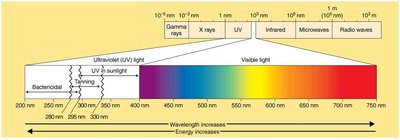
Example: UV light is effective for surface sterilization but does not penetrate deeply.
Principles of Effective Disinfection
Several factors influence the effectiveness of chemical disinfectants.
Concentration of disinfectant
Presence of organic matter
pH
Temperature
Time
The Disk-Diffusion Method
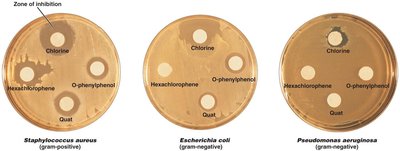
The disk-diffusion method evaluates the efficacy of chemical agents by measuring the zone of inhibition around filter paper disks soaked in chemicals and placed on a microbial culture.
Common Chemical Agents and Their Actions
Chemical Agent | How it works | How it is used | Examples |
|---|---|---|---|
Phenols/phenolics | Disrupt plasma membranes | Disinfectant | Lysol, O-syl |
Bisphenols | Disrupt plasma membranes | Used with soap | Triclosan (antibiotic soaps) |
Iodine (Halogen) | Alters protein synthesis and membranes | Antiseptic | Betadine |
Chlorine (Halogen) | Enzyme damage | Water treatment, disinfectant | Chlorine gas, bleach |
Alcohol | Denatures proteins, dissolves lipids | Enhances other chemical antiseptics | Isopropanol, hand sanitizers |
Heavy metals | Denature proteins | Antiseptic | Silver impregnated dressing |
Surfactants | Decrease surface tension, wash away cells | Soap | Soap |
Microbial Characteristics and Microbial Control
Microbial resistance to biocides varies depending on structural and physiological characteristics.
Gram-negative bacteria: More resistant due to lipopolysaccharide in their outer membrane.
Mycobacteria: Exhibit considerable resistance to biocides.
Bacterial endospores: Very resistant to many biocides.
Nonenveloped viruses: More resistant than enveloped viruses.
Prions: Difficult to disinfect surgical instruments.
Additional info: The effectiveness of microbial control methods is influenced by the type of microorganism, environmental conditions, and the method used. Understanding these principles is essential for selecting appropriate sterilization and disinfection strategies in clinical and laboratory settings.
