 Back
BackThe Control of Microbial Growth: Principles and Methods
Study Guide - Smart Notes
 Tailored notes based on your materials, expanded with key definitions, examples, and context.
Chapter 7: The Control of Microbial Growth
Introduction
The control of microbial growth is essential in healthcare, food safety, and laboratory settings. This chapter explores the terminology, principles, and methods used to inhibit or eliminate microorganisms, including both physical and chemical approaches.
Terminology of Microbial Control
Key Terms and Definitions
Sterilization: The removal or destruction of all microbial life, including endospores. Commercial sterilization refers specifically to killing Clostridium botulinum endospores in canned goods.
Disinfection: The destruction of harmful microorganisms on inanimate surfaces or environments.
Antisepsis: The destruction of harmful microorganisms from living tissue.
Degerming: The mechanical removal of microbes from a limited area (e.g., skin before injection).
Sanitization: Lowering microbial counts on eating utensils to safe levels.
Biocide (germicide): Treatments that kill microbes.
Bacteriostasis: Inhibiting, not killing, microbes.
Sepsis: Refers to bacterial contamination.
Asepsis: The absence of significant contamination; aseptic techniques prevent microbial contamination of wounds.
Principles of Microbial Death
Factors Affecting Microbial Death
Number of microbes: Larger populations take longer to eliminate.
Environment: Presence of organic matter, temperature, and biofilms can affect effectiveness.
Time of exposure: Longer exposure increases effectiveness.
Microbial characteristics: Endospores, cell wall structure, and other features influence resistance.
Actions of Microbial Control Agents
Damage to plasma membrane: Causes leakage of cellular contents and interferes with cell growth.
Damage to proteins (enzymes): Denaturation leads to loss of function.
Damage to nucleic acids: Prevents replication and function.
Physical Methods of Microbial Control
Heat
Denatures enzymes and other proteins, leading to cell death.
Thermal death point (TDP): Lowest temperature at which all cells in a liquid culture are killed in 10 minutes.
Thermal death time (TDT): Minimal time for all bacteria in a liquid culture to be killed at a given temperature.
Decimal reduction time (DRT): Minutes to kill 90% of a specific population at a given temperature.
Moist Heat Sterilization
Boiling and free-flowing steam: Coagulate and denature proteins.
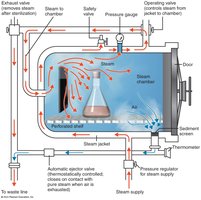
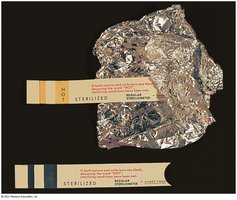
Autoclaving: Steam under pressure (15 psi, 15 min) kills all organisms (except prions) and endospores. Steam must contact the item’s surface. Large containers require longer times. Test strips indicate sterility.
Pasteurization and Dry Heat
Pasteurization: Reduces spoilage organisms and pathogens in liquids. High-temperature short-time (HTST) is 15 seconds; ultra-high-temperature (UHT) is 4 seconds, allowing storage without refrigeration.
Dry heat sterilization: Kills by oxidation (flaming, incineration, hot-air oven for 2 hours).
Filtration
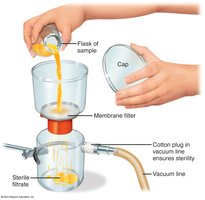
Used for heat-sensitive materials. Substances pass through a screenlike material (e.g., membrane filters, HEPA filters).
Membrane filters can remove microbes as small as viruses and large proteins.
Other Physical Methods
Low temperature: Bacteriostatic effect (refrigeration, deep-freezing, lyophilization).
High pressure: Denatures proteins and alters carbohydrate structure.
Desiccation: Absence of water prevents metabolism.
Osmotic pressure: High concentrations of salts and sugars create a hypertonic environment, causing plasmolysis.
Radiation
Ionizing radiation: (X-rays, gamma rays, electron beams) Ionizes water to create reactive hydroxyl radicals, damaging DNA and causing lethal mutations. Used for sterilizing pharmaceuticals, medical supplies, and food.
Nonionizing radiation: (UV, 260 nm) Damages DNA by creating thymine dimers. Used for surface sterilization (e.g., hospital rooms).
Visible blue light (470 nm): Kills bacteria via singlet oxygen formation.
Microwaves: Kill by heat, not especially antimicrobial.
Chemical Methods of Microbial Control
Principles of Effective Disinfection
Concentration of disinfectant
Presence of organic matter
pH
Temperature
Time of exposure
Evaluating Disinfectants
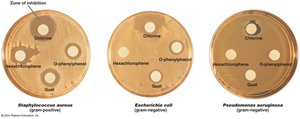
Disk-diffusion method: Filter paper disks soaked in chemicals are placed on a culture; zones of inhibition indicate effectiveness.
Major Types of Chemical Agents
Phenol and Phenolics: Disrupt plasma membranes; remain active in organic matter. Example: O-phenylphenol (Lysol®).
Biguanides: Disrupt plasma membranes; effective against gram-positive, many gram-negative bacteria, and enveloped viruses. Example: Chlorhexidine.
Essential Oils: Plant-derived, broad-spectrum activity, especially against gram-positive bacteria.
Halogens: Iodine (impairs protein synthesis, alters membranes), Chlorine (oxidizing agent, used in water disinfection).
Alcohols: Denature proteins and dissolve lipids; ineffective against endospores and nonenveloped viruses.
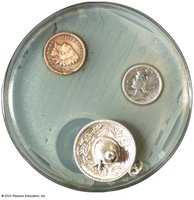
Heavy Metals: Oligodynamic action; denature proteins. Examples: Silver nitrate (prevents ophthalmia neonatorum), copper sulfate (algicide), zinc chloride (mouthwash).
Other Chemical Methods
Surface-active agents: Soaps and detergents lower surface tension, aiding in mechanical removal of microbes.
Chemical food preservatives: Sulfur dioxide, organic acids, nitrites, and nitrates prevent spoilage and endospore germination.
Supercritical fluids: Used for sterilizing food and medical implants.
Antibiotics (for food preservation): Bacteriocins such as nisin and natamycin prevent spoilage in cheese.
Microbial Characteristics and Resistance
Microbial Resistance to Control Methods
Gram-negative bacteria: More resistant to biocides due to their outer membrane's lipopolysaccharide layer.
Pseudomonas and Burkholderia: Notably resistant to many disinfectants.
Mycobacteria: Resistant due to waxy cell wall; require special testing for tuberculocidal activity.
Bacterial endospores: Highly resistant to many biocides.
Nonenveloped viruses: More resistant than enveloped viruses.
Prions: Extremely resistant; require immersion in NaOH and autoclaving for 1 hour.
Summary Table: Effectiveness of Physical and Chemical Methods
Method | Target | Effectiveness | Notes |
|---|---|---|---|
Autoclaving | All microbes, endospores | High | Preferred for sterilization; not effective against prions |
Filtration | Heat-sensitive liquids | High | Removes bacteria, some viruses |
Alcohols | Bacteria, enveloped viruses | Moderate | Ineffective against endospores, nonenveloped viruses |
Halogens | Bacteria, viruses, fungi | High | Iodine and chlorine commonly used |
Heavy metals | Bacteria, fungi, algae | Moderate | Oligodynamic action; toxicity limits use |
Key Equations
Decimal Reduction Time (DRT):
Conclusion
Understanding the principles and methods of microbial control is crucial for preventing infection, ensuring food safety, and maintaining sterile environments in healthcare and laboratory settings. Both physical and chemical methods have specific applications, advantages, and limitations depending on the type of microbe and the context of use.
