 Back
BackMicrobial Growth II
Study Guide - Smart Notes
 Tailored notes based on your materials, expanded with key definitions, examples, and context.
The Control of Microbial Growth
Introduction to Microbial Control
Controlling microbial growth is essential in healthcare, food safety, and laboratory settings to prevent infection and contamination. Understanding the terminology and mechanisms involved is foundational for microbiology students.
Sepsis: Refers to microbial contamination, especially in clinical contexts.
Asepsis: The absence of significant contamination; critical for surgical and laboratory procedures.
Aseptic Techniques: Methods used to prevent microbial contamination of wounds or sterile environments.
Key Terminology in Microbial Control
Sterilization: Removal or destruction of all microbial life, including endospores.
Disinfection: Elimination of most pathogenic microorganisms (not necessarily all microbes or spores) from inanimate objects.
Antisepsis: Removal of pathogens from living tissue.
Degerming: Mechanical removal of microbes from a limited area (e.g., skin before injection).
Sanitization: Lowering microbial counts on eating utensils to safe public health levels.
Biocide/Germicide: Agents that kill microbes.
Bacteriostasis: Inhibition of microbial growth without killing the organisms.
Effectiveness of Antimicrobial Treatment
Factors Influencing Effectiveness
The success of antimicrobial treatments depends on several factors:
Number of Microbes: Higher populations require longer treatment times for effective control.
Environment: Presence of organic matter, temperature, and biofilms can protect microbes from treatment.
Time of Exposure: Longer exposure increases effectiveness.
Microbial Characteristics: Some microbes are inherently more resistant to control methods.
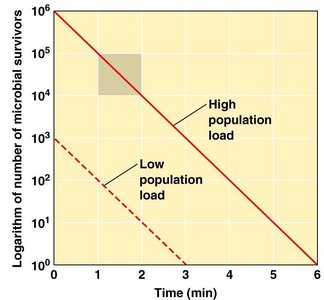
Image explanation: The graph demonstrates that a higher initial microbial population (high population load) requires more time to achieve the same reduction in survivors compared to a lower population load.
Microbial Resistance Hierarchy
Microorganisms vary in their resistance to antimicrobial agents. Understanding this hierarchy is crucial for selecting appropriate control methods.
Most Resistant: Prions, bacterial endospores, mycobacteria
Moderately Resistant: Protozoan cysts, vegetative protozoa, Gram-negative bacteria, fungi (including spores), non-enveloped viruses
Least Resistant: Gram-positive bacteria, enveloped viruses
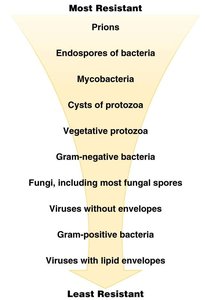
Image explanation: The funnel diagram visually ranks microorganisms from most to least resistant to chemical and physical control methods.
Actions of Microbial Control Agents
Mechanisms of Action
Antimicrobial agents act through several primary mechanisms:
Disruption of Cell Membranes: Damages the integrity of the plasma membrane, leading to leakage of cellular contents.
Alteration of Membrane Permeability: Affects the selective barrier function, causing cell death.
Damage to Proteins: Denaturation or inactivation of enzymes and structural proteins.
Damage to Nucleic Acids: Interferes with DNA/RNA synthesis, preventing replication and function.
Chemical Methods of Microbial Control
Types and Mechanisms of Chemical Disinfectants
Chemical agents are widely used for disinfection and antisepsis. Their effectiveness depends on their mechanism of action and the type of microorganism targeted.
Type of Agent | Use | Mechanism of Action |
|---|---|---|
Phenol & Phenolics | Disinfection of instruments, surfaces; found in hand soaps, Lysol | Membrane disruption, protein denaturation |
Biguanides | Antiseptic (e.g., Chlorhexidine) | Membrane disruption |
Halogens | Antiseptics (e.g., Betadine), instrument disinfection | Membrane disruption, impairment of protein synthesis |
Quats (Quaternary Ammonium Compounds) | Mild antiseptics, mouthwashes (e.g., Cepacol, Zephiran) | Alteration of membrane permeability |
Alcohols | Disinfection of instruments, surfaces | Membrane disruption, protein denaturation |
Effectiveness Against Resistant Microbes
The table below summarizes the effectiveness of common chemical antimicrobials against endospores and mycobacteria.
Chemical Agent | Endospores | Mycobacteria |
|---|---|---|
Mercury | No activity | No activity |
Phenolics | Poor | Good |
Bisphenols | No activity | No activity |
Quaternary ammonium compounds | No activity | No activity |
Chlorines | Fair | Fair |
Iodine | Fair | Good |
Alcohols | Poor | Good |
Glutaraldehyde | Fair | Good |
Chlorhexidine | No activity | Fair |
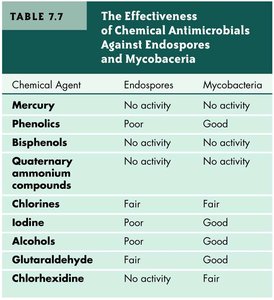
Image explanation: This table highlights that some agents (e.g., glutaraldehyde, iodine) are more effective against resistant forms like mycobacteria and endospores.
Comparison of Antiseptics
Different antiseptics vary in their effectiveness at reducing bacterial populations.
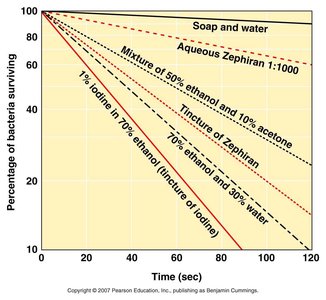
Image explanation: The graph compares the percentage of bacteria surviving after treatment with various antiseptics and soaps. Alcohol-based solutions and iodine are generally more effective than soap and water alone.
Soaps and Detergents
Most soaps and detergents are not true antiseptics but act as degerming agents. They emulsify oils and debris on the skin, allowing microbes to be rinsed away with water.
Degerming: Physical removal of microbes rather than killing them.
Application: Essential for hand hygiene in healthcare and food preparation.
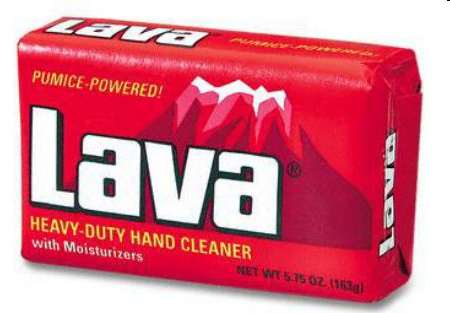
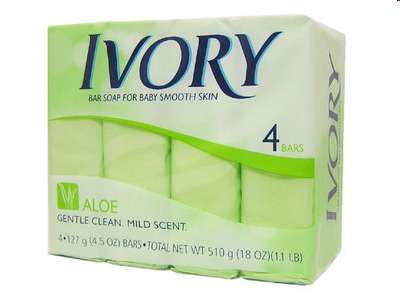
Image explanation: Examples of soaps used for degerming. Lava is a heavy-duty hand cleaner, while Ivory is a gentle bar soap.
Physical Methods of Microbial Control
Heat-Based Methods
Heat is one of the most common and effective methods for microbial control. It works primarily by denaturing proteins and disrupting cell structures.
Moist Heat: Includes boiling, autoclaving, and pasteurization. Moist heat denatures proteins more effectively than dry heat.
Autoclave: Uses steam under pressure (typically 121°C, 15 psi, 15 min) to achieve sterilization.
Dry Heat: Includes flaming, incineration, and hot-air sterilization (e.g., 170°C for 2 hours).
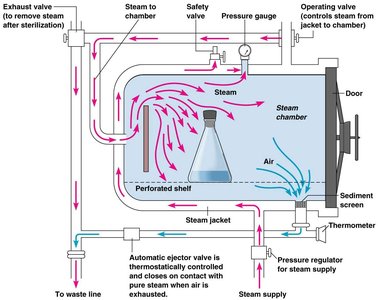
Image explanation: The diagram shows the structure and operation of an autoclave, a device used for sterilizing equipment and media using pressurized steam.
Pasteurization and Equivalent Treatments
Pasteurization reduces spoilage organisms and pathogens in food and beverages without achieving complete sterilization. Equivalent treatments use different combinations of temperature and time to achieve similar microbial reductions.
63°C for 30 min (classic pasteurization)
72°C for 15 sec (high-temperature, short-time, HTST)
140°C for <1 sec (ultra-high temperature, UHT)
Thermo-resistant organisms may survive pasteurization.
Other Physical Methods
Filtration: Physically removes microbes from liquids or air (e.g., HEPA filters).
Low Temperature: Inhibits microbial growth (refrigeration, deep freezing, lyophilization).
High Pressure: Denatures proteins and inactivates microbes.
Desiccation: Removal of water prevents metabolism and growth.
Osmotic Pressure: High salt or sugar concentrations cause plasmolysis in microbes.
Radiation
Radiation damages microbial DNA, leading to cell death or inactivation.
Ionizing Radiation: (X-rays, gamma rays, electron beams) causes breaks in DNA strands.
Nonionizing Radiation: (UV light) causes thymine dimers, inhibiting DNA replication.
Microwaves: Kill by heat generation, not direct antimicrobial action.
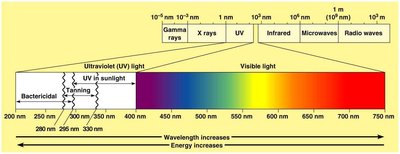
Image explanation: The electromagnetic spectrum diagram highlights the regions of ionizing and nonionizing radiation used for microbial control.
Evaluating Disinfectants
Disk-Diffusion Method
The disk-diffusion method is a standard laboratory technique for evaluating the effectiveness of chemical disinfectants and antibiotics. Disks soaked in chemicals are placed on agar plates inoculated with bacteria. Zones of inhibition indicate effectiveness.
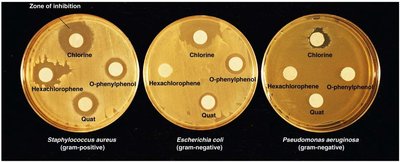
Image explanation: The image shows agar plates with disks containing different disinfectants. Clear zones around disks indicate inhibition of bacterial growth.
Summary Table: Physical and Chemical Methods of Microbial Control
Method | Mechanism | Application |
|---|---|---|
Moist Heat (Autoclave) | Protein denaturation | Sterilization of media, instruments |
Dry Heat | Oxidation | Glassware, metal instruments |
Filtration | Physical removal | Heat-sensitive liquids |
Radiation | DNA damage | Medical supplies, food |
Alcohols | Protein denaturation, membrane disruption | Surface disinfection, antisepsis |
Halogens | Protein synthesis impairment | Antiseptics, water treatment |
Quats | Membrane permeability alteration | Surface cleaning, mouthwashes |
Additional info: The effectiveness of any method depends on the type of microorganism, the environment, and the application technique. Always consider the resistance hierarchy when choosing a control method.
