 Back
BackThe Effects of Temperature & pH on Microbial Growth
Study Guide - Smart Notes
 Tailored notes based on your materials, expanded with key definitions, examples, and context.
The Effects of Temperature & pH on Microbial Growth
Introduction
Microbial growth is profoundly influenced by environmental factors such as temperature and pH. Understanding these effects is essential for controlling microbial populations in laboratory and clinical settings, as well as for industrial and environmental microbiology applications.
Microbial Growth and Binary Fission
Binary Fission
Most prokaryotes reproduce by binary fission, a process in which a single cell divides into two genetically identical daughter cells. This process involves the duplication of cellular components and DNA, elongation of the cell, and formation of a septum that separates the two new cells.
Step 1: Cell elongates and DNA is replicated.
Step 2: Cell wall and plasma membrane begin to constrict.
Step 3: Cross-wall forms, completely separating the two DNA copies.
Step 4: Cells separate, resulting in two daughter cells.
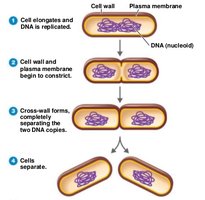
Generation time is the time required for one complete growth cycle, which varies among species and depends on environmental conditions. For example, Escherichia coli can divide every 20 minutes under optimal conditions.
Population Growth and Growth Phases
Exponential Growth
Microbial populations grow exponentially under favorable conditions, meaning the number of cells doubles at regular intervals. The rate of growth is influenced by the medium and incubation conditions.
Exponential growth equation: where is the final cell number, is the initial cell number, and is the number of generations.
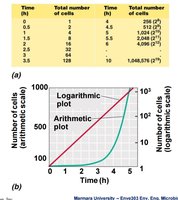
The Growth Curve in Batch Culture
A typical microbial growth curve in a closed system (batch culture) consists of four phases:
Lag phase: Cells adapt to new environment; synthesis of enzymes and repair of damage occur.
Exponential (log) phase: Cells divide at a constant, rapid rate; population is healthiest.
Stationary phase: Growth rate slows and stabilizes due to nutrient depletion or waste accumulation; metabolism continues but cell number remains constant.
Death (decline) phase: Cells die at an exponential rate, often due to toxic conditions or lack of nutrients.
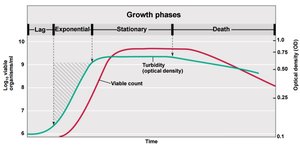
Measuring Microbial Growth
Direct Measurement Methods
Microbial growth can be measured directly by counting cells or colonies:
Microscopic counts: Cells are counted using a microscope and a counting chamber. This method cannot distinguish live from dead cells and may be inaccurate for dilute or motile samples.
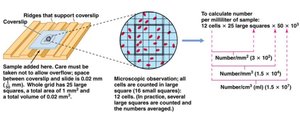
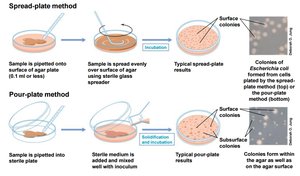
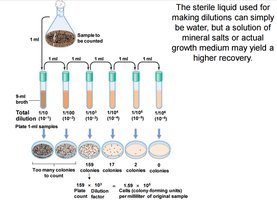
Viable cell counts (plate counts): Only living cells are counted by spreading or pouring diluted samples onto agar plates. Colonies are counted to estimate the number of viable cells in the original sample.
Indirect Measurement Methods
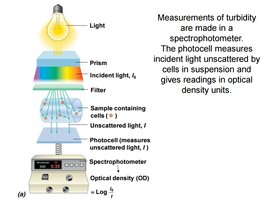
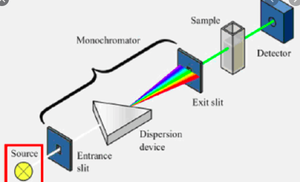
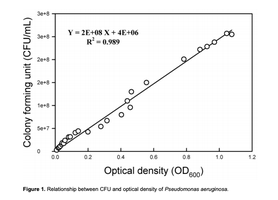
Turbidimetric methods measure the cloudiness (turbidity) of a culture, which increases as cell density rises. Turbidity is measured using a spectrophotometer, which provides a rapid and indirect estimate of cell concentration.
Optical density (OD): The amount of light absorbed by the culture is proportional to cell density.
By generating a standard curve, the optical density can be correlated with colony forming units (CFU) to estimate viable cell numbers.
Temperature and Microbial Growth
Cardinal Temperatures
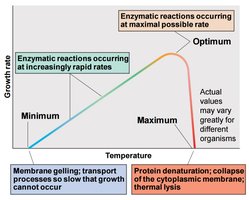
Each microorganism has minimum, optimum, and maximum temperatures for growth, known as cardinal temperatures. Growth rate increases with temperature up to the optimum, then declines rapidly as proteins denature and membranes collapse.
Temperature Classification of Microbes
Psychrophiles: Grow best at low temperatures (0–20°C); example: Polaromonas vacuolata.
Psychrotrophs: Can grow at low temperatures but have higher optimums (often 20–30°C).
Mesophiles: Grow best at moderate temperatures (20–45°C); example: Escherichia coli.
Thermophiles: Grow best at high temperatures (45–80°C); example: Geobacillus stearothermophilus.
Hyperthermophiles: Grow at very high temperatures (above 80°C); example: Pyrolobus fumarii.
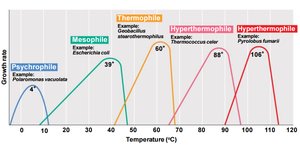
Temperatures outside the optimal range can damage enzymes, cell walls, and membranes, leading to cell death.
pH and Microbial Growth
pH Requirements
The pH of the environment affects microbial growth by influencing enzyme activity and membrane stability. Most microbes grow best at neutral pH (6–8), but some are adapted to acidic or alkaline conditions.
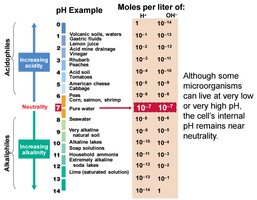
Acidophiles: Grow best at low pH (<6); some are obligate acidophiles whose membranes are unstable at neutral pH.
Neutrophiles: Grow best at neutral pH (6–8); most bacteria and protozoa fall into this category.
Alkaliphiles: Grow best at high pH (>8); some use sodium motive force instead of proton motive force.
Microbial cells maintain an internal pH near neutrality, even when external pH is extreme. Culture media often contain buffers to stabilize pH during growth.
Laboratory Applications
Testing Temperature and pH Effects
Laboratory experiments can be designed to test the effects of temperature and pH on microbial growth by inoculating bacteria onto nutrient agar plates or into broth at different temperatures and pH values. Common test organisms include E. coli, S. marcescens, B. subtilis, and S. aureus.
Temperature treatments may include refrigeration (4°C), room temperature (25°C), body temperature (37°C), and heat treatments (boiling or pasteurization).
pH treatments typically include acidic (pH 3), neutral (pH 7), and alkaline (pH 9) conditions.
Summary Table: Microbial Growth Categories by Temperature and pH
Category | Temperature Range (°C) | pH Range | Example Organism |
|---|---|---|---|
Psychrophile | 0–20 | 6–8 | Polaromonas vacuolata |
Mesophile | 20–45 | 6–8 | Escherichia coli |
Thermophile | 45–80 | 6–8 | Geobacillus stearothermophilus |
Hyperthermophile | >80 | 6–8 | Pyrolobus fumarii |
Acidophile | Varies | <6 | Acid mine bacteria |
Neutrophile | Varies | 6–8 | Most bacteria |
Alkaliphile | Varies | >8 | Alkaline lake bacteria |
Additional info: Laboratory protocols often include serial dilution and plating to quantify viable cells, and the use of spectrophotometry for rapid estimation of cell density. Buffers are essential in culture media to prevent drastic pH changes during microbial metabolism.
