 Back
BackThe Eukaryotes: Fungi, Algae, Protozoa, and Helminths – Study Notes
Study Guide - Smart Notes
 Tailored notes based on your materials, expanded with key definitions, examples, and context.
Fungi: General Characteristics
Defining Features of Fungi
Fungi are a diverse group of eukaryotic organisms that play essential roles in ecosystems as decomposers, symbionts, and pathogens. The study of fungi is known as mycology.
Cell Type: Eukaryotic
Nutrition: Chemoheterotrophs (obtain energy and carbon from organic compounds)
Cell Wall: Composed of glucans, mannans, and chitin (never peptidoglycan)
Cell Membrane: Contains sterols
Growth: Aerobic or facultative anaerobic
Symbiosis: Many plants form mutualistic associations with fungi called mycorrhizae to enhance nutrient absorption
Comparison with Bacteria: Fungi are eukaryotic, have sterols in their membranes, and possess chitinous cell walls, while bacteria are prokaryotic, lack sterols (except Mycoplasma), and have peptidoglycan cell walls.
Fungal Structure and Growth
Hyphae and Mycelium
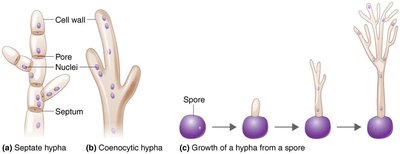
Fungi grow as multicellular filaments called hyphae, which collectively form a mycelium (the fungal body). Hyphae can be:
Septate hyphae: Contain cross-walls (septa) dividing cells
Coenocytic hyphae: Lack septa, forming continuous cytoplasmic masses with many nuclei
Growth: Occurs at the tips of hyphae
Aerial and Vegetative Hyphae
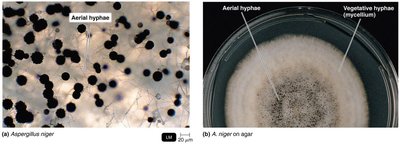
Fungi have specialized hyphae:
Vegetative hyphae: Involved in nutrient absorption
Aerial (reproductive) hyphae: Involved in spore production and dispersal
Yeasts
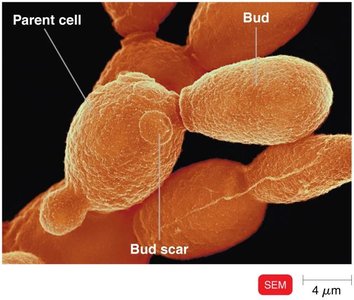
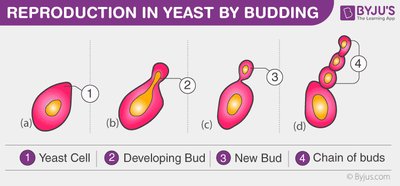
Yeasts are unicellular, non-filamentous fungi. They reproduce by budding (uneven division) or fission (even division). Some yeasts can form chains of cells called pseudohyphae if buds fail to detach.
Budding: Parent cell forms a bud, nucleus divides, one nucleus migrates into the bud, and a new cell wall forms.
Facultative anaerobes: Can grow with or without oxygen (respiration or fermentation).
Dimorphic Fungi
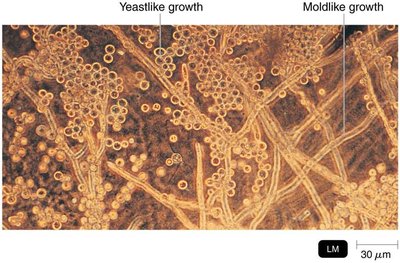
Dimorphic fungi can exist as either yeast (unicellular) or mold (filamentous) forms, often depending on temperature. Many pathogenic fungi are dimorphic.
Yeastlike growth: At 37°C (body temperature)
Moldlike growth: At 25°C (environmental temperature)
Fungal Reproduction and Life Cycle
Asexual and Sexual Reproduction
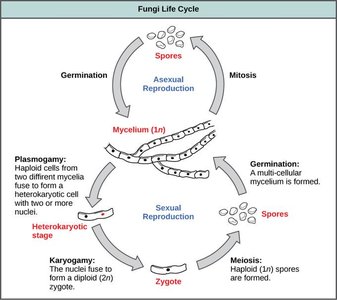
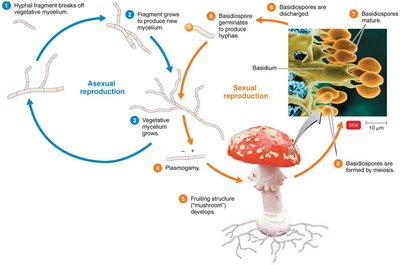
Fungi reproduce by forming spores, either asexually (via mitosis) or sexually (via fusion of nuclei from different mating types).
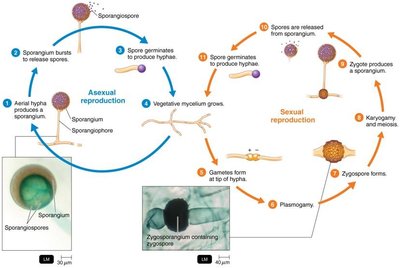
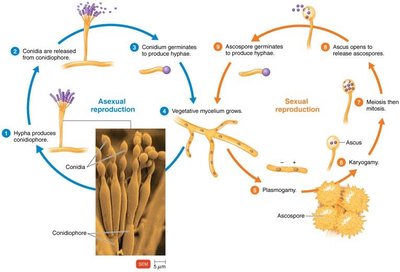
Asexual spores: Conidiospores, arthroconidia, blastoconidia, chlamydoconidia, sporangiospores
Sexual reproduction: Involves three phases—plasmogamy (fusion of cytoplasm), karyogamy (fusion of nuclei), and meiosis (formation of haploid spores)
Classification of Fungi
Major Fungal Phyla
Zygomycota (Conjugation Fungi): Coenocytic hyphae, asexual sporangiospores, sexual zygospores
Ascomycota (Sac Fungi): Septate hyphae, asexual conidiospores, sexual ascospores in saclike ascus
Basidiomycota (Club Fungi): Septate hyphae, asexual conidiospores, sexual basidiospores formed on basidium (mushrooms)
Microsporidia: Obligate intracellular parasites, lack mitochondria, no observed sexual reproduction
Fungal Diseases (Mycoses)
Types of Mycoses
Systemic mycoses: Deep within the body (e.g., soil fungi)
Subcutaneous mycoses: Beneath the skin
Cutaneous mycoses: Affect hair, skin, and nails (dermatophytes)
Superficial mycoses: Localized, e.g., hair shafts
Opportunistic mycoses: Normally harmless fungi become pathogenic in immunocompromised hosts
Lichens
Structure and Function
Lichens are mutualistic associations between a fungus and a green alga or cyanobacterium. They colonize harsh environments and contribute to soil formation.
Thallus: Body composed of medulla (hyphae around algal cells), rhizines (holdfasts), and cortex (protective layer)
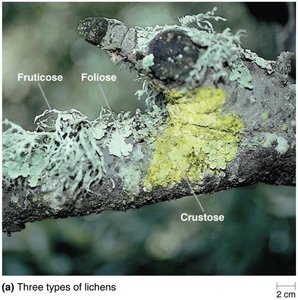
Types: Crustose (encrusted), foliose (leaflike), fruticose (fingerlike)
Roles: Alga produces carbohydrates; fungus provides structure and protection
Algae
General Characteristics
Algae are a diverse group of mostly aquatic, photosynthetic eukaryotes. They are not true plants and lack roots, stems, and leaves.
Cell wall: Usually cellulose
Photosynthetic pigments: Vary by group (chlorophylls, carotenoids, phycobiliproteins)
Reproduction: Asexual and sexual (alternation of generations in some)
Major Groups of Algae
Group | Cell Wall | Pigments | Storage | Pathogenicity |
|---|---|---|---|---|
Brown Algae | Cellulose, alginic acid | Chlorophyll a, c, xanthophylls | Carbohydrate | None |
Diatoms | Pectin, silica | Chlorophyll a, c, carotene, xanthophylls | Oil | Toxins |
Dinoflagellates | Cellulose | Chlorophyll a, c, carotene, xanthins | Starch | Toxins |
Red Algae | Cellulose | Chlorophyll a, d, phycobiliproteins | Glucose polymer | Some toxins |
Green Algae | Cellulose | Chlorophyll a, b | Starch | None |
Protozoa
General Characteristics
Protozoa are unicellular eukaryotes with animal-like nutrition. They inhabit water and soil and often have complex life cycles.
Movement: By pseudopods, flagella, or cilia
Reproduction: Asexual (fission, budding, schizogony) and sexual (conjugation)
Helminths
General Characteristics
Helminths are multicellular parasitic worms, including flatworms (Platyhelminthes) and roundworms (Nematoda). They are specialized for parasitism with reduced digestive, nervous, and locomotor systems, but complex reproductive systems.
Dioecious: Separate male and female individuals
Monoecious (hermaphroditic): Both reproductive organs in one individual
Arthropods as Vectors
Role in Disease Transmission
Arthropods are animals with segmented bodies, exoskeletons, and jointed legs. Some act as vectors, transmitting pathogenic microorganisms to humans.
Mechanical transmission: Pathogen is carried on the body surface
Biological transmission: Pathogen multiplies within the vector and is transmitted via bite
Definitive host: Where the pathogen undergoes sexual reproduction
Vector | Disease |
|---|---|
Dermacentor (tick) | Rocky Mountain spotted fever |
Ixodes (tick) | Lyme disease, babesiosis, ehrlichiosis |
Aedes (mosquito) | Dengue, Zika virus disease, heartworm |
Anopheles (mosquito) | Malaria |
Triatoma (kissing bug) | Chagas disease |
