 Back
BackThe Eukaryotes: Fungi, Algae, Protozoa, and Helminths – Study Notes
Study Guide - Smart Notes
 Tailored notes based on your materials, expanded with key definitions, examples, and context.
Fungi
General Characteristics of Fungi
Fungi are a diverse group of eukaryotic organisms that play essential roles in ecosystems as decomposers, pathogens, and symbionts. The study of fungi is known as mycology. Fungi are chemoheterotrophs, meaning they obtain energy by decomposing organic matter. They can be aerobic or facultative anaerobes.
Cell Type: Eukaryotic
Cell Membrane: Contains sterols
Cell Wall: Composed of glucans, mannans, and chitin (no peptidoglycan)
Reproduction: Sexual and asexual spores
Metabolism: Limited to heterotrophic; aerobic or facultatively anaerobic
Feature | Fungi | Bacteria |
|---|---|---|
Cell Type | Eukaryotic | Prokaryotic |
Cell Membrane | Sterols present | Sterols absent (except Mycoplasma) |
Cell Wall | Glucans, mannans, chitin | Peptidoglycan |
Spores | Sexual and asexual | Endospores (not for reproduction) |
Metabolism | Heterotrophic | Heterotrophic, autotrophic |
Nutritional Adaptations
Grow best at pH 5
Resistant to high sugar and salt concentrations (osmotic pressure)
Can grow in low moisture environments
Capable of metabolizing complex carbohydrates
Vegetative Structures
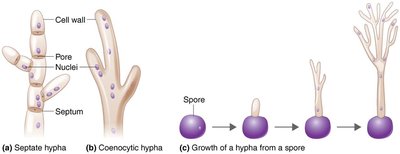
Fungi exist as molds (multicellular) or yeasts (unicellular). The main body of a mold is called a thallus, composed of filaments called hyphae. A mass of hyphae is termed a mycelium. Hyphae can be:
Septate hyphae: Have cross-walls (septa) dividing cells
Coenocytic (aseptate) hyphae: Lack septa, forming a continuous cell with many nuclei
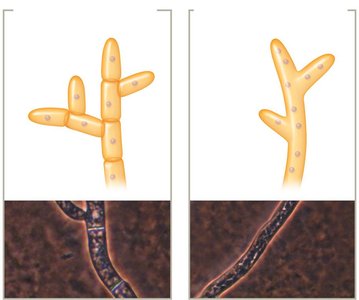
Yeasts are nonfilamentous, unicellular fungi. They reproduce by:
Budding: Uneven division (e.g., Saccharomyces)
Fission: Even division
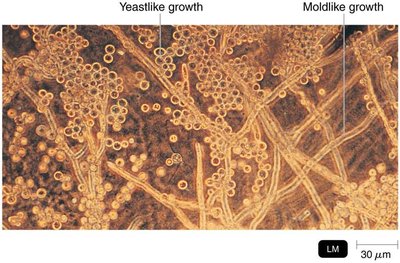
Dimorphic fungi can exist as either yeast-like or mold-like forms, often depending on temperature (yeast-like at 37°C, mold-like at 25°C).
Fungal Reproduction and Spores
Fungi reproduce by forming spores, which are important for classification. Spores can be:
Asexual spores: Produced by mitosis (no genetic variation)
Sexual spores: Produced by meiosis (genetic variation)
Asexual Spores
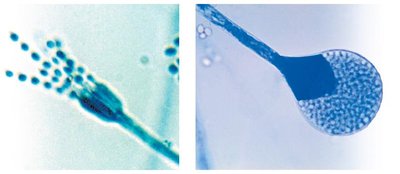
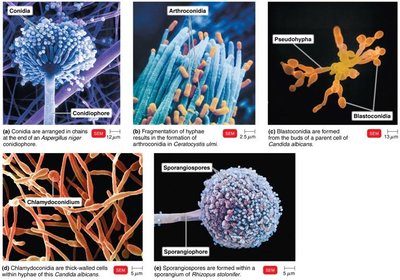
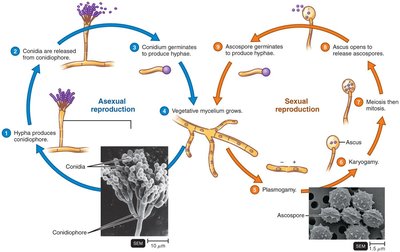
Conidiospores: Not enclosed in a sac (e.g., Penicillium)
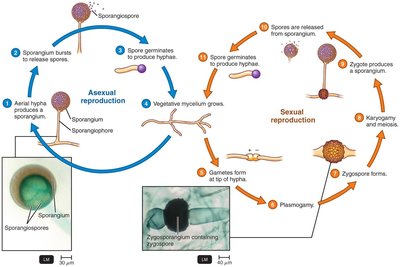
Sporangiospores: Enclosed in a sac (sporangium; e.g., Absidia)
Arthroconidia: Fragmentation of septate hyphae
Blastoconidia: Buds of the parent cell
Chlamydoconidium: Spore within a hyphal segment
Sexual Spores
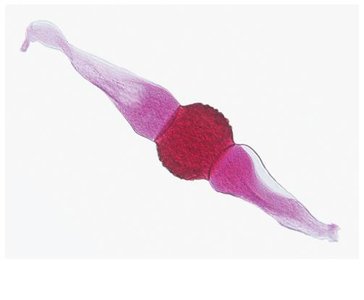
Zygospores: Fusion of similar cells (e.g., Rhizopus)
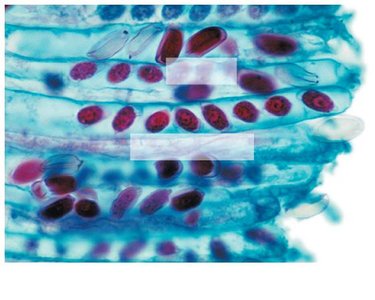
Ascospores: Formed in a sac (ascus; e.g., cup fungi)
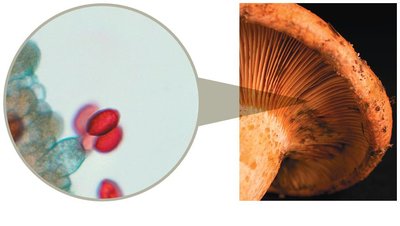
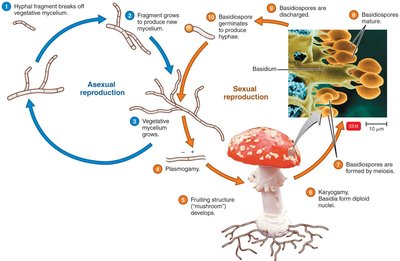
Basidiospores: Formed externally on a pedestal (basidium; e.g., mushrooms)
The sexual reproductive cycle involves three phases:
Plasmogamy: Fusion of cytoplasm from two parent cells
Karyogamy: Fusion of nuclei to form a diploid zygote
Meiosis: Production of haploid sexual spores
Major Fungal Phyla
Mucoromycota (Zygomycota): Conjugation fungi, coenocytic hyphae, produce sporangiospores (asexual) and zygospores (sexual). Example: Rhizopus stolonifer (black bread mold).
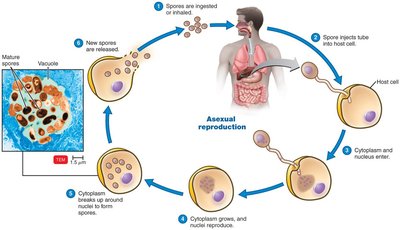
Microsporidia: Obligate intracellular parasites, lack mitochondria, cause diseases like chronic diarrhea and keratoconjunctivitis.
Ascomycota: Sac fungi, septate hyphae, produce conidiospores (asexual) and ascospores (sexual). Includes yeasts, truffles, and morels.
Basidiomycota: Club fungi, septate hyphae, produce conidiospores (asexual) and basidiospores (sexual). Includes mushrooms.
Fungal Diseases (Mycoses)
Mycoses are fungal infections classified by the site of infection:
Systemic mycoses: Deep within the body
Subcutaneous mycoses: Beneath the skin
Cutaneous mycoses (dermatomycoses): Affect hair, skin, and nails (e.g., ringworm)
Superficial mycoses: Localized, e.g., hair shafts
Opportunistic mycoses: Pathogenic in immunocompromised hosts
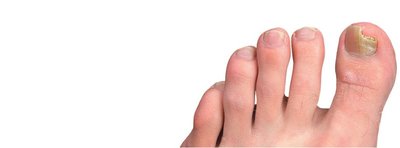
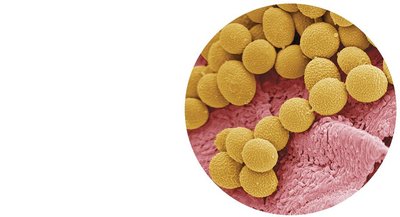
Some fungi produce mycotoxins (e.g., ergot toxin from Claviceps purpurea), which can cause severe health effects.
Economic Importance of Fungi
Aspergillus niger: Production of citric acid
Saccharomyces cerevisiae: Bread, wine, hepatitis B vaccine
Trichoderma: Cellulase production
Taxomyces: Taxol (anticancer drug)
Tolypocladium inflatum: Cyclosporine (immunosuppressant)
Protists
General Characteristics
Protists are a diverse group of eukaryotic organisms that may be unicellular, multicellular, or multinucleated. They can be autotrophs or heterotrophs and reproduce sexually or asexually. Some have cell walls, while others do not.
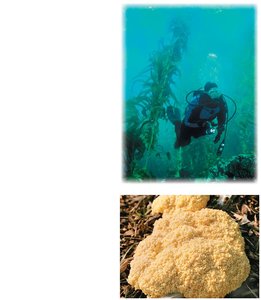
Major groups include:
Algae
Slime molds
Protozoans
Protozoa
Protozoa are unicellular eukaryotes that require a moist environment. They have animal-like nutrition and may be free-living or parasitic. Many have a protective pellicle and specialized feeding structures.
Some are normal microbiota; others are pathogens (e.g., Plasmodium, Toxoplasma gondii, Giardia)
Complex life cycles, often involving multiple hosts
Life Cycle
Trophozoite: Active, feeding, and growing stage
Cyst: Dormant, resistant stage for survival in harsh conditions
Asexual reproduction: Fission, budding, or schizogony
Sexual reproduction: Conjugation
Classification by Motility
Type | Motility | Example |
|---|---|---|
Amoeboid | Pseudopods | Entamoeba histolytica |
Flagellated | Flagella | Giardia lamblia |
Ciliated | Cilia | Tetrahymena thermophila |
Spore-forming | Non-motile | Plasmodium |
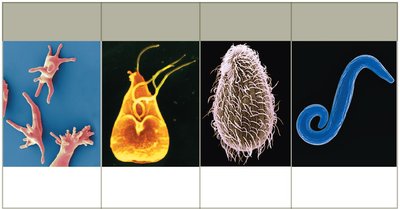
Medically Important Protozoa
Excavata: Flagellated, often lack mitochondria (e.g., Giardia intestinalis, Trichomonas vaginalis, Trypanosoma)
Amoebozoa: Move by pseudopods (e.g., Entamoeba histolytica)
Apicomplexa: Nonmotile, obligate intracellular parasites (e.g., Plasmodium, Toxoplasma gondii)
Ciliates: Move by cilia (e.g., Balantidium coli)
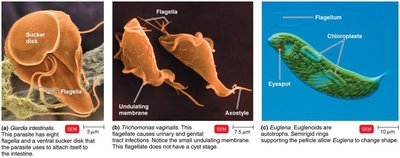
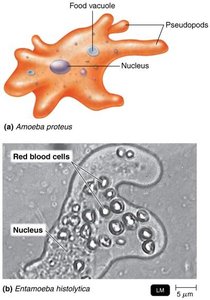
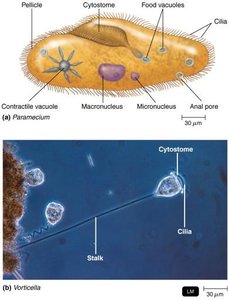
Spore-Forming Protozoans (Apicomplexa)
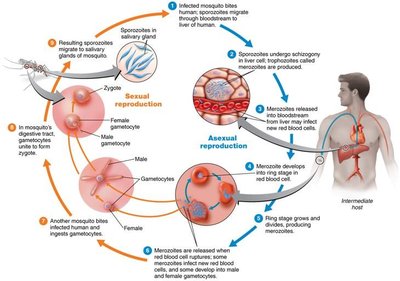
Apicomplexans are the largest phylum of protozoans. They are obligate intracellular parasites with complex life cycles involving both sexual and asexual stages:
Merogony: Asexual reproduction producing merozoites
Gamogony: Sexual reproduction producing gametes
Sporogony: Formation of sporozoites (infective stage)
Notable diseases include malaria (Plasmodium), toxoplasmosis, and cryptosporidiosis.
Helminths (Parasitic Worms)
General Features
Helminths are multicellular, eukaryotic animals, many of which are parasitic. They are classified into two main phyla:
Platyhelminthes: Flatworms (includes trematodes and cestodes)
Nematoda: Roundworms
Helminths have complex life cycles, often involving multiple hosts and larval stages. They may lack digestive systems and have reduced nervous and locomotor systems, but possess complex reproductive systems.
Phylum | Structure | Size Range | Reproduction | Examples |
|---|---|---|---|---|
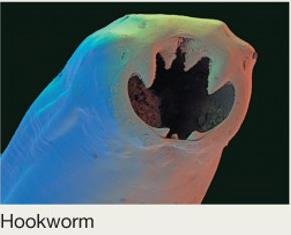
Roundworms (Nematodes) | Non-segmented, cylindrical | Microscopic–1 m | Sexual, two sexes | Hookworm, pinworm |
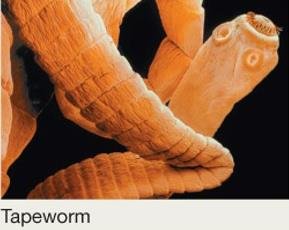
Flatworms (Cestodes) | Segmented, ribbon-like | 1 mm–10 m | Hermaphroditic | Tapeworms |
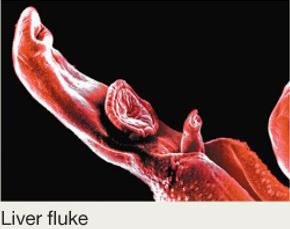
Flatworms (Trematodes) | Non-segmented, leaf-shaped | 1 mm–7 cm | Hermaphroditic (except blood flukes) | Liver fluke, blood fluke |
Platyhelminths (Flatworms)
Trematodes (Flukes)
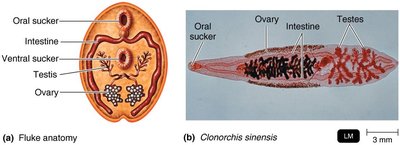
Flat, leaf-shaped
Ventral and oral suckers
Absorb food through cuticle
Examples: Paragonimus (lung fluke), Schistosoma (blood fluke)
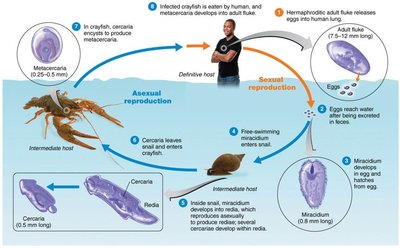
Cestodes (Tapeworms)
Segmented body with scolex (head) and proglottids (body segments)
Absorb nutrients through cuticle
Examples: Taenia solium (pork tapeworm), Echinococcus granulosus
Nematodes (Roundworms)
Cylindrical, complete digestive system
Dioecious (separate sexes)
Examples: Ascaris lumbricoides, Enterobius vermicularis (pinworm), Necator americanus (hookworm)
Arthropods as Vectors
General Features
Arthropods are animals with segmented bodies, exoskeletons, and jointed legs. Many serve as vectors, transmitting pathogens to humans.
Arachnida: Mites and ticks (8 legs)
Crustacea: Crabs, crayfish (4 antennae)
Insecta: Mosquitoes, flies, lice, fleas (6 legs)
Transmission can be mechanical (passive) or biological (pathogen multiplies in vector). The definitive host is where the microbe's sexual reproduction occurs.
Class | Order | Vector | Disease |
|---|---|---|---|
Arachnida | Mites and ticks | Dermacentor, Ixodes | Rocky Mountain spotted fever, Lyme disease |
Insecta | Flies, mosquitoes, lice, fleas | Aedes, Anopheles, Pediculus | Dengue, malaria, typhus |
