 Back
BackThe Microbial World and You: Foundations of Microbiology
Study Guide - Smart Notes
 Tailored notes based on your materials, expanded with key definitions, examples, and context.
The Microbial World and You
Introduction to Microbiology
Microbiology is the study of microorganisms, which are organisms too small to be seen with the unaided eye. This field encompasses a diverse group of life forms, including bacteria, archaea, fungi, protozoa, algae, viruses, and prions. Microorganisms play essential roles in the environment, industry, and human health.
Microbes in Our Lives
Microorganisms are vital for the balance of life on Earth. They are involved in nutrient cycling, decomposition, and the production of oxygen.
While a few microbes are pathogenic (disease-causing), most are beneficial or harmless.
Microbes are used in the production of foods (e.g., cheese, yogurt, bread), beverages (e.g., wine, beer), and industrial products (e.g., ethanol, acetone, vitamins).
They are also crucial in biotechnology and medicine, such as the production of antibiotics and insulin.
The Microbiome
The microbiome refers to the community of microorganisms living in and on the human body. An adult human harbors approximately 40 trillion bacterial cells, which outnumber human body cells.
Normal microbiota: Microbes that are consistently present in a healthy human.
Transient microbiota: Microbes that colonize the body for a short period.
Microbiota help maintain health by preventing the growth of pathogens and training the immune system.
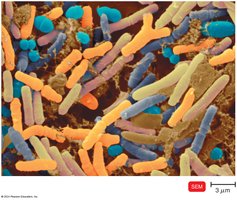
Image: Scanning electron micrograph of normal intestinal bacteria, illustrating the diversity and abundance of microbes in the human gut.
Major Microbial Groups and Their Characteristics
Bacteria: Prokaryotic, unicellular, peptidoglycan cell walls, reproduce by binary fission, diverse metabolism.
Archaea: Prokaryotic, lack peptidoglycan, often inhabit extreme environments, not known to cause disease.
Fungi: Eukaryotic, chitin cell walls, absorb nutrients, include unicellular yeasts and multicellular molds/mushrooms.
Protozoa: Eukaryotic, absorb/ingest organic chemicals, motile by pseudopods, cilia, or flagella, some are parasitic.
Algae: Eukaryotic, cellulose cell walls, photosynthetic, produce oxygen and carbohydrates.
Viruses: Acellular, DNA or RNA core, protein coat, replicate only in living hosts.
Multicellular Animal Parasites: Eukaryotic, include helminths (parasitic worms), some stages are microscopic.
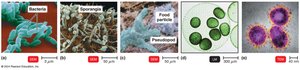
Image: Representative images of bacteria, fungi, protozoa, algae, and viruses, highlighting their diversity and morphology.
Naming and Classifying Microorganisms
Scientific nomenclature uses two names: genus (capitalized) and specific epithet (lowercase), both italicized or underlined (e.g., Escherichia coli).
Classification is based on cellular organization: Bacteria, Archaea, and Eukarya (which includes protists, fungi, plants, and animals).
A Brief History of Microbiology
Early Observations and Cell Theory
1665: Robert Hooke observed "cells" in cork, marking the beginning of cell theory.
1673–1723: Anton van Leeuwenhoek observed "animalcules" (bacteria and protozoa) with simple microscopes.

Image: Replica of van Leeuwenhoek's microscope, illustrating the simplicity and ingenuity of early microscopy.
Spontaneous Generation vs. Biogenesis
Spontaneous generation: Hypothesis that life arises from nonliving matter.
Biogenesis: Hypothesis that living cells arise only from preexisting cells (Rudolf Virchow, 1858).
Louis Pasteur disproved spontaneous generation using S-shaped flasks, showing that microbes come from the air, not mystical forces.
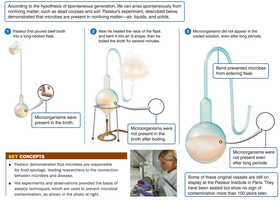
Image: Diagram of Pasteur's experiment using S-shaped flasks to demonstrate that microorganisms originate from the air.
The Golden Ages of Microbiology
First Golden Age (1857–1914): Discoveries included the relationship between microbes and disease, immunity, fermentation, pasteurization, and aseptic techniques.
Second Golden Age: Focused on chemotherapy, antibiotics, and the development of synthetic drugs.
Third Golden Age: Emphasizes genomics, molecular biology, and biotechnology.
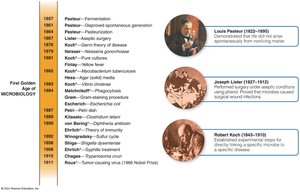
Image: Timeline of major discoveries during the First Golden Age of Microbiology, highlighting key figures and breakthroughs.

Image: Timeline of the Second and Third Golden Ages, showing advances in antibiotics, genomics, and molecular biology.
Key Disciplines in Microbiology
Bacteriology: Study of bacteria.
Mycology: Study of fungi.
Parasitology: Study of protozoa and parasitic worms.
Immunology: Study of immunity; includes vaccines and interferons.
Virology: Study of viruses.
Molecular genetics: Study of microbial inheritance and gene function.
Genomics: Study of an organism’s genes and their functions.
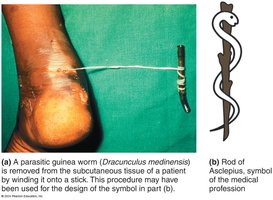
Image: Removal of a parasitic guinea worm and the Rod of Asclepius, symbolizing the medical profession.
Microbes and Human Welfare
Beneficial Activities of Microorganisms
Recycling vital elements: Microbes convert elements like carbon, nitrogen, and sulfur into forms usable by plants and animals.
Sewage treatment: Microbes break down organic matter in sewage, recycling water and producing useful by-products.
Bioremediation: Use of microbes to degrade or detoxify pollutants (e.g., oil spills, mercury).
Insect pest control: Microbes such as Bacillus thuringiensis are used as biological pesticides.

Image: Industrial composting process, demonstrating the role of microbes in recycling municipal waste.
Biotechnology and Recombinant DNA Technology
Biotechnology: Use of microbes for practical applications (e.g., food production, chemical synthesis).
Recombinant DNA technology: Genetic engineering to produce proteins, vaccines, and enzymes; includes gene therapy and genetically modified organisms.
Microbes and Human Disease
Normal Microbiota and Resistance
Normal microbiota prevent pathogen growth and produce essential vitamins (e.g., B, K).
Resistance: The body's ability to ward off disease, involving barriers like skin, stomach acid, and immune chemicals.
Biofilms
Microbes can form biofilms—complex communities attached to surfaces (e.g., teeth, medical implants).
Biofilms can be beneficial (protective, food sources) or harmful (cause infections, resist antibiotics).
Emerging Infectious Diseases (EIDs)
Emerging infectious diseases are new or increasing in incidence, often due to microbial evolution, resistance, or changes in human behavior and environment.
Examples include COVID-19, Mpox, Zika virus, H1N1 influenza, avian influenza, antibiotic-resistant infections (e.g., MRSA), Ebola, and Marburg virus.
Table: Examples of Emerging Infectious Diseases
Disease | Pathogen | Transmission | Notes |
|---|---|---|---|
COVID-19 | SARS-CoV-2 (virus) | Respiratory droplets | Pandemic declared in 2020 |
Mpox | Orthopoxvirus | Direct contact | Outbreaks outside Africa since 2022 |
Zika | Zika virus | Mosquito, sexual | Birth defects if contracted during pregnancy |
H1N1 Influenza | Influenza virus | Respiratory | Pandemic in 2009 |
MRSA | Staphylococcus aureus | Contact | Antibiotic resistance |
Ebola | Ebolavirus | Body fluids | High mortality, outbreaks in Africa |
Marburg | Marburg virus | Body fluids | Fruit bats as reservoir |
Additional info: The study of microbiology is foundational for understanding infectious diseases, biotechnology, and the ecological roles of microbes. Advances in genomics and molecular biology continue to expand our knowledge and applications of microorganisms.
