 Back
BackThe Microbial World and You: Introduction to Microbiology
Study Guide - Smart Notes
 Tailored notes based on your materials, expanded with key definitions, examples, and context.
The Microbial World and You
Introduction to Microorganisms
Microorganisms, or microbes, are organisms too small to be seen with the unaided eye. They play essential roles in the environment, industry, and health. The study of these organisms is called microbiology.
Types of Microbes: Bacteria, fungi, protozoa, microscopic algae, viruses, and prions.
Importance: Some are pathogenic, but most are beneficial or harmless.
Roles of Microbes in the Environment and Industry
Microbes are vital to many natural and industrial processes.
Pathogenicity: A minority cause disease in humans, animals, or plants.
Food Spoilage: Some microbes spoil food, but others are used to produce fermented foods (e.g., cheese, yogurt, bread, alcoholic beverages).
Ecological Roles:
Form the base of aquatic food chains.
Decompose organic waste, recycling nutrients.
Fix nitrogen from the atmosphere into usable forms for plants.
Generate oxygen via photosynthesis (e.g., algae, cyanobacteria).
Industrial and Medical Applications:
Produce chemicals (ethanol, acetone, vitamins).
Manufacture products (cellulose, insulin).
Microbial Recycling and Environmental Applications
Microbes are essential for recycling vital elements and cleaning up pollutants.
Microbial Ecology: Study of interactions between microbes and their environment.
Nutrient Cycling: Bacteria convert carbon, oxygen, nitrogen, sulfur, and phosphorus into forms usable by plants and animals.
Sewage Treatment: Microbes break down organic material in sewage, producing by-products like carbon dioxide, nitrates, and methane.
Bioremediation: Use of microbes to degrade or detoxify pollutants (e.g., oil spills, mercury contamination).
Microbes in Agriculture and Biotechnology
Microorganisms are used in pest control, genetic engineering, and biotechnology.
Insect Pest Control: Microbes such as Bacillus thuringiensis produce toxins fatal to insects but harmless to other organisms. The toxin gene can be inserted into plants for pest resistance.
Biotechnology: Use of microbes to produce foods, chemicals, and pharmaceuticals.
Recombinant DNA Technology: Genetic engineering allows microbes to produce proteins, vaccines, and enzymes; gene therapy can replace defective genes in humans.
Historical Foundations of Microbiology
Early Observations and Cell Theory
The development of microscopy led to the discovery of microorganisms and the formulation of cell theory.
1665: Robert Hooke observed "cells" in cork, marking the beginning of cell theory: all living things are composed of cells.
1673–1723: Anton van Leeuwenhoek observed and described "animalcules" (bacteria and protozoa) using simple microscopes.
The Debate over Spontaneous Generation
Scientists debated whether life could arise spontaneously from nonliving matter.
Spontaneous Generation: Hypothesis that life arises from nonliving matter via a "vital force."
Biogenesis: Hypothesis that living cells arise only from preexisting living cells.
Key Experiments:
1668: Francesco Redi's experiments with decaying meat challenged spontaneous generation.
1745: John Needham's boiled broth experiments seemed to support spontaneous generation.
1765: Lazzaro Spallanzani improved on Needham's work, supporting biogenesis.
Disproving Spontaneous Generation: Pasteur's Experiments
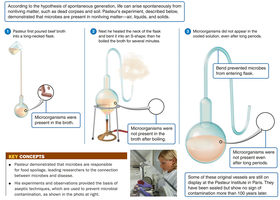
Louis Pasteur's experiments provided strong evidence for biogenesis by showing that microorganisms come from the environment, not from mystical forces.
Used S-shaped (swan-necked) flasks to keep broth sterile while allowing air in.
Microbes were trapped in the neck, preventing contamination of the broth.
Demonstrated that life does not arise spontaneously in sterilized, sealed environments.
The Germ Theory of Disease
Development of the Germ Theory
The germ theory states that specific microorganisms cause specific diseases. This concept revolutionized medicine and hygiene.
1835: Agostino Bassi showed a fungus caused silkworm disease.
1865: Pasteur identified a protozoan as the cause of another silkworm disease.
1840s: Ignaz Semmelweis advocated handwashing to prevent puerperal fever.
1860s: Joseph Lister used phenol as an antiseptic in surgery, reducing infections.
1876: Robert Koch proved that a specific bacterium causes anthrax, formulating Koch's postulates for linking microbes to diseases.
Vaccination and Antibiotics
Microbiology has led to the development of vaccines and antibiotics, transforming public health.
1796: Edward Jenner developed the first vaccine (cowpox for smallpox).
1928: Alexander Fleming discovered penicillin, the first antibiotic.
1940s: Penicillin was mass-produced, saving countless lives.
Naming and Classifying Microorganisms
Scientific Nomenclature
Microorganisms are named using a standardized system developed by Carolus Linnaeus.
Binomial Nomenclature: Each organism has a two-part name: Genus species.
Formatting: Names are italicized or underlined; genus is capitalized, species is lowercase.
Examples:
Escherichia coli: Honors Theodor Escherich; found in the colon.
Staphylococcus aureus: Describes clustered, spherical, gold-colored cells.
Classification of Microorganisms
Microorganisms are classified into three domains based on cellular organization, as proposed by Carl Woese in 1978.
Bacteria: Prokaryotic, peptidoglycan cell walls.
Archaea: Prokaryotic, lack peptidoglycan, often extremophiles.
Eukarya: Eukaryotic; includes protists, fungi, plants, and animals.
Types of Microorganisms
Bacteria
Prokaryotic, unicellular organisms.
Cell walls contain peptidoglycan.
Reproduce by binary fission.
Obtain energy from organic/inorganic chemicals or photosynthesis.
May be motile via flagella.
Archaea
Prokaryotic, often extremophiles (e.g., methanogens, halophiles, thermophiles).
Lack peptidoglycan in cell walls; some lack cell walls entirely.
Not known to cause human disease.
Fungi
Eukaryotic, with chitin cell walls.
Absorb organic chemicals for energy.
Yeasts are unicellular; molds and mushrooms are multicellular.
Molds consist of mycelia made of hyphae.
Protozoa
Eukaryotic, unicellular.
Absorb or ingest organic chemicals; some are photosynthetic.
Motile via pseudopods, cilia, or flagella.
Reproduce sexually or asexually.
Algae
Eukaryotic, mostly aquatic.
Photosynthetic; produce oxygen and carbohydrates.
Cell walls contain cellulose.
Viruses
Acellular; consist of DNA or RNA core surrounded by a protein coat (sometimes with a lipid envelope).
Replicate only inside living host cells; inert outside hosts.
Multicellular Animal Parasites
Eukaryotic, multicellular animals (e.g., helminths: flatworms and roundworms).
Not strictly microorganisms, but have microscopic life stages.
Summary Table: Major Groups of Microorganisms
Group | Cell Type | Cell Wall | Reproduction | Nutrition | Examples |
|---|---|---|---|---|---|
Bacteria | Prokaryotic | Peptidoglycan | Binary fission | Organic/inorganic/phototrophic | Escherichia coli |
Archaea | Prokaryotic | None or pseudopeptidoglycan | Binary fission | Varied (often extremophiles) | Methanogens |
Fungi | Eukaryotic | Chitin | Spores, budding | Absorptive | Yeasts, molds |
Protozoa | Eukaryotic | None | Sexual/asexual | Ingestive/absorptive | Amoeba, Paramecium |
Algae | Eukaryotic | Cellulose | Sexual/asexual | Photosynthetic | Green algae |
Viruses | Acellular | None | Host-dependent | Host-dependent | Influenza virus |
Helminths | Eukaryotic | None | Sexual | Parasitic | Tapeworms, roundworms |
