 Back
The Prokaryotes: Domains Bacteria and Archaea – Classification, Structure, and Diversity
Study Guide - Smart Notes
 Tailored notes based on your materials, expanded with key definitions, examples, and context.
Chapter 11: The Prokaryotes – Domains Bacteria and Archaea
Overview of Prokaryotic Diversity
This chapter explores the classification, structure, and ecological roles of prokaryotes, focusing on the domains Bacteria and Archaea. Prokaryotes are the most ancient and diverse forms of life, occupying nearly every environment on Earth. Their classification is based on genetic, biochemical, and morphological characteristics.
Bacteria: Includes both Gram-negative and Gram-positive phyla, with a wide range of metabolic capabilities.
Archaea: Distinguished by unique cell wall structures and adaptation to extreme environments.
Classification of Selected Prokaryotes
Major Bacterial Phyla and Classes
Bacteria are classified into several phyla, each with unique characteristics. The following table summarizes key groups and their notable features:
Phylum | Selected Classes | Key Features |
|---|---|---|
Pseudomonadota (Proteobacteria) | Alpha-, Beta-, Gamma-, Delta-proteobacteria | Gram-negative, chemoheterotrophic, largest group |
Campylobacterota | Campylobacterales | Helical/curved rods, microaerophilic |
Cyanobacteria | Cyanobacteria | Oxygenic photosynthesis |
Chlorobiota | Chlorobia | Anoxygenic, green sulfur bacteria |
Bacillota (Firmicutes) | Bacilli, Clostridia | Low G+C Gram-positive rods/cocci |
Actinomycetota | Actinobacteria | High G+C Gram-positive bacteria |
Chlamydiota | Chlamydiae | Obligate intracellular, no peptidoglycan |
Spirochaetota | Spirochaetia | Axial filaments, corkscrew motility |
Gram-Negative Bacteria
Pseudomonadota (Proteobacteria)
The largest and most diverse group of Gram-negative bacteria, divided into five classes based on genetic and metabolic differences.
Alphaproteobacteria: Adapted to low-nutrient environments; many have stalks or buds (prosthecae).
Betaproteobacteria: Includes important environmental and pathogenic genera.
Gammaproteobacteria: Contains many medically and ecologically significant bacteria.
Deltaproteobacteria: Includes bacteria with unique predatory or sulfur-reducing lifestyles.
Campylobacterota: Helical or curved rods, often microaerophilic.
Key Genera and Their Roles
Pelagibacter: Abundant in oceans, important in the carbon cycle.
Azospirillum: Nitrogen-fixing, associates with plant roots.
Acetobacteraceae: Convert ethanol to acetic acid.
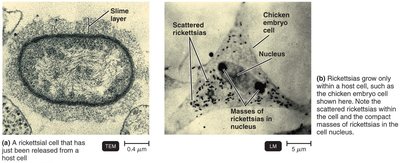
Rickettsia: Obligate intracellular parasites, cause spotted fevers, transmitted by arthropods.
Rhizobium & Bradyrhizobium: Nitrogen-fixing symbionts of legumes.
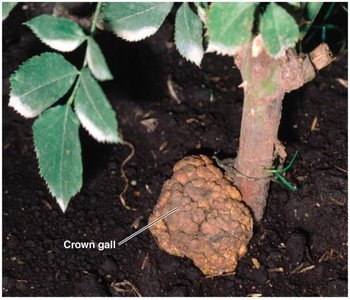
Agrobacterium: Plant pathogen causing crown gall disease by inserting DNA into plant cells.
Nitrosomonas & Nitrobacter: Chemoautotrophs involved in nitrification:
(Nitrosomonas)
(Nitrobacter)
Betaproteobacteria
Spirillum: Motile freshwater bacteria with polar flagella.
Sphaerotilus: Forms protective sheaths in aquatic environments.
Burkholderia: Degrades diverse organic molecules; some species are pathogenic.
Bordetella: Nonmotile rods; B. pertussis causes whooping cough.
Neisseria: Pathogenic cocci; N. gonorrhoeae (gonorrhea), N. meningitidis (meningitis).
Gammaproteobacteria
Acidithiobacillus: Oxidizes sulfur compounds for energy.
Beggiatoa: Oxidizes hydrogen sulfide in aquatic sediments.
Francisella tularensis: Causes tularemia.
Pseudomonas: Metabolically diverse, opportunistic pathogens, common in soil and water.
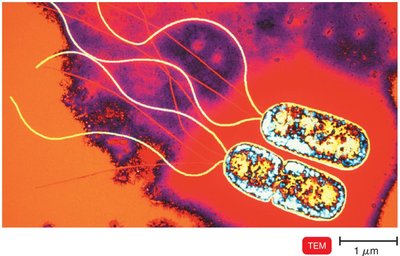
Legionella: Found in water systems, causes legionellosis.
Coxiella burnetii: Causes Q fever, transmitted by aerosols or contaminated milk.
Vibrio: Aquatic, curved rods; V. cholerae causes cholera, V. parahaemolyticus causes gastroenteritis.
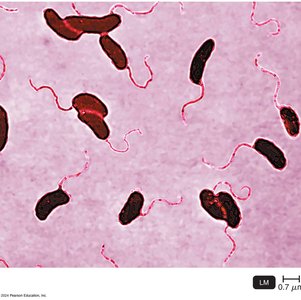
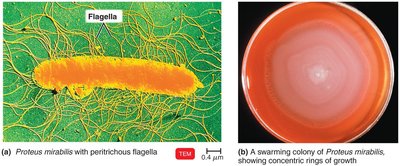
Enterobacteriales (Enterics): Facultative anaerobes, ferment carbohydrates, peritrichous flagella.
Escherichia coli: Indicator of fecal contamination, some strains pathogenic.
Salmonella: Many serovars, causes foodborne illness and typhoid fever.
Shigella: Causes bacillary dysentery.
Klebsiella: K. pneumoniae causes pneumonia.
Serratia: Red pigment producer, nosocomial infections.
Proteus: Swarming motility, forms concentric rings on agar.
Yersinia pestis: Causes plague, transmitted by fleas.
Erwinia: Plant pathogens.
Campylobacterota
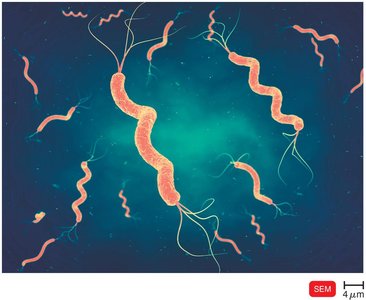
Campylobacter: Microaerophilic, single polar flagellum, causes foodborne intestinal disease.
Helicobacter: Multiple flagella, causes peptic ulcers and stomach cancer.
Photosynthesizing Bacteria
Types and Characteristics
Common Name | Example | Phylum | Electron Donor | Oxygenic/Anoxygenic |
|---|---|---|---|---|
Cyanobacteria | Anabaena | Cyanobacteria | H2O | Oxygenic |
Green nonsulfur bacteria | Chloroflexus | Chloroflexi | Organic compounds | Anoxygenic |
Green sulfur bacteria | Chlorobium | Chlorobi | H2S | Anoxygenic |
Purple nonsulfur bacteria | Rhodospirillum | Proteobacteria | Organic compounds | Anoxygenic |
Purple sulfur bacteria | Chromatium | Proteobacteria | H2S | Anoxygenic |
Other Gram-Negative Bacteria
Chlamydiae
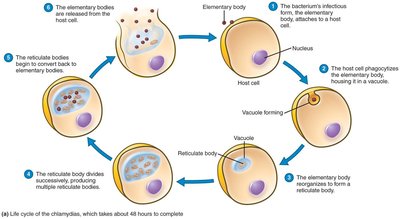
No peptidoglycan in cell wall; obligate intracellular pathogens.
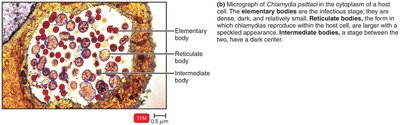
Form elementary bodies (infective) and reticulate bodies (reproductive).
Chlamydia trachomatis: Causes trachoma and urethritis.
Chlamydophila psittaci: Causes psittacosis (respiratory disease).
Chlamydophila pneumoniae: Causes mild pneumonia in young adults.
Bacteroidota and Fusobacteria
Bacteroides: Anaerobic, abundant in the human gut and mouth.
Cytophaga: Degrades cellulose and chitin in soil.
Fusobacteria: Anaerobic, found in the mouth, cause dental abscesses.
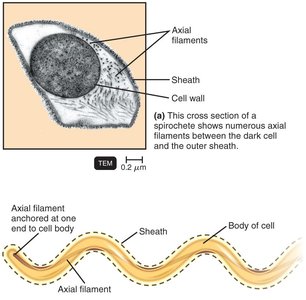
Spirochaetes
Coiled bacteria with axial filaments for corkscrew motility.
Treponema pallidum: Causes syphilis.
Borrelia: Causes relapsing fever and Lyme disease.
Leptospira: Excreted in animal urine, can infect humans.
Gram-Positive Bacteria
Classification by G+C Content
High G+C: Streptomyces, Mycobacterium
Low G+C: Streptococcus, Clostridium
Bacillota (Low G+C Gram-Positive Bacteria)
Bacillus: Endospore-forming rods; includes B. anthracis (anthrax), B. thuringiensis (insect pathogen), B. cereus (food poisoning).
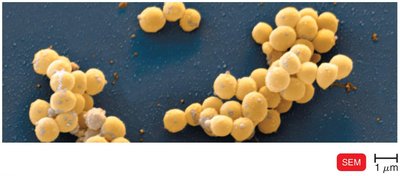
Staphylococcus: Grape-like clusters of cocci; S. aureus causes wound infections, is often antibiotic-resistant, and produces enterotoxins.
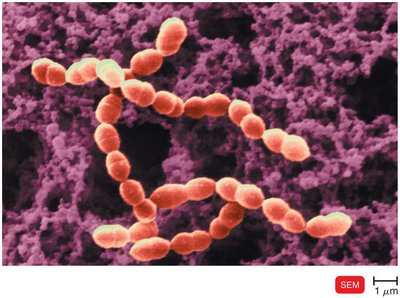
Streptococcus: Chains of cocci; includes important human pathogens.
Domain Archaea
Diversity and Adaptations
Lack peptidoglycan in cell walls.
Many are extremophiles:
Halophiles: Require high salt concentrations (>25%).
Thermophiles: Grow at temperatures >80°C.
Acidophiles: Grow at very low pH (approaching 0).
Methanogens: Anaerobic, produce methane, some are part of human microbiota.
Microbial Diversity and Detection
Limits of Microbial Knowledge
Many microbes cannot be cultured in the laboratory.
Detection of unculturable bacteria relies on molecular techniques such as PCR and DNA sequencing.
Example: Environmental DNA sampling can reveal the presence of bacteria that have never been grown in the lab.
