 Back
BackThe Ubiquity of Microorganisms: Experimental Investigation Using Agar Plates
Study Guide - Smart Notes
 Tailored notes based on your materials, expanded with key definitions, examples, and context.
The Microbial World and You
Ubiquity of Prokaryotes
Prokaryotes, including bacteria and archaea, are found everywhere on Earth, from extreme environments such as hot springs and Antarctic ice to deep ocean trenches. They are also abundant on and within the human body, with estimates suggesting that bacterial cells may outnumber human cells or be present in roughly equal numbers. Large colonies of bacteria are commonly found on healthy human skin, especially in moist areas like the armpits, navel, and behind the ears.
Definition: Ubiquity refers to the presence of microorganisms in virtually all environments.
Human Microbiome: The collection of microorganisms living on and inside the human body.
Example: Bacteria on skin, in the gut, and in other body sites.
Observing Microorganisms Through a Microscope
Experimental Materials and Methods
To investigate the presence of microorganisms in various environments, students use agar plates and sterile tools to collect samples from everyday surfaces and body sites. The experiment demonstrates the widespread distribution of microbes.
Tryptic Soy Agar (TSA): A general-purpose medium for growing a wide variety of bacteria.
Blood Agar: A nutrient-rich medium used to detect hemolytic activity and grow fastidious organisms.
Sampling Tools: Sterile swabs, toothpicks, and saline are used to collect and transfer samples.
Procedure: Samples are collected from cell phones, skin, nails, and other surfaces, then streaked onto agar plates for incubation.
Sampling Procedures
Samples are collected from various sources to demonstrate microbial ubiquity. Each sample is streaked onto a section of an agar plate to observe microbial growth after incubation.
Cell Phone Sampling: Swabbing the surface of a cell phone to collect microbes.
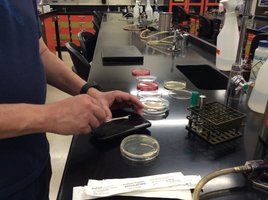
Sole of Shoe Sampling: Swabbing the sole of a shoe to collect environmental microbes.
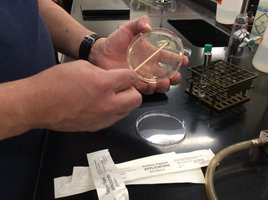
Behind the Ear Sampling: Swabbing behind the ear, a moist area with abundant skin bacteria.
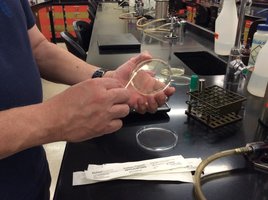
Under the Nails Sampling: Using a toothpick to collect microbes from under the fingernails.
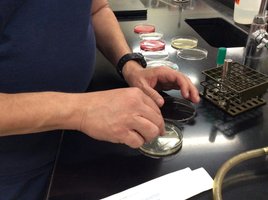
Microbial Growth
Results: Growth on Agar Plates
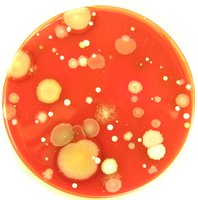
After incubation, agar plates show visible colonies of microorganisms, confirming their presence on sampled surfaces. Blood agar plates may display a variety of colony morphologies and colors, indicating different microbial species and possible hemolytic activity.
Colony Morphology: Colonies may differ in size, shape, color, and texture, reflecting microbial diversity.
Growth Patterns: The number and appearance of colonies provide information about microbial abundance and types.
Example: Blood agar plate with diverse colonies from air exposure.
Comparison of TSA and Blood Agar
TSA supports the growth of a wide range of bacteria, while blood agar is used to detect hemolytic activity and grow more fastidious organisms. The experiment allows students to compare microbial growth on different media.
Medium | Purpose | Microbial Growth |
|---|---|---|
Tryptic Soy Agar (TSA) | General-purpose, supports many bacteria | Wide variety of colonies |
Blood Agar | Detects hemolysis, supports fastidious bacteria | Diverse colonies, possible hemolytic zones |
Functional Anatomy of Prokaryotic Cells
Microbial Colonies and Cell Structure
Microbial colonies observed on agar plates are composed of millions of individual prokaryotic cells. These cells reproduce rapidly and form visible masses.
Prokaryotic Cell Structure: Lacks a nucleus, contains a cell wall, plasma membrane, and ribosomes.
Colony Formation: Each colony originates from a single cell or group of cells.
Summary Table: Sampling Sites and Microbial Growth
Sampling Site | Expected Microbial Abundance | Example Microbes |
|---|---|---|
Cell Phone | High | Staphylococcus, Micrococcus |
Sole of Shoe | High | Bacillus, environmental bacteria |
Behind Ear | Moderate | Staphylococcus epidermidis |
Under Nails | High | Staphylococcus, soil bacteria |
Additional info: The experiment reinforces the concept that microorganisms are present in all environments and on common surfaces, highlighting the importance of aseptic technique and microbial awareness in daily life and laboratory practice.
