 Back
BackTranscription and Gene Structure in Bacteria: Mechanisms and Regulation
Study Guide - Smart Notes
 Tailored notes based on your materials, expanded with key definitions, examples, and context.
Transcription and Gene Structure
Overview of Transcription
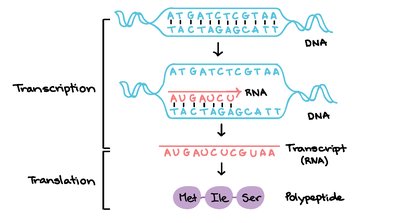
Transcription is the process by which RNA is synthesized from a DNA template. In bacteria, this process is tightly regulated to ensure that genes are expressed at the right time and in the correct amounts. The enzyme responsible for transcription is RNA polymerase (RNAP), which interacts with specific DNA sequences to initiate, elongate, and terminate RNA synthesis.
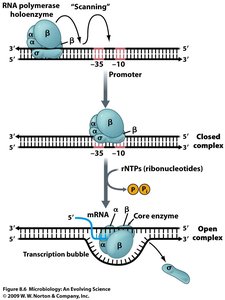
Initiation: RNAP binds to the promoter region of DNA, guided by sigma factors.
Elongation: RNAP synthesizes RNA by matching ribonucleotides (rNTPs) to the DNA template strand.
Termination: RNAP stops transcription at specific terminator sequences.
Gene Structure in Bacteria
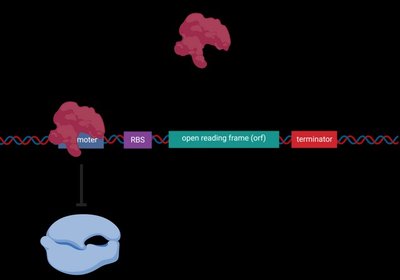
Bacterial genes are organized into distinct regions that control transcription and translation. Understanding these regions is essential for grasping how gene expression is regulated.
Promoter: DNA sequence upstream of a gene where RNAP binds to initiate transcription. The promoter sequence determines when and how often a gene is transcribed.
Operator: DNA sequence recognized by regulatory proteins (repressors or activators) that modulate gene expression.
Open Reading Frame (ORF): The protein-coding region of the gene, which is translated by the ribosome.
Terminator: Sequence signaling RNAP to stop transcription and release the RNA transcript.
Transcription and Translation Coupling
In bacteria, transcription and translation are often coupled, meaning that ribosomes can begin translating the mRNA while it is still being synthesized. This allows for rapid gene expression in response to environmental changes.
RNA Polymerase and Sigma Factors
Structure and Function of RNA Polymerase
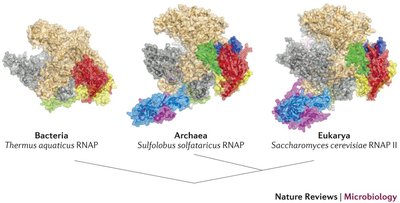
Bacterial RNA polymerase is a multi-subunit enzyme responsible for synthesizing RNA from a DNA template. It does not require a primer and uses rNTPs as substrates. The core enzyme is composed of five subunits, but for initiation, it associates with a sigma factor to form the holoenzyme.
Core Enzyme: Responsible for RNA synthesis.
Holoenzyme: Core enzyme plus sigma factor, which recognizes promoter sequences.
Sigma Factors
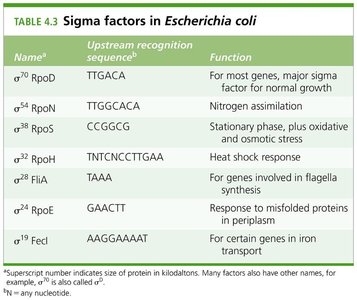
Sigma factors are specialized proteins that direct RNAP to specific promoter sequences. Different sigma factors recognize different sets of genes, allowing bacteria to rapidly alter gene expression in response to environmental changes.
σ70 (RpoD): Major sigma factor for normal growth.
σ54 (RpoN): Involved in nitrogen assimilation.
σ38 (RpoS): Controls genes for stationary phase and stress responses.
σ32 (RpoH): Heat shock response.
σ28 (FliA): Flagella synthesis.
σ24 (RpoE): Response to misfolded proteins in the periplasm.
σ19 (FecI): Iron transport genes.
Name | Upstream Recognition Sequence | Function |
|---|---|---|
σ70 RpoD | TTGACA | Major sigma factor for normal growth |
σ54 RpoN | TTGGCACA | Nitrogen assimilation |
σ38 RpoS | CCGGCGG | Stationary phase, stress response |
σ32 RpoH | TNTCNCCTTGAA | Heat shock response |
σ28 FliA | TAAA | Flagella synthesis |
σ24 RpoE | GAACCTT | Misfolded proteins in periplasm |
σ19 FecI | AAGGAAAAT | Iron transport genes |
Types of RNA and Their Stability
Classes of RNA
Transcription produces several types of RNA, each with distinct functions and stabilities:
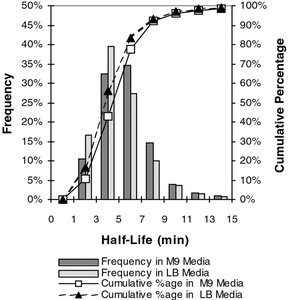
mRNA (messenger RNA): Encodes proteins; short-lived (minutes).
rRNA (ribosomal RNA): Structural and catalytic component of ribosomes; stable (hours to days).
tRNA (transfer RNA): Brings amino acids to the ribosome during translation; stable.
Other small RNAs: Regulatory roles in gene expression.
RNA Stability
mRNA stability varies depending on growth conditions and is regulated by ribonucleases (RNases). Stable RNAs such as rRNA and tRNA are much more abundant and long-lived than mRNAs.
RNA Processing in Bacteria
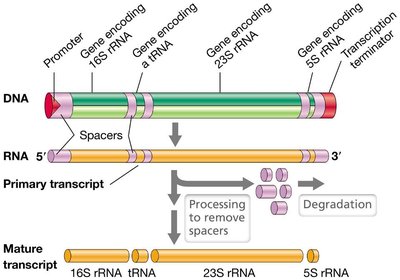
Unlike eukaryotes, bacterial and archaeal mRNAs are not capped, polyadenylated, or spliced. RNases process and degrade RNA, playing roles in RNA maturation and recycling.
RNA Secondary Structure and Transcription Termination
RNA Secondary Structure
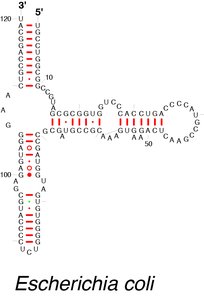
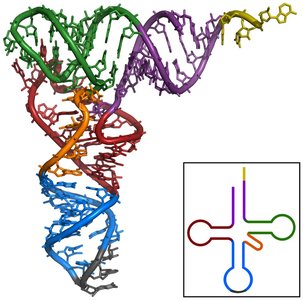
RNA molecules can form complex secondary structures through intramolecular base pairing. These structures are critical for RNA function and can influence transcription termination.
Primary Structure (1°): Linear sequence of nucleotides.
Secondary Structure (2°): Hydrogen-bonded regions such as stem-loops, hairpins, and bulges.
Mechanisms of Transcription Termination
Transcription termination in bacteria occurs via two main mechanisms:
Rho-independent (Intrinsic) Termination: Relies on the formation of a GC-rich stem-loop structure in the RNA followed by a stretch of U residues. The stem-loop causes RNAP to stall, and the weak A-U hybrid destabilizes the complex, leading to release of the RNA.
Rho-dependent Termination: Requires the Rho protein, a helicase that binds to C-rich regions of the RNA and moves toward the stalled RNAP, disrupting the RNA:DNA hybrid and releasing the transcript.
Summary
Bacterial RNA polymerase scans DNA for promoter sequences, guided by sigma factors.
Transcription produces mRNA, rRNA, and tRNA; stable RNAs are more abundant and longer-lived than mRNAs.
Termination occurs via Rho-dependent and Rho-independent mechanisms, often involving RNA secondary structures.
