 Back
BackUnderstanding Growth Patterns on Slant Media in Microbiology
Study Guide - Smart Notes
 Tailored notes based on your materials, expanded with key definitions, examples, and context.
Q21. Be prepared to identify growth patterns in slant media.
Background
Topic: Bacterial Growth Patterns on Slant Media
This question tests your ability to recognize and interpret different types of bacterial growth patterns on agar slants, which is a common method for culturing and maintaining bacterial isolates in the microbiology lab.
Key Terms and Concepts:
Agar slant: A tube of solidified agar medium that is set at an angle, providing a larger surface area for microbial growth.
Growth pattern: The visible appearance and distribution of microbial colonies on the surface of the slant, which can help in identification and characterization of bacteria.
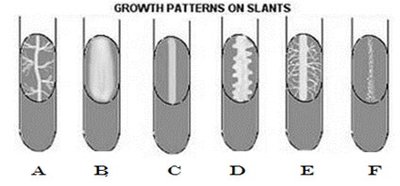
Common growth patterns include: filiform (even), echinulate (spiny), beaded, effuse (spreading), arborescent (branched), and rhizoid (root-like).
Step-by-Step Guidance
Examine the surface of the agar slant for the overall distribution and texture of the microbial growth. Is it smooth, branched, or spreading?
Compare the observed growth to standard patterns:
Filiform: uniform, straight line of growth
Echinulate: growth with spiny edges
Beaded: discrete or semi-confluent colonies
Effuse: thin, spreading growth
Arborescent: tree-like, branched growth
Rhizoid: root-like, branching growth
Note the color, opacity, and any other distinguishing features of the growth, as these can also aid in identification.
Relate the observed pattern to possible bacterial species or genera, as some bacteria have characteristic growth patterns on slants.
Try solving on your own before revealing the answer!
Final Answer:
The image shows six common growth patterns on slants: A (arborescent), B (beaded), C (effuse), D (filiform), E (rhizoid), F (echinulate). Recognizing these patterns helps in identifying and differentiating bacterial species in the lab.
