 Back
Backunit 5 lecture 1
Study Guide - Smart Notes
 Tailored notes based on your materials, expanded with key definitions, examples, and context.
Vaccination and Disease Prevention
Principles of Vaccination
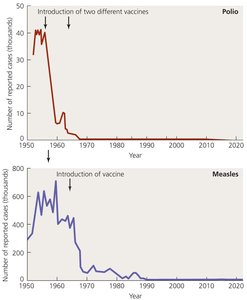
Vaccination is a cornerstone of public health, providing artificial active immunity by exposing individuals to antigens that stimulate the immune system to develop protection against specific pathogens.
Active Immunization: Involves inoculation with antigens (whole pathogens or pathogen products) to elicit an immune response.
Types of Antigens: Can include attenuated (live but weakened), inactivated (killed), or subunit (fragmented) microbial components.
Effectiveness: Immunization with live cells or viruses is generally more effective than with inactivated material due to greater antigenic stimulation.
Combination Vaccines: Provide immunity to multiple pathogens in a single dose.
Antibody Responses to Vaccination
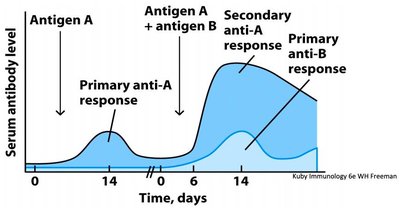
The immune system responds to vaccination with distinct primary and secondary antibody responses, which are critical for understanding vaccine schedules and effectiveness.
Primary Response: Occurs after initial exposure; produces short-lived plasma cells and mainly IgM antibodies.
Secondary Response: Triggered by subsequent exposures; produces longer-lived plasma cells and predominantly IgG antibodies, resulting in a faster and stronger response.
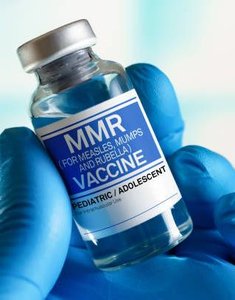
Vaccine Doses: Two-dose vaccines (e.g., MMR) are designed to maximize the secondary response and ensure long-lasting immunity.
Passive Immunotherapy
Passive immunotherapy involves the direct administration of antibodies to patients, providing immediate but temporary protection against pathogens.
Mechanism: Antibodies neutralize toxins or pathogens, aiding in rapid defense.
Types: Includes antitoxins, antivenins, and virus-specific antibodies.
Source: Antiserum from human donors or animals.
Duration: Protection is short-term as no memory cells are generated; antibody levels decline over time.
Classes of Vaccines
Vaccines are classified based on their composition and method of preparation, each with unique advantages and limitations.
Attenuated (Live) Vaccines: Contain weakened microbes; replicate in host, induce robust immunity, and may confer contact immunity.
Inactivated (Killed) Vaccines: Contain killed microbes or parts; require multiple doses or adjuvants for effectiveness.
Subunit Vaccines: Contain immunogenic fragments; limited antigenic diversity, often require boosters.
Toxoid Vaccines: Contain modified toxins; stimulate immunity without causing disease.
Recombinant Vaccines: Use genetically engineered microbes or products (proteins, DNA, mRNA).
Vaccine Schedules
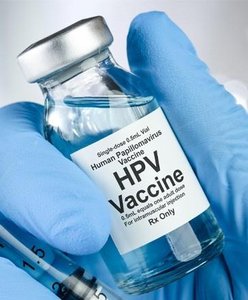
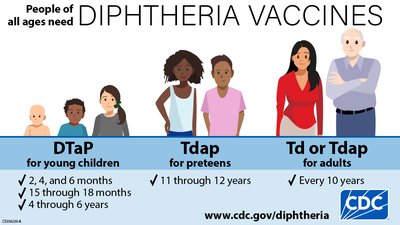
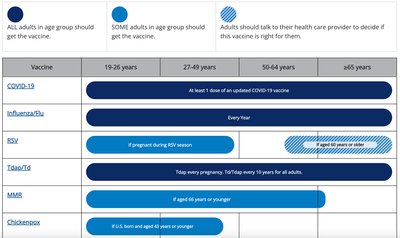
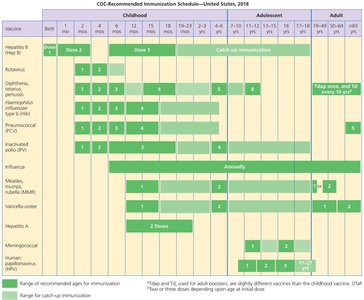
Vaccine schedules are designed to optimize immunity across the lifespan, as recommended by public health authorities such as the CDC.
Age-Specific Recommendations: Different vaccines are recommended for children, adolescents, and adults.
Booster Doses: Some vaccines require periodic boosters to maintain immunity.
Catch-Up Immunization: Available for individuals who missed scheduled doses.
Epidemiology and Disease Control
Fundamentals of Epidemiology
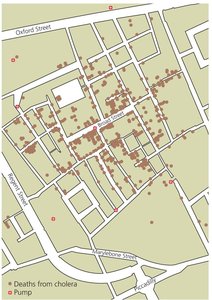
Epidemiology is the study of the occurrence, distribution, and determinants of health and disease within populations. It is essential for understanding and controlling infectious diseases.
Disease Surveillance: Systematic observation, recognition, and reporting of diseases to trace their spread and identify origins.
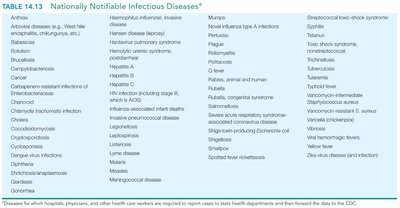
Reportable Diseases: Certain diseases must be reported to health authorities for monitoring and control.

Mechanisms to Limit Disease Spread
Several strategies are employed to control the spread of infectious diseases within populations.
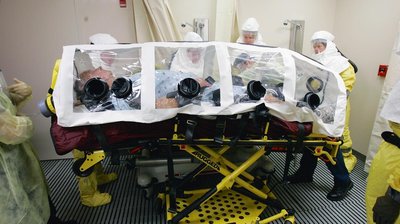
Isolation: Separation of infected individuals to prevent transmission.
Quarantine: Separation of exposed individuals during the incubation period.
Immunization: Widespread vaccination reduces the number of susceptible individuals.
Treatment: Medical interventions (antimicrobials, antivirals) when available.
Subgroups Within Populations and SIR Models
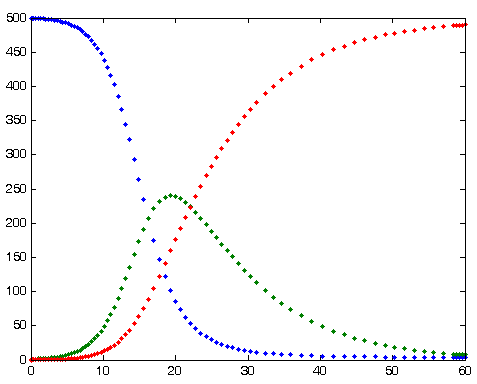
The spread of disease depends on the proportion of susceptible, infected, and recovered individuals. Mathematical models, such as SIR (Susceptible-Infectious-Recovered), are used to predict and limit disease spread.
SIR Model: Compartmental model dividing population into susceptible, infectious, and recovered groups.
Adaptive Immunity: Recovered individuals are resistant due to immune memory.

Herd Immunity and Pathogen Eradication
Herd Immunity
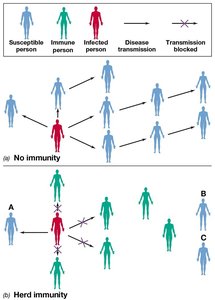
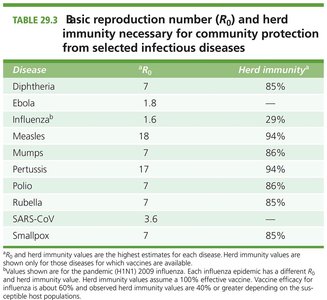
Herd immunity is the resistance of a population to infection due to a high proportion of immune individuals, which limits disease transmission.
Threshold: Usually requires >75% immunity; higher for highly infectious diseases.
Sources: Immunity can be acquired through vaccination or natural infection.
Importance: Critical for protecting vulnerable individuals and preventing outbreaks.
Pathogen Eradication
Pathogen eradication refers to the complete elimination of a disease-causing agent from a population. Methods include mass vaccination, surveillance, isolation, and quarantine.
Historical Examples: Smallpox eradication through global vaccination campaigns.
Challenges: Requires high levels of immunity, effective surveillance, and international cooperation.
Additional info:
Mathematical models (SIR) use differential equations to describe transitions between susceptible, infectious, and recovered states:
Where S = susceptible, I = infectious, R = recovered, \beta = transmission rate, \gamma = recovery rate.
----------------------------------------
