 Back
BackVaccines, Herd Immunity, and Natural Immunity: Principles and Applications
Study Guide - Smart Notes
 Tailored notes based on your materials, expanded with key definitions, examples, and context.
Vaccines and Immunological Memory
How Vaccines Work
Vaccines are biological preparations that stimulate the immune system to develop protection against specific pathogens. They do not provide immediate protection; instead, it takes about two weeks for antibody levels to reach their peak after vaccination. Both infection and vaccination stimulate immunological memory, enabling the immune system to respond rapidly upon subsequent exposure to the pathogen.
Immunological Memory: The ability of the immune system to remember a pathogen and mount a faster, stronger response upon re-exposure.
Antibody Production: Vaccines trigger the production of antibodies, which are proteins that neutralize pathogens.
Delayed Protection: Peak antibody levels are typically achieved two weeks post-vaccination.
Example: After receiving a measles vaccine, the body produces memory cells that quickly respond if exposed to measles virus in the future.
Herd Immunity
Definition and Mechanism
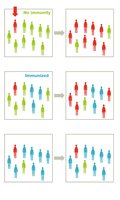
Herd immunity occurs when a significant portion of a population becomes immune to a disease, making it difficult for the pathogen to spread. This immunity can be achieved through vaccination or natural infection. Herd immunity protects individuals who are not immunized by reducing the likelihood of disease transmission.
Threshold: Most pathogens require vaccination of approximately 85% of the population for effective herd immunity. Highly contagious diseases like measles and whooping cough require up to 95% vaccination rates.
Public Health Initiatives: Immunization programs aim to achieve herd immunity to prevent outbreaks.
Example: In a community where most people are vaccinated against measles, the disease cannot spread, protecting those who are unvaccinated.
Types of Immunity
Active Immunity
Active immunity results when exposure to a disease organism triggers the immune system to produce antibodies. This can occur through natural infection or vaccination. Active immunity is typically long-lasting and sometimes lifelong.
Natural Immunity: Acquired from exposure to the disease organism through infection.
Vaccine-Induced Immunity: Acquired through the introduction of a killed or weakened form of the disease organism via vaccination.
Immunological Response: Upon future exposure, the immune system recognizes the pathogen and produces antibodies rapidly.
Example: A person who recovers from chickenpox develops natural immunity and is unlikely to contract the disease again.
Natural Immunity
Acquisition and Characteristics
Natural immunity is acquired when an individual is exposed to a pathogen and recovers from the infection. This process generates memory cells and antibodies specific to the pathogen, providing long-term protection.
Memory Cells: Specialized immune cells that remember the pathogen and enable a rapid response upon re-exposure.
Duration: Natural immunity can be long-lasting, depending on the pathogen.
Example: After recovering from hepatitis A, a person develops natural immunity against future infections by the same virus.
Vaccines and Immunocompromised Individuals
Special Considerations
Immunocompromised individuals have weakened immune systems due to medical conditions or treatments. There are specific recommendations regarding which vaccines are safe and effective for these individuals. Some vaccines may be contraindicated, while others are recommended to provide protection.
Definition: Immunocompromised status can result from diseases (e.g., HIV/AIDS), medications (e.g., chemotherapy), or organ transplants.
Vaccine Recommendations: Guidelines exist for immunization in adult immunocompromised patients, specifying which vaccines to use and which to avoid.
Example: Live attenuated vaccines are generally avoided in severely immunocompromised individuals due to the risk of infection.
Summary Table: Types of Immunity
Type of Immunity | How Acquired | Duration | Example |
|---|---|---|---|
Natural Immunity | Infection with actual disease organism | Long-lasting, sometimes lifelong | Recovery from measles |
Vaccine-Induced Immunity | Vaccination with killed or weakened pathogen | Long-lasting, sometimes lifelong | Measles vaccine |
Herd Immunity | High population immunity (natural or vaccine-induced) | Depends on population coverage | Community protection against measles |
Key Equations
Herd Immunity Threshold
The herd immunity threshold (HIT) is the proportion of the population that must be immune to prevent disease spread. It is calculated as:
Where is the basic reproduction number of the pathogen.
Additional info: The notes expand on the CDC definitions and provide context for immunocompromised individuals, as well as a summary table for clarity.
