 Back
BackViruses and Prions: Structure, Classification, Replication, and Pathogenesis
Study Guide - Smart Notes
 Tailored notes based on your materials, expanded with key definitions, examples, and context.
Viruses and Prions
Introduction to Viruses
Viruses are nonliving pathogens that require living cells to replicate. The study of viruses is known as virology. Viruses are submicroscopic, infectious agents composed of genetic material (DNA or RNA) encased in a protein shell called a capsid. A single virus particle is termed a virion.
Virion: The complete, infectious form of a virus outside a host cell.
Capsid: Protective protein shell surrounding the viral genome.
Genetic Material: Can be DNA or RNA, single or double stranded.
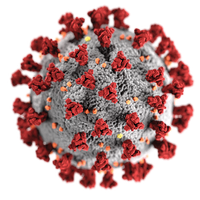
General Properties of Viruses
Viruses are extremely small (20–400 nm), acellular, and obligate intracellular pathogens. They infect a wide range of hosts, including mammals, plants, and bacteria. Over 5,000 mammal-infecting viral species have been described, with many more uncharacterized.
Acellular: Not composed of cells.
Obligate Intracellular Pathogens: Must invade host cells to replicate.
Host Range: The collection of species a virus can infect.
Structure of Viruses
Viruses are much smaller than their host cells. The smallest viruses are about 20 nm, while the largest can reach 1,500 nm. Transmission electron microscopy (TEM) is used to visualize viruses.

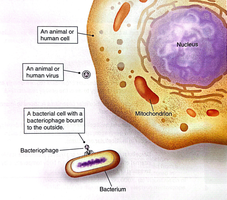
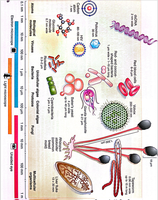
Comparison of Viruses, Prokaryotes, and Eukaryotes
Viruses differ from prokaryotes and eukaryotes in structure, replication, and genetic material. They lack cellular components and metabolic machinery.
Feature | Viruses | Prokaryotes | Eukaryotes |
|---|---|---|---|
Cellular Structure | Acellular | Cellular | Cellular |
Genetic Material | DNA or RNA | DNA | DNA |
Replication | Host-dependent | Binary fission | Mitosis/meiosis |
Metabolism | None | Present | Present |
Viral Capsids
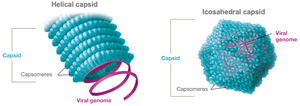
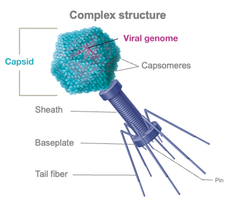
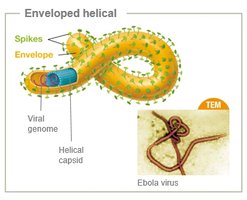
The capsid is a protein shell that packages and protects the viral genome. It is composed of subunits called capsomeres and can have helical, icosahedral, or complex arrangements.
Helical Capsid: Hollow tube-like structure.
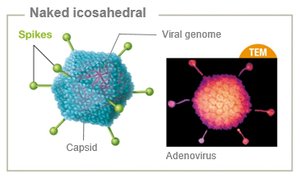
Icosahedral Capsid: Three-dimensional polygon.
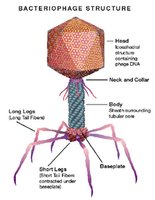
Complex Capsid: Found in bacteriophages, often with additional structures for genome injection.
Naked vs. Enveloped Viruses
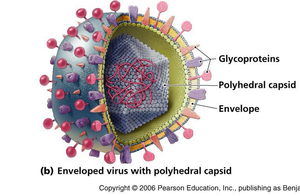
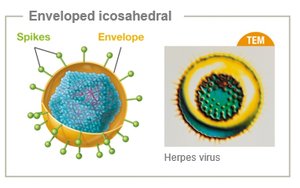
Viruses can be classified as naked or enveloped. Enveloped viruses have a lipid-based envelope derived from the host cell membrane, while naked viruses lack this envelope.
Enveloped Viruses: Acquire envelope by budding from host cell.
Naked Viruses: Released by lysing the host cell.
Viral Spikes (Peplomers)
Viral spikes are glycoprotein extensions that facilitate attachment to host cells. They are critical for host specificity and infectivity.
Hemagglutinin (HA): Spike protein in influenza viruses.
Neuraminidase (NA): Another spike protein in influenza viruses.
Viral Genomes
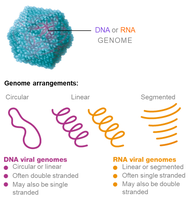
Viral genomes are highly diverse and can be DNA or RNA, single or double stranded, circular or linear, and segmented or non-segmented. Most viruses have fewer than 300 genes.
ssDNA: Single-stranded DNA
dsDNA: Double-stranded DNA
ssRNA: Single-stranded RNA
dsRNA: Double-stranded RNA
Viral Genome Replication Strategies
Viruses hijack host cell machinery to replicate their genomes. The replication strategy depends on the type of viral genome.
dsDNA Viruses: DNA transcribed by host RNA polymerases, mRNA translated into protein.
ssDNA Viruses: Converted to double-stranded form before transcription.
+ssRNA Viruses: Genome acts as mRNA, directly translated by host ribosomes.
-ssRNA Viruses: Genome is complementary to mRNA, transcribed into mRNA by viral RNA-dependent RNA polymerases.
Retroviruses: RNA genome converted to DNA by reverse transcriptase, integrated into host genome.
dsRNA Viruses: Transcribed by viral RNA-dependent RNA polymerases to make mRNA.
Evolution of Viral Genomes
Viruses evolve rapidly due to quick replication and high mutation rates, especially in RNA viruses. Genetic changes can lead to attenuated strains (used in vaccines) or increased infectivity.
Antigenic Drift: Minor mutations in viral genome, leading to new strains.
Antigenic Shift: Major genetic reassortment, often when two strains co-infect a cell.
Viral Classification
Viruses are classified based on their genome type, capsid symmetry, envelope presence, and replication method. The Baltimore classification system groups viruses into seven categories based on genome and replication strategy.
Classification Criteria | Examples |
|---|---|
Genome Type | DNA, RNA, ss, ds, segmented |
Capsid Symmetry | Helical, icosahedral, complex |
Envelope | Present or absent |
Replication Method | Baltimore groups |
Viral Replication Pathways
Viruses replicate via lytic or lysogenic pathways. The lytic pathway results in host cell lysis and release of new virions, while the lysogenic pathway involves integration of viral genome into the host genome (prophage).
Lytic Replication: Attachment, penetration, replication, assembly, release.
Lysogenic Replication: Attachment, penetration, integration, cell division, lytic cycle entry upon stress.
Animal Virus Replication
Animal viruses replicate in six steps: attachment, penetration, uncoating, replication, assembly, and release. Entry can occur via fusion or endocytosis.
Attachment: Viral proteins interact with host membrane proteins.
Penetration: Entry by fusion (enveloped viruses) or endocytosis (both types).
Uncoating: Viral genome released from capsid.
Replication: Genome and proteins synthesized.
Assembly: New virions assembled.
Release: Virions exit by budding or lysis.
Acute vs. Persistent Infections
Viral infections can be acute (cleared by immune system) or persistent (chronic or latent). Persistent infections may involve continuous or intermittent virion release.
Acute Infection: Rapid onset, cleared by immune response.
Chronic Infection: Continuous release of virions.
Latent Infection: Periods of dormancy with occasional flare-ups.
Oncogenic Viruses
Some viruses, called oncoviruses, can cause cancer by stimulating uncontrolled cell division or inhibiting cell death. Examples include human papilloma viruses (HPVs) and human T-lymphotropic viruses (HTLV).
Growing Viruses and Diagnostic Tests
Bacteriophages are grown using plaque assays, while animal viruses require tissue culture or live animal hosts. Diagnostic tests include antigen/antibody assays (agglutination, ELISA) and molecular methods (DNA/RNA detection).
Test Type | Purpose |
|---|---|
Agglutination | Detects viral antigens or patient antibodies |
ELISA | Detects antigens or antibodies via color change |
Molecular | Detects viral genetic material |
Antiviral Drugs
Antiviral drugs target various steps in the viral replication pathway, such as attachment, penetration, and uncoating. Most drugs limit infection spread rather than cure.
Prions
Prions are infectious proteins that cause transmissible spongiform encephalopathies (TSEs), such as Creutzfeldt-Jakob disease and Kuru. Prions lack genetic material and do not replicate like viruses.
Creutzfeldt-Jakob Disease (CJD): Neurodegenerative disease, also known as 'mad cow disease'.
Kuru: Transmitted through cannibalism, causes neurodegeneration.
Key Terms
Capsid
Capsomere
Host Range
Transmission
Virulence
