Back
BackViruses and Prions: Structure, Replication, and Pathogenesis
Study Guide - Smart Notes
 Tailored notes based on your materials, expanded with key definitions, examples, and context.
Viruses and Prions
Introduction to Viruses
Viruses are unique infectious agents that can infect every type of cell, including bacteria, algae, fungi, protozoa, plants, and animals. They are highly specific to their host cells and are distinguished from cellular life by several unique characteristics.
Viruses are infectious particles, not organisms.
They are described as active or inactive rather than alive or dead.
Viruses are obligate intracellular parasites—they cannot multiply unless they invade a specific host cell and commandeer its genetic and metabolic machinery.
Properties of Viruses
Viruses are not cells and lack cellular structure.
They are inactive macromolecules outside the host cell and become active only inside host cells.
Basic structure: a protein shell (capsid) surrounds a nucleic acid core.
Viruses are ubiquitous in nature and ultramicroscopic in size.
They contain either DNA or RNA, but never both.
Surface molecules determine host cell specificity.
They lack enzymes and ribosomes necessary for independent life.
Example: HIV, influenza virus, and bacteriophages are all viruses with distinct host ranges and replication strategies.
Virus Sizes
Viruses are much smaller than most cells, ranging from about 20 nm to 1,500 nm in length. For comparison, a human red blood cell is about 8,000 nm in diameter, and a typical bacterium like E. coli is about 2,000 nm long.

Generalized Structure of Viruses
The structure of viruses is simple but highly efficient for infection and replication.
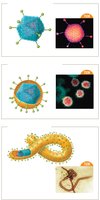
Capsid: Protein shell that surrounds and protects the nucleic acid. Composed of protein subunits called capsomeres.
Nucleocapsid: The combination of the capsid and nucleic acid.
Spikes: Surface projections found on both naked and enveloped viruses, allowing attachment to host cells.
Envelope: Some viruses have a lipid-based envelope derived from the host cell membrane (enveloped viruses), while others lack this feature (naked viruses).
The Viral Genome
Viral genomes are compact and encode only the genes necessary for infection and replication.
Contain either DNA or RNA, which may be single- or double-stranded, segmented or non-segmented, circular or linear.
Genetic changes can lead to attenuated strains with reduced infectivity.
Viral Genome Evolution
Viruses evolve rapidly due to their short replication times and high mutation rates, especially RNA viruses.
Mutations can be neutral, beneficial, or harmful.
Beneficial mutations may help viruses evade the immune system, expand host range, or increase infectivity.
Reassortment: When two different viral strains coinfect a host cell, their genomes can mix, creating new viral strains.
Host Range and Specificity
Viruses can only infect cells with specific receptors matching their surface molecules.
Restricted host range: e.g., hepatitis B infects only human liver cells.
Moderately restrictive: e.g., poliovirus infects primate intestinal and nerve cells.
Broad host range: e.g., rabies virus infects many mammalian cells.
Bacteriophages
Importance of Bacteriophages
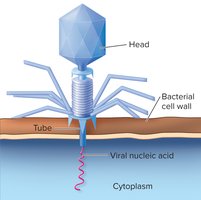
Bacteriophages (phages) are viruses that infect bacteria. They are important in medicine and biotechnology.
Phage genomes may encode toxins (e.g., cholera, diphtheria, botulinum toxins).
Prophages can confer new properties to bacteria, such as antibiotic resistance.
Phage detection can serve as a biomarker for bacterial presence in environmental samples.
Bacteriophage Replication
Lytic pathway: Phage infects, replicates, and lyses the host cell to release new virions.
Lysogenic pathway: Phage genome integrates into the host genome as a prophage, replicating with the host until induced to enter the lytic cycle.
Animal Virus Replication
Generalized Steps
Animal viruses replicate through a series of coordinated steps:
Attachment: Virus binds to specific receptors on the host cell membrane.
Penetration: Virus enters the cell via endocytosis or membrane fusion.
Uncoating: Viral capsid is removed, releasing the genome.
Replication: Viral genome is replicated and proteins are synthesized.
Assembly: New virions are assembled.
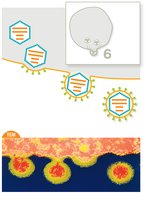
Release: Enveloped viruses bud from the cell; naked viruses cause cell lysis.
Attachment
Naked viruses attach via capsid proteins, while enveloped viruses use spikes.


Penetration and Uncoating
Enveloped viruses may enter by membrane fusion or endocytosis; naked viruses enter by endocytosis. Uncoating releases the viral genome into the host cell.
Replication, Assembly, and Release
RNA viruses typically replicate in the cytoplasm; DNA viruses in the nucleus.
Assembly forms new virions, which are released by budding (enveloped) or lysis (naked).
Persistent Infections
Some viruses establish persistent infections, evading immune clearance.
Chronic: Continuous viral production (e.g., HIV).
Latent: Periods of dormancy with occasional reactivation (e.g., herpesviruses).
Oncogenic Viruses
Certain viruses can cause cancer by disrupting normal cell growth regulation.
Epstein-Barr virus: Linked to Burkitt’s lymphoma.
Hepatitis B virus: Linked to liver cancer.
Human papillomavirus (HPV): Linked to cervical and penile cancers.
Viral Diseases of the Respiratory Tract
Common Cold
Caused by rhinoviruses and coronaviruses.
Transmission: respiratory droplets, fomites, direct contact.
Symptoms: sore throat, runny nose, cough, sneezing, fatigue.
Treatment: usually self-limiting.
Influenza Virus Structure and Disease
Influenza A is an enveloped virus with two key glycoprotein spikes: hemagglutinin (HA) and neuraminidase (NA). The genome consists of 8 RNA segments.
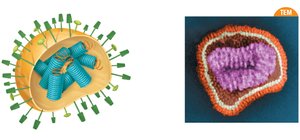
HA: Binds to host cell receptors and mediates entry.
NA: Facilitates release of new virions from the host cell.
Symptoms include headache, chills, cough, fever, and fatigue. Complications can include pneumonia. Treatment is symptomatic; antivirals may be used in severe cases.
Antigenic Drift and Shift
Antigenic drift: Minor mutations in HA and NA genes cause seasonal variation, necessitating annual vaccines.
Antigenic shift: Major genetic reassortment creates new viral strains, potentially leading to pandemics (e.g., 1918 H1N1, 2009 H1N1).
Prions
Characteristics of Prions
Prions are infectious proteins that lack genetic material and do not replicate like viruses. They cause transmissible spongiform encephalopathies (TSEs), which are fatal neurodegenerative diseases.
Cellular PrP: Normal protein with alpha-helices.
Prion PrP: Disease-causing form with beta-sheets.
Prion Diseases
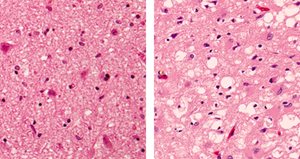
Characterized by loss of brain matter and formation of large vacuoles (spongiform changes).
Examples: Gerstmann-Straussler-Schienker syndrome, fatal familial insomnia, Creutzfeldt-Jakob Disease (CJD).
Symptoms: altered behavior, dementia, memory loss, impaired senses, delirium, premature senility.
No cure currently exists for prion diseases.