 Back
BackViruses: Structure, Classification, and Replication
Study Guide - Smart Notes
 Tailored notes based on your materials, expanded with key definitions, examples, and context.
Viruses: Discovery and Definition
Historical Discovery
Viruses were discovered after bacteria, using filtration methods that excluded bacteria but not viruses. Ivanovsky and Beijerinck are credited with early studies on tobacco mosaic disease, leading to the concept of infectious agents smaller than bacteria. Walter Reed later demonstrated viral transmission via mosquitoes in yellow fever.
Ivanovsky: First described the tobacco mosaic virus.
Beijerinck: Coined the term "virus" and established the field of virology.
Viruses: Infect all cell types, including plants, animals, bacteria, and fungi.
What Are Viruses?
Viruses are obligate intracellular parasites that require a living host cell to reproduce. They are acellular and not considered living organisms. Their genomes consist of either DNA or RNA, which may be single- or double-stranded, linear, circular, or segmented.
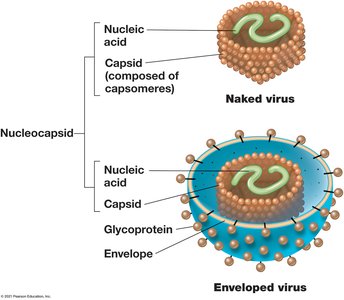
Virion: The extracellular form of a virus, consisting of nucleic acid surrounded by a protein coat (capsid), and sometimes an envelope.
Bacteriophage: A virus that infects bacteria.
Virus Structure
Virion Components
Virions range from 10–1000 nm in diameter and contain a nucleic acid genome and a protein coat (capsid). Some viruses have additional components such as envelopes and spikes.
Capsid: Protein shell composed of subunits called capsomeres, protecting the nucleic acid.
Envelope: Lipid bilayer derived from the host cell, containing viral glycoproteins.
Nucleocapsid: The combination of nucleic acid and capsid.
Virus Symmetry
Viruses are classified by the symmetry of their capsids:
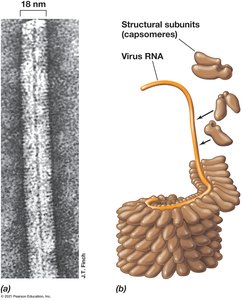
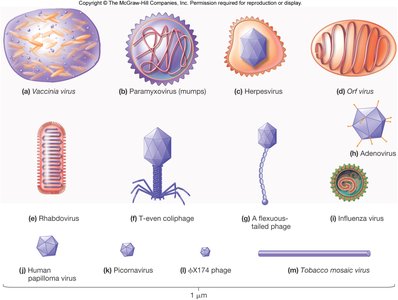
Helical Symmetry: Capsomeres form a spiral around the nucleic acid, as seen in tobacco mosaic virus.
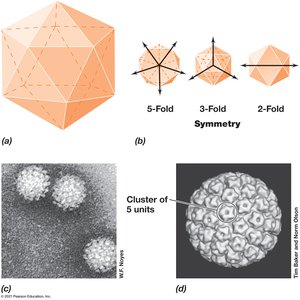
Icosahedral Symmetry: Capsid forms a polyhedron with 20 triangular faces, maximizing internal volume.
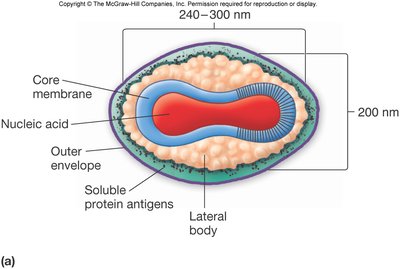
Complex Symmetry: Some viruses (e.g., poxviruses, bacteriophages) have both helical and icosahedral features or additional structures.
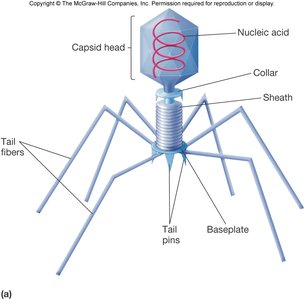
Capsid and Envelope
Capsomeres: Protein subunits forming the capsid.
Envelope: Contains viral glycoproteins (spikes) for attachment and entry into host cells.
Virus Classification by Morphology
Viruses are classified based on their structure, genome type, and host range.
Viral Genomes
Types of Viral Genomes
Viruses possess diverse genome types:
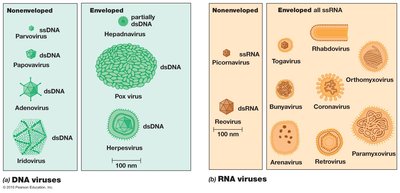
DNA Viruses: Can be single-stranded (ssDNA) or double-stranded (dsDNA).
RNA Viruses: Can be single-stranded (ssRNA) or double-stranded (dsRNA).
Retroviruses: ssRNA viruses that replicate through a DNA intermediate.
Positive Sense (+) ssRNA: Genome acts as mRNA.
Negative Sense (-) ssRNA: Genome is complementary to mRNA and must be transcribed to positive sense before translation.

Viral Envelopes
Envelope Structure and Function
The viral envelope is a flexible, membranous layer derived from the host cell, containing viral proteins (spikes) that facilitate attachment, enzymatic activity, and identification.
Envelope Proteins: Project from the surface, aiding in host cell recognition and entry.
Budding: Most enveloped viruses acquire their envelope during release from the host cell.
Viral Replication
General Steps of Viral Replication
All viruses follow a similar replication cycle, with variations depending on their structure and genome:
Attachment: Virus binds to host cell receptors.
Entry: Virus or viral genome enters the host cell.
Uncoating: Removal of capsid to release nucleic acid.
Synthesis: Viral genome and proteins are synthesized.
Assembly: New virions are assembled.
Release: Virions exit the host cell, often by lysis or budding.
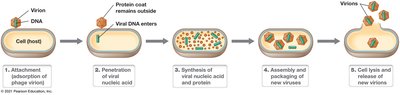
Bacteriophages
Structure and Classification
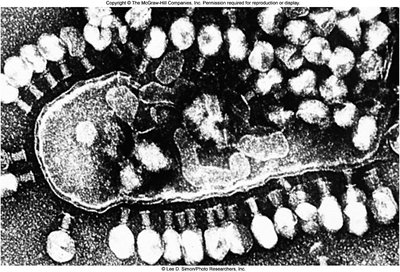
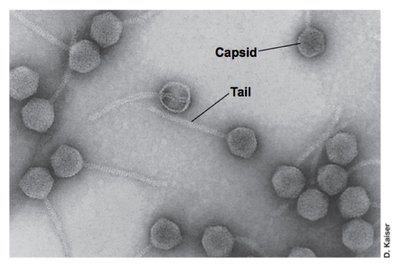
Bacteriophages (phages) are viruses that infect bacteria. They are structurally diverse, often possessing complex symmetry and typically have naked, double-stranded DNA genomes.
Phage Morphology: Includes head (capsid), tail, baseplate, and tail fibers.
Classification: Based on morphology and genome type.
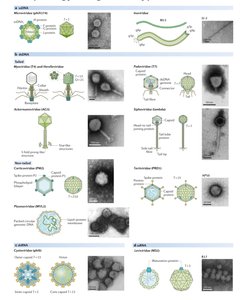
Phage Replication Cycles
Phages can follow two main replication pathways:
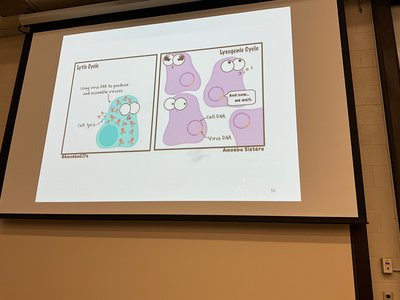
Lytic Cycle (Virulent Phages): Phage multiplies immediately, lysing the host cell to release new virions. Example: T4 phage.
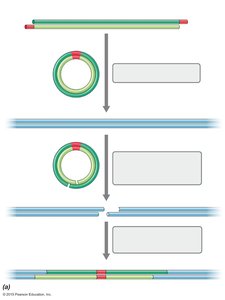
Lysogenic Cycle (Temperate Phages): Phage genome integrates into the host chromosome as a prophage, replicating with the host without causing immediate lysis. Example: Lambda phage.
Lysogeny and Prophage
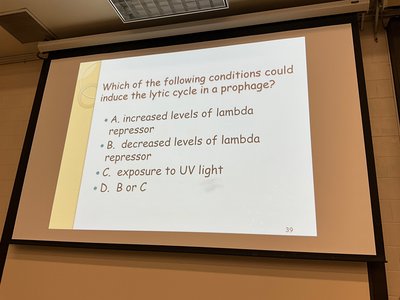
Lysogeny is a non-lytic relationship between a phage and its host. The integrated phage genome (prophage) can alter host phenotype (lysogenic conversion) and may switch to the lytic cycle upon induction (e.g., DNA damage).
Integrase: Enzyme used by phage to integrate its genome into the host chromosome.
Induction: Triggered by decreased lambda repressor levels or exposure to mutagens, leading to excision of the prophage and entry into the lytic cycle.
Animal Viruses
Entry and Replication
Animal viruses typically enter the host cell as a complete virion. Many replicate in the nucleus and are often enveloped. Entry mechanisms include endocytosis and membrane fusion.
Enveloped Viruses: Acquire envelope from host cell membrane during budding.
Genome Types: ssRNA, dsDNA, etc.
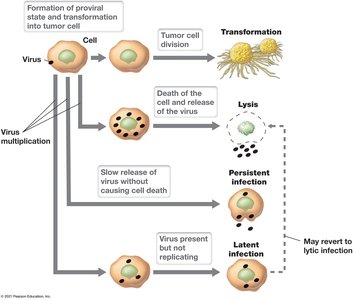
Effects of Animal Viruses
Animal viruses can cause various types of infections:
Virulent: Immediate lysis and release of virions.
Latent: Virus remains dormant; symptoms and virus are undetectable.
Persistent: Virus is continuously detectable; symptoms are mild or absent.
Cancer: Some viruses can transform host cells, leading to tumor formation.
Latent and Persistent Infections
Latent Infection: Virus stops reproducing and remains dormant (e.g., HSV, varicella-zoster).
Persistent Infection: Virus is always detectable; symptoms may be mild or absent (e.g., hepatitis B, HIV).
Viruses and Cancer
Oncogenic Viruses
Some viruses are associated with human cancers. They may incorporate oncogenes or mutate host proto-oncogenes, leading to transformation.
Examples: HPV (cervical cancer), Epstein-Barr virus (Burkitt's lymphoma), hepatitis B and C (liver cancer), HTLV-1 (T-cell leukemia).
Virus | Genome Type | Cancer |
|---|---|---|
Human herpesvirus 8 (HHV8) | dsDNA | Kaposi's sarcoma |
Epstein-Barr virus (EBV) | dsDNA | Burkitt's lymphoma, nasopharyngeal carcinoma |
Hepatitis B virus | dsDNA | Hepatocellular carcinoma |
Hepatitis C virus | ssRNA | Liver cancer |
Human papillomavirus (HPV) | dsDNA | Cervical cancer |
HTLV-1 | ssRNA (retrovirus) | T-cell leukemia |
Retroviruses
Replication Mechanism
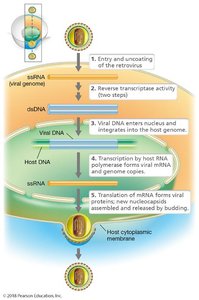
Retroviruses are ssRNA viruses that replicate through a DNA intermediate using reverse transcriptase. The viral DNA integrates into the host genome, forming a provirus, and new virions are released by budding.
Reverse Transcriptase: Enzyme that synthesizes DNA from RNA.
Provirus: Integrated viral DNA in the host genome.
Example: HIV.
SARS-CoV-2 and Coronaviruses
Structure and Genome
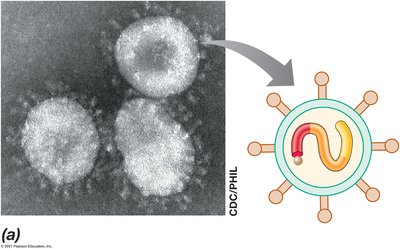
SARS-CoV-2 is an enveloped virus with club-shaped spike glycoproteins and a positive-sense, single-stranded RNA genome. It exhibits helical capsid symmetry.
Spike Glycoprotein (S): Attaches to ACE2 receptors on host epithelial cells.
Entry: Via membrane fusion or endocytosis.
Release: New virions are released by exocytosis.
Transmission and Symptoms
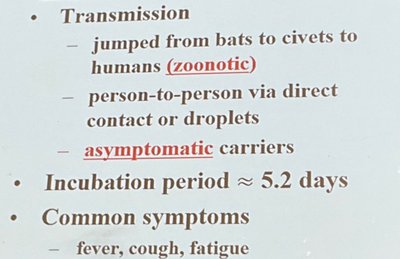
Zoonotic Transmission: Jumped from bats to civets to humans.
Person-to-Person: Direct contact or droplets.
Asymptomatic Carriers: Can transmit the virus without symptoms.
Incubation Period: Approximately 5.2 days.
Common Symptoms: Fever, cough, fatigue.
Summary Table: Virus Types and Properties
Virus Type | Genome | Envelope | Example |
|---|---|---|---|
DNA Virus | dsDNA or ssDNA | May be enveloped | Herpesvirus, Adenovirus |
RNA Virus | ssRNA or dsRNA | May be enveloped | Influenza, Coronavirus |
Retrovirus | ssRNA (via DNA intermediate) | Enveloped | HIV |
Additional info: Academic context was added to clarify virus structure, genome types, and replication cycles, as well as to provide examples and tables for classification and cancer association.
