 Back
BackViruses: Structure, Life Cycle, and Medical Relevance
Study Guide - Smart Notes
 Tailored notes based on your materials, expanded with key definitions, examples, and context.
Viruses: General Characteristics
Definition and Nature of Viruses
Viruses are obligate intracellular parasites that require a host cell for reproduction. They are fundamentally different from cellular life forms, as they lack the machinery for independent metabolism and replication. Instead, viruses use host enzymes, ribosomes, and other cellular materials to synthesize progeny viruses, effectively turning the infected cell into a factory for viral production. The outer part of a virus serves as a delivery system for the viral genome, which is the core infectious component.
Bacteriophage: A virus that infects bacteria.
Host Range: Determined by specific interactions between viral and host cell-surface proteins; only certain species or cell types can be infected by a given virus.
Virus Structure
Basic Components
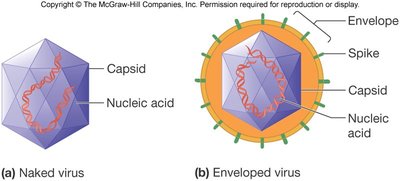
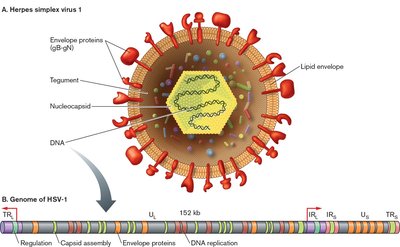
Viruses are composed of genetic material (DNA or RNA) encased in a protein shell called a capsid. Some viruses also possess an outer lipid envelope derived from the host cell membrane.
Capsid: Protein shell that encases the viral genome.
Envelope: Lipid membrane surrounding some viruses, acquired from the host cell during viral budding.
Genome: Can be DNA or RNA, single- or double-stranded, linear or circular, whole or segmented.
Bacteriophage Structure
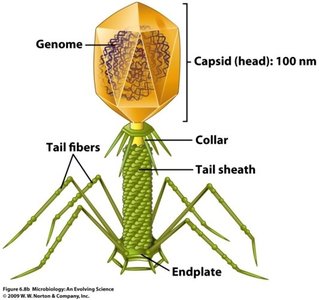
Bacteriophages have a complex structure with a head (capsid) containing DNA, a tail sheath, tail fibers, and an endplate for attachment to bacterial cells.
Virus Size and Simplicity
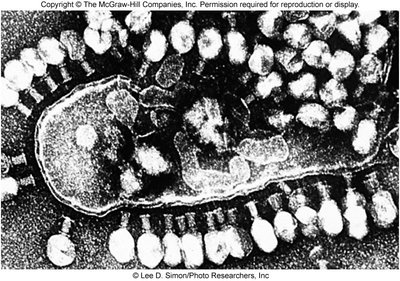
Viruses are much smaller and structurally simpler than bacteria. For example, E. coli is about 1 µm (1000 nm) long, while viruses are typically tens to hundreds of nanometers in size.
Types of Viruses
Nonenveloped vs. Enveloped Viruses
Nonenveloped (Naked) Viruses: Consist only of a capsid and nucleic acid.
Enveloped Viruses: Possess an additional lipid membrane (envelope) with embedded proteins (spikes). Most disease-causing viruses are enveloped (e.g., HIV, influenza, herpesviruses, coronaviruses).
Host Range and Examples
Bacteriophages: Infect bacteria (e.g., T4 phage infecting E. coli).
Plant Viruses: Cause significant agricultural losses (e.g., Tobacco Mosaic Virus).
Animal Viruses: Infect animals and humans (e.g., measles, influenza, HIV).

Viral Life Cycle
General Steps
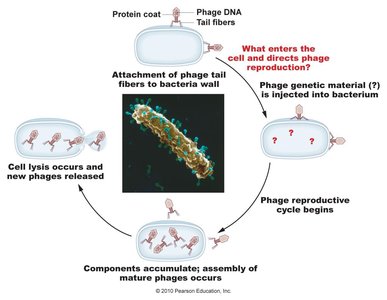
The viral life cycle consists of several key steps, reflecting the obligate intracellular nature of viruses:
Attachment to and entry into the host cell
Replication of viral nucleic acid
Translation of viral proteins
Assembly of new viral particles
Release (export) of progeny viruses
Host Range Determinants
The host range of a virus is determined by the compatibility between viral surface proteins and host cell receptors. For example, HIV infects only human CD4+ T cells due to specific receptor interactions.
Viral Genomes and Replication Strategies
Types of Viral Genomes
Double-stranded DNA (dsDNA): e.g., herpes simplex virus, smallpox
Single-stranded DNA (ssDNA): e.g., canine parvovirus
Double-stranded RNA (dsRNA): e.g., rotavirus
Single-stranded RNA (ssRNA): e.g., coronavirus, HIV, influenza
Central Dogma and Viral Replication
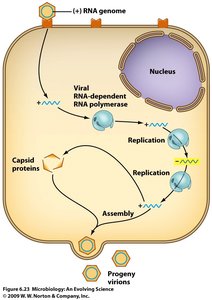
The central dogma of molecular biology describes the flow of genetic information: DNA → RNA → Protein. Viruses, especially RNA viruses, often require additional steps or enzymes (e.g., RNA-dependent RNA polymerase, reverse transcriptase) to replicate their genomes and produce proteins.

Plus Sense vs. Minus Sense RNA Viruses
Plus-sense (+) RNA: Genome can serve directly as mRNA for translation.
Minus-sense (-) RNA: Genome must first be transcribed into complementary (+) RNA by viral RNA-dependent RNA polymerase before translation.
Viral Entry and Uncoating
Mechanisms of Entry
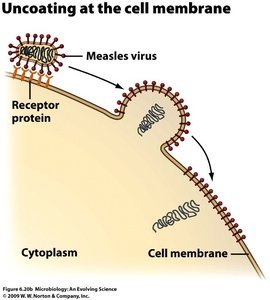
Viruses enter host cells through various mechanisms, including membrane fusion and endocytosis. The site of uncoating (release of the viral genome) depends on the virus type and entry mechanism.
Membrane Fusion: Common for enveloped viruses (e.g., measles, HIV).
Endocytosis: Virus is taken up into endosomes, where acidification triggers uncoating (e.g., hepatitis C).
Viral Evolution and Immune Evasion
Genetic Reassortment and Mutation
Viruses, especially those with segmented genomes like influenza, can undergo genetic reassortment, leading to new strains with altered virulence and transmissibility. High mutation rates in RNA viruses also contribute to immune evasion and the need for updated vaccines.
Antigenic Drift: Gradual accumulation of mutations in viral genes.
Antigenic Shift: Reassortment of genome segments, producing novel viruses.
Medical Relevance of Viruses
Diseases Caused by Viruses
Acute infections (e.g., influenza, measles)
Chronic infections (e.g., hepatitis C)
Latent infections (e.g., varicella-zoster virus: chickenpox and shingles)
Oncogenesis (integration of viral DNA can lead to cancer)
Antiviral Drugs and Targets
Antiviral drugs target specific steps in the viral life cycle, such as viral polymerases (e.g., Remdesivir for SARS-CoV-2), proteases (e.g., Paxlovid), or neuraminidase (e.g., Tamiflu for influenza). The effectiveness of these drugs depends on early administration and the specific viral enzymes present.
Viruses as Tools in Medicine
Viruses are used as vectors in gene therapy to deliver therapeutic genes to patients with genetic disorders. However, integration of viral DNA can sometimes lead to unintended consequences, such as oncogenesis.
Summary Table: Virus Types and Examples
Genome Type | Example Virus | Host | Notes |
|---|---|---|---|
dsDNA | Herpes simplex virus | Humans | Latent infection possible |
ssDNA | Canine parvovirus | Dogs | Nonenveloped |
dsRNA | Rotavirus | Humans | Segmented genome |
+ssRNA | Poliovirus, SARS-CoV-2 | Humans | Genome serves as mRNA |
-ssRNA | Influenza virus | Humans, animals | Requires RdRP in virion |
Retrovirus (+ssRNA) | HIV | Humans | Reverse transcription, integration |
*Additional info: This guide expands on the provided slides with definitions, examples, and a summary table for clarity and completeness.*
