 Back
BackViruses: Structure, Multiplication, and Roles in Microbiology
Study Guide - Smart Notes
 Tailored notes based on your materials, expanded with key definitions, examples, and context.
Viruses: Structure, Multiplication, and Roles in Microbiology
Introduction to Viruses
Viruses are acellular infectious agents that play significant roles in disease, ecology, and molecular biology. While often associated with causing illness, viruses are also vital in aquatic ecosystems, can regulate the human microbiome, and serve as important model organisms in research.
Virology: The scientific study of viruses.
Viruses: Unique infectious agents with a simple, acellular organization and a distinct pattern of multiplication.
Viruses can infect all cell types, including bacteria (bacteriophages), archaea, and eukaryotes (plants, animals, protists, fungi).
Viruses are major causes of disease but also have beneficial applications, such as cancer therapy and microbiome regulation.
Viruses are important model systems in molecular biology.
Classification of Microbial Life
Microbiologists study both cellular and acellular entities. Viruses are classified as acellular, distinct from cellular life forms such as bacteria, archaea, fungi, and protists.

Structure of Viruses
Virion and Nucleocapsid
The virion is the complete, mature virus particle. It consists of a nucleocapsid, which is composed of nucleic acid (DNA or RNA) and a protein coat (capsid). Some viruses also possess an outer lipid envelope.
Enveloped viruses: Surrounded by a lipid membrane derived from the host cell.
Nonenveloped (naked) viruses: Lack a lipid envelope and consist only of the nucleocapsid.
Capsid Structure and Symmetry
The capsid is a protein shell made of subunits called protomers. It protects the viral genome and facilitates its transfer between host cells. Capsids can have different symmetries:
Helical: Hollow tubes with protein walls; protomers self-assemble into a rigid tube.
Icosahedral: Polyhedral with 20 triangular faces and 12 vertices; composed of capsomers (rings of 5 or 6 protomers).
Complex: Do not fit into helical or icosahedral categories; e.g., poxviruses and large bacteriophages with binal symmetry.
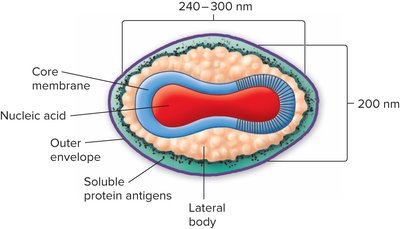
Viral Envelopes and Proteins
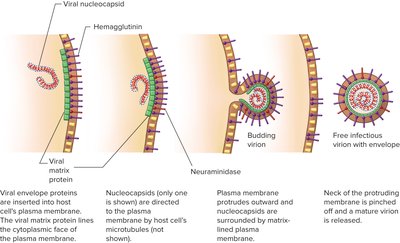
Many animal viruses are surrounded by an envelope derived from the host cell membrane. Viral envelope proteins, often in the form of spikes or peplomers, are crucial for attachment, entry, and release from host cells.
Envelope proteins can have enzymatic activity (e.g., neuraminidase in influenza).
Spikes are used for host cell recognition and attachment.
Envelope composition: Lipids and carbohydrates from the host, proteins encoded by the virus.
Viral Genomes
Viral genomes are highly diverse in structure and composition:
May be DNA or RNA, single-stranded (ss) or double-stranded (ds).
Can be linear or circular, and some RNA viruses have segmented genomes.
Genome size varies from about 4,000 to over 2 million nucleotides.
Viral Multiplication and Life Cycle
General Steps of Viral Multiplication
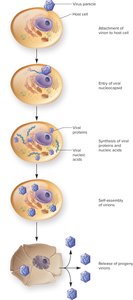
Viral replication involves five main steps, with variations depending on the virus type:
Attachment (Adsorption): Virus binds to specific receptors on the host cell surface.
Entry: Viral genome or nucleocapsid enters the host cytoplasm.
Synthesis: Viral genome is replicated, and viral proteins are synthesized.
Assembly: New virions are assembled from synthesized components.
Release: Mature virions exit the host cell by lysis or budding.
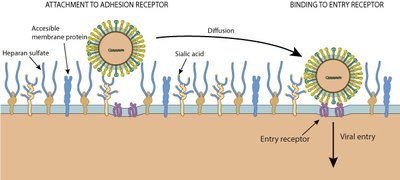
Attachment and Entry
Attachment involves specific interactions between viral ligands (e.g., spike proteins) and host cell receptors. This specificity determines host range and tissue tropism. Entry mechanisms vary:
Direct fusion with the plasma membrane (enveloped viruses).
Endocytosis (enveloped or nonenveloped viruses).
Injection of genome (bacteriophages).
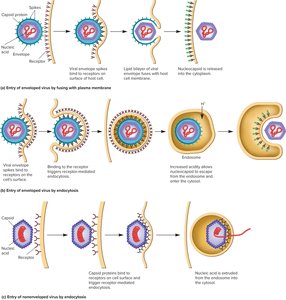
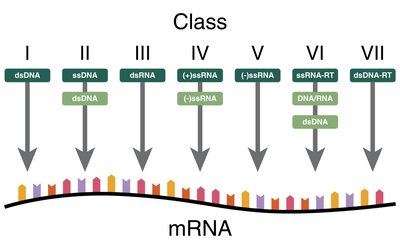
Synthesis of Viral Components
The synthesis phase is dictated by the viral genome type. DNA viruses typically use host machinery for transcription and translation, while RNA viruses may carry or encode their own polymerases. Gene expression is tightly regulated.
DNA-dependent RNA polymerase is used by DNA viruses.
RNA viruses may require RNA-dependent RNA polymerase.
Some viruses form replication complexes to facilitate genome replication.
Assembly and Release
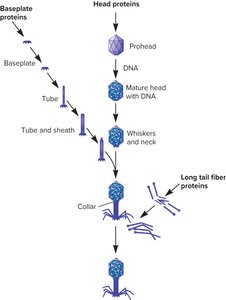
Assembly of new virions is a complex process, especially in large bacteriophages, where different components are assembled separately. Virion release occurs by:
Lysis: Nonenveloped viruses rupture the host cell.
Budding: Enveloped viruses acquire their envelope from the host membrane and are released without immediately killing the cell.
Types of Viral Infections
Bacterial and Archaeal Viral Infections
Bacteriophages can have two types of life cycles:
Virulent phages: Undergo only the lytic cycle, resulting in host cell lysis and release of progeny.
Temperate phages: Can enter a lysogenic cycle, integrating their genome as a prophage and replicating with the host without causing immediate lysis.
Lysogeny: The state in which a temperate phage genome is maintained within the host genome, conferring immunity to superinfection by the same phage.
Archaeal viruses may be virulent or temperate, and many establish chronic infections, though their life cycles are less well understood.
Viral Infections in Eukaryotes
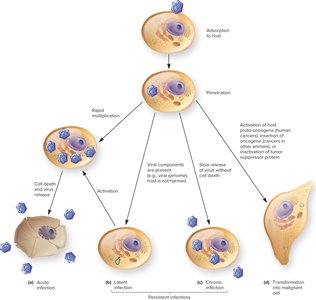
Viral infections in eukaryotic cells can result in various outcomes:
Acute infection: Rapid multiplication and cell death.
Latent infection: Virus remains dormant within the host cell.
Chronic infection: Slow release of virus without cell death.
Transformation: Activation of host proto-oncogenes or inactivation of tumor suppressor genes, potentially leading to cancer.
Summary Table: Viral Structure and Life Cycle
Feature | Description |
|---|---|
Genome Type | DNA or RNA, single- or double-stranded, linear or circular, segmented or non-segmented |
Capsid Symmetry | Helical, icosahedral, or complex |
Envelope | Present (enveloped) or absent (naked) |
Replication Site | Cytoplasm or nucleus (depending on virus) |
Release Mechanism | Lysis (nonenveloped) or budding (enveloped) |
Additional info: Viruses are not classified as living organisms because they lack cellular structure and independent metabolism. Their study is crucial for understanding infectious diseases, biotechnology, and molecular genetics.
