Back
BackViruses: Structure, Replication, and Life Strategies
Study Guide - Smart Notes
 Tailored notes based on your materials, expanded with key definitions, examples, and context.
Viruses: Structure, Replication, and Life Strategies
What Is a Virus?
Viruses are genetic elements that can multiply only inside living host cells. They are not considered living organisms and are absent from the tree of life. Viruses are obligate intracellular parasites, relying on their host for energy, metabolic intermediates, and protein synthesis. Each virus contains its own nucleic acid genome, which may be DNA or RNA.
Virion: The extracellular form of a virus, existing outside the host and enabling transmission between hosts. Replication occurs only after infection.
Key Characteristics: Not living, obligate intracellular parasite, contains nucleic acid genome.
Viral Components
The structure of viruses is defined by several key components, each serving a specific function in the viral life cycle.
Capsid: Protein shell surrounding the genome, built from repeating units called capsomeres.
Nucleocapsid: The combination of genome and capsid, found inside the envelope of enveloped viruses.
Surface Proteins: Facilitate host recognition, cell attachment, and sometimes enzymatic functions.
Types of Viruses
Viruses can be classified based on their structural features:
Type | Description |
|---|---|
Naked virus | Only nucleic acid + capsid |
Enveloped virus | Has lipid membrane from host + viral proteins |
Viral Life Strategies
Viruses employ different strategies to replicate and persist within their hosts.
Lytic (Virulent) Infection: Virus replicates, host cell dies, cell lyses to release virions.
Lysogenic (Temperate) Infection: Viral genome integrates into host genome, forming a prophage. The virus can later switch to lytic mode (induction).
Viral Genomes and Hosts
Viral genomes are diverse and much smaller than cellular genomes. They may be DNA or RNA, single- or double-stranded. Viruses infect a wide range of hosts, including bacteria (bacteriophages), archaea, animals, plants, protozoa, and even other viruses.
Virus Size & Structure
Viruses vary greatly in size and structural complexity.
Size: Most viruses are 0.02–0.3 μm; giant viruses (e.g., Pandoravirus) can exceed 1 μm.
Capsid Assembly: Often self-assemble, sometimes require host folding proteins.
Virus Symmetry
Viruses exhibit distinct structural symmetries:
Helical: Rod-shaped, e.g., Tobacco Mosaic Virus (TMV).
Icosahedral: Spherical, 20 triangular faces, e.g., Human papillomavirus.
Complex: Head + tail bacteriophages (e.g., T4), giant amoeba viruses (e.g., Mimivirus).
Enveloped Viruses
Enveloped viruses possess a lipid membrane around the nucleocapsid, facilitating easier exit from the host via budding. This feature is common in animal viruses (e.g., Ebola, HIV) but rare in bacteria and plants due to cell walls.
Enzymes in Virions
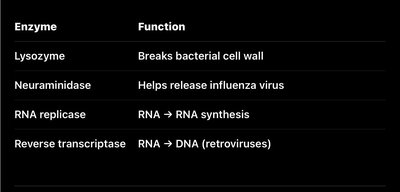
Some viruses package enzymes within their virions to facilitate infection and replication.
Enzyme | Function |
|---|---|
Lysozyme | Breaks bacterial cell wall |
Neuraminidase | Helps release influenza virus |
RNA replicase | RNA → RNA synthesis |
Reverse transcriptase | RNA → DNA (retroviruses) |
Culturing & Counting Viruses
Viruses are cultured and quantified using plaque assays, which measure the number of infectious virions (titer) per volume. Plating efficiency is always less than 100% due to defective virions.
Plaque Assay: Clear zones (plaques) indicate infection; each plaque represents one infectious virus.
Titer: Number of infectious virions per volume.
Plating Efficiency: Many virions are defective; electron microscopy counts exceed plaque counts.
Viral Replication Cycle
The viral replication cycle consists of five distinct steps:
Attachment (adsorption)
Penetration
Synthesis
Assembly
Release
One-Step Growth Curve: Includes eclipse phase (no detectable virions), maturation (assembly), latent period (eclipse + maturation), and burst size (number released).
Bacteriophage T4 (Model Lytic Virus)
Bacteriophage T4 infects Escherichia coli and serves as a model for lytic viral infection.
Attachment: Uses LPS receptors.
Penetration: Tail fibers bind, tail sheath contracts, DNA injected like a syringe, capsid remains outside.
Host Defenses: CRISPR, restriction enzymes, toxin-antitoxin systems.
Virion Production: Early proteins (replication enzymes), late proteins (structural parts), genome pumped into capsid using ATP, 100+ virions released per cell.
Temperate Phages (Lambda)
Temperate phages, such as Lambda, can integrate their genome into the host, forming a prophage. A repressor keeps the virus inactive, and induction (triggered by stress) causes the virus to enter the lytic cycle.
Viruses of Eukaryotes
Viruses infecting eukaryotes differ from those infecting prokaryotes. The entire virion enters the cell, and replication often occurs in the nucleus. Viral factories, known as viroplasms, are sites of viral replication.
Animal Virus Infection
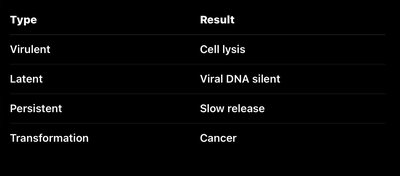
Animal viruses enter cells via membrane fusion or endocytosis. Outcomes of infection include cell lysis, latent infection, persistent infection, or transformation (cancer).
Plant Viruses
Plant viruses are mostly RNA viruses and are usually not enveloped. They have a wide host range and enter through wounds or vectors such as insects, nematodes, and fungi. Movement proteins facilitate cell-to-cell spread via plasmodesmata.
Retroviruses (HIV)
Retroviruses, such as HIV, possess an RNA genome and use reverse transcriptase to convert RNA into DNA, which integrates into the host genome as a provirus.
Comparison: Virus vs Bacteria Growth
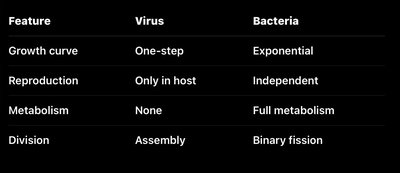
Viruses and bacteria differ fundamentally in their growth, reproduction, metabolism, and division.
Feature | Virus | Bacteria |
|---|---|---|
Growth curve | One-step | Exponential |
Reproduction | Only in host | Independent |
Metabolism | None | Full metabolism |
Division | Assembly | Binary fission |
Possible Results of Viral Infections
Viral infections can result in various outcomes depending on the virus and host cell.
Type | Result |
|---|---|
Virulent | Cell lysis |
Latent | Viral DNA silent |
Persistent | Slow release |
Transformation | Cancer |
Functions of Viral Enzymes
Viral enzymes play crucial roles in infection and replication:
Lysozyme: Breaks bacterial cell walls for genome entry and virion release.
Polymerase: Synthesizes viral nucleic acids.
Neuraminidase: Cleaves host cell surface molecules for virus release (influenza).
Review Questions – Key Concepts
Virus vs Cell: Viruses lack metabolism, ribosomes, and cellular structure; can only replicate inside host cells.
Host Requirement: Viruses rely on the host for energy, enzymes, ribosomes, and metabolic intermediates.
Viral Genomes: Can be DNA or RNA, single- or double-stranded, much smaller than cellular genomes.
Capsid vs Capsomere: Capsid is the whole protein shell; capsomere is the individual protein unit. Common spherical symmetry is icosahedral.
Naked vs Enveloped Virus: Naked: capsid only; Enveloped: capsid + lipid membrane from host.
Enzymes in RNA Virus Virions: RNA-dependent RNA polymerases and reverse transcriptase, as host cells cannot make RNA from RNA.
Capsid Maturation: Viral genome (DNA or RNA) is packaged into capsids during maturation.
Burst Size: Number of virions released from a single infected cell.