 Back
BackViruses, Viroids, and Prions: Structure, Classification, and Replication
Study Guide - Smart Notes
 Tailored notes based on your materials, expanded with key definitions, examples, and context.
Viruses, Viroids, and Prions
Distinctive Features of Viruses
Viruses are unique infectious agents that differ significantly from cellular life forms. They are obligate intracellular parasites, meaning they require living host cells to multiply. Viruses contain either DNA or RNA (never both), which may be single- or double-stranded, and are surrounded by a protein coat called a capsid. They lack ribosomes and ATP-generating mechanisms, relying entirely on the host cell's machinery for replication.
Obligate intracellular parasites: Cannot reproduce outside a host cell.
Genetic material: DNA or RNA, single- or double-stranded, linear, circular, or segmented.
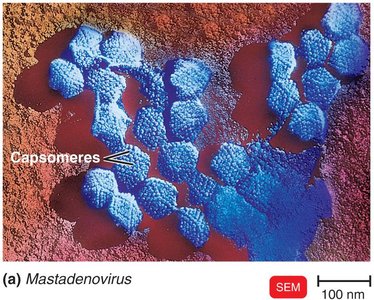
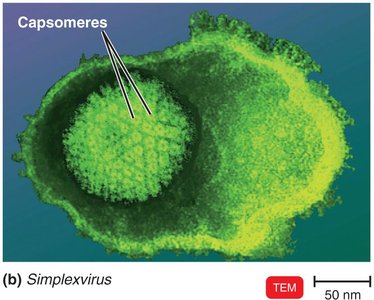
Capsid: Protein coat made of capsomeres.
No ribosomes or ATP production: Dependent on host cell for protein synthesis and energy.
Comparison of Viruses and Bacteria
Viruses and bacteria differ in several fundamental ways, as summarized in the table below:
Feature | Bacteria | Rickettsias/Chlamydias | Viruses |
|---|---|---|---|
Intracellular Parasite | No | Yes | Yes |
Plasma Membrane | Yes | Yes | No |
Binary Fission | Yes | Yes | No |
Pass through Bacteriological Filters | No | No/Yes | Yes |
Possess Both DNA and RNA | Yes | Yes | No |
ATP-Generating Metabolism | Yes | Yes/No | No |
Ribosomes | Yes | Yes | No |
Sensitive to Antibiotics | Yes | Yes | No |
Sensitive to Interferon | No | No | Yes |
Host Range
The host range of a virus refers to the spectrum of host cells it can infect. Most viruses are highly specific, infecting only certain cell types within a single host species. This specificity is determined by the presence of suitable attachment sites and cellular factors.
Bacteriophages: Infect bacteria; receptor sites may be on the cell wall, fimbriae, or flagella.
Animal viruses: Receptor sites are typically on the plasma membrane.
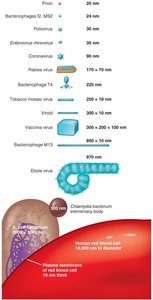
Viral Structure
Virion Components
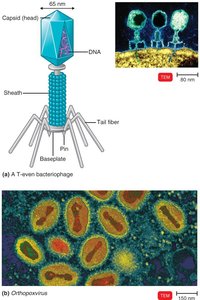
A virion is a complete, fully developed viral particle. Its main components include:
Nucleic acid: DNA or RNA, single- or double-stranded, linear, circular, or segmented.
Capsid: Protein coat made of capsomeres.
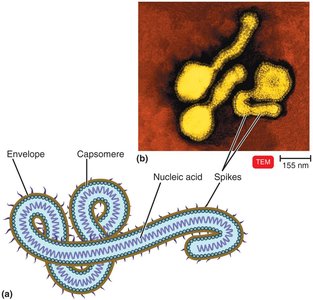
Envelope: Lipid, protein, and carbohydrate coating present in some viruses, derived from the host cell membrane.
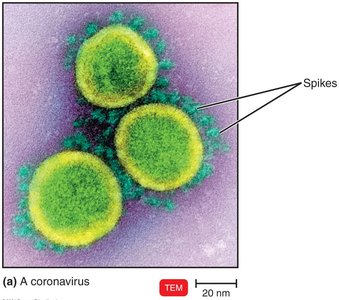
Spikes: Projections from the envelope, used for attachment to host cells.
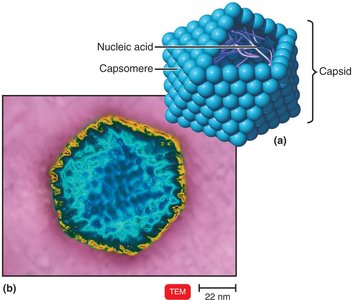
General Morphology of Viruses
Viruses exhibit several morphological types:
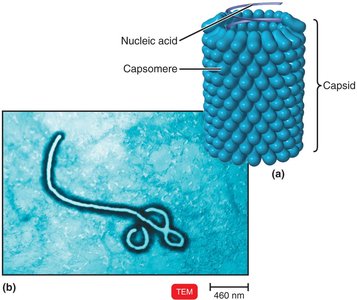
Helical viruses: Hollow, cylindrical capsid (e.g., rabies, Ebola).
Polyhedral viruses: Many-sided, usually icosahedral (e.g., adenoviruses, poliovirus).
Enveloped viruses: Spherical, with a lipid envelope (e.g., influenza, herpesviruses).
Complex viruses: Complicated structures (e.g., bacteriophages).
Taxonomy and Classification of Viruses
Baltimore Classification System
Viruses are classified based on their nucleic acid type and replication strategy. The Baltimore system divides viruses into seven groups (realms) based on how their mRNA is produced. Viral taxonomy uses the following conventions:
Genus names: End in -virus
Family names: End in -viridae
Order names: End in -ales
Viral species: Group of viruses sharing genetic information and ecological niche (host)
Isolation, Cultivation, and Identification of Viruses
Growing Bacteriophages
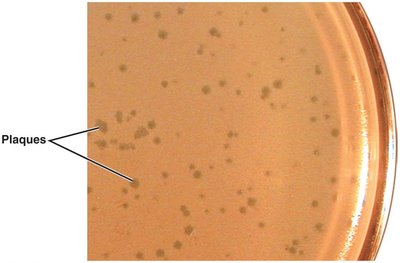
Bacteriophages are grown in bacteria. They form plaques—clearings on a lawn of bacteria on agar. Each plaque corresponds to a single virus and can be quantified as plaque-forming units (PFU).
Growing Animal Viruses
In living animals: Mice, rabbits, guinea pigs; some human viruses do not grow or cause disease in animals.
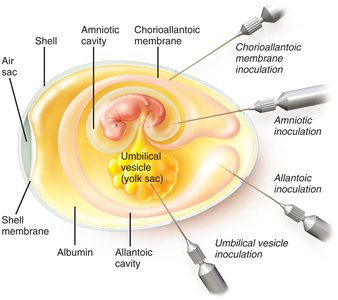
In embryonated eggs: Virus is injected into the egg; growth is detected by changes or death of the embryo. Used for vaccine production.
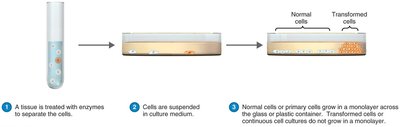
In cell cultures: Primary cell lines (short-lived), diploid cell lines (from human embryos, ~100 generations), and continuous cell lines (from cancer cells, e.g., HeLa cells, maintained indefinitely).
Viral Identification
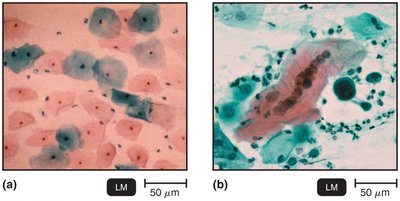
Cytopathic effects: Visible changes in infected cell cultures.
Serological tests: ELISA detects viral antigens using antibodies.
Nucleic acid tests: PCR amplifies and detects viral genetic material.
Viral Multiplication
One-Step Growth Curve
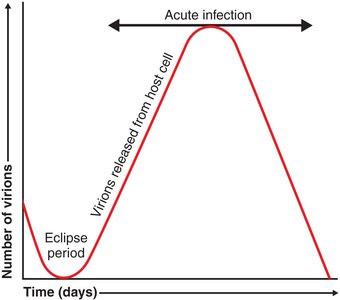
Viral replication follows a one-step growth curve, with an eclipse period (no detectable virions), followed by a sharp increase as virions are released from the host cell.
Multiplication of Bacteriophages
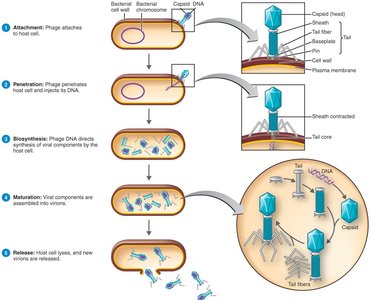
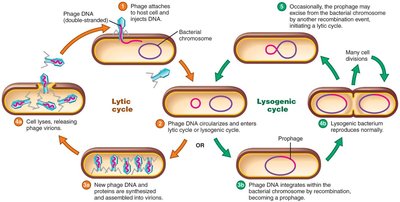
Bacteriophages multiply via two main mechanisms:
Lytic cycle: Phage causes lysis and death of the host cell (e.g., T-even bacteriophages).
Lysogenic cycle: Phage DNA integrates into host DNA as a prophage, replicating with the host cell without killing it immediately.
Outcomes of Lysogeny
Lysogenic cells are immune to reinfection by the same phage.
Phage conversion: Host cell exhibits new properties (e.g., toxin production).
Specialized transduction: Specific bacterial genes are transferred to another bacterium via a phage.
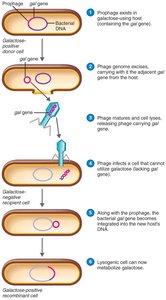
Comparison: Bacteriophage vs. Animal Virus Multiplication
Stage | Bacteriophages | Animal Viruses |
|---|---|---|
Attachment | Tail fibers attach to cell wall proteins | Receptor sites are plasma membrane proteins/glycoproteins |
Entry | Viral DNA injected into host cell | Capsid enters by endocytosis or fusion |
Uncoating | Not required | Enzymatic removal of capsid proteins |
Biosynthesis | In cytoplasm | In nucleus (DNA viruses) or cytoplasm (RNA viruses) |
Chronic Infection | Lysogeny | Latency; slow viral infections; cancer |
Release | Host cell is lysed | Enveloped viruses bud out; nonenveloped viruses rupture plasma membrane |
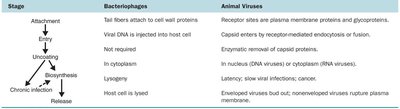
Multiplication of Animal Viruses
Attachment: To cell membrane receptors.
Entry: By receptor-mediated endocytosis or fusion.
Uncoating: Separation of viral nucleic acid from capsid by enzymes.
Biosynthesis: Production of viral nucleic acid and proteins.
Maturation: Assembly of viral components.
Release: By budding (enveloped viruses) or rupture (nonenveloped viruses).
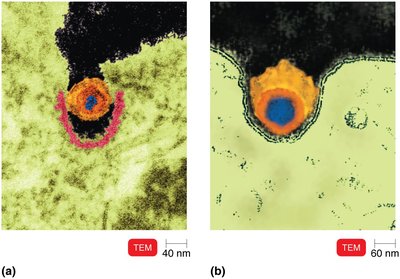


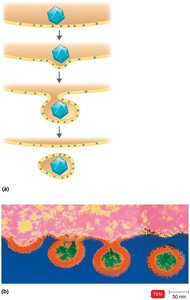
Naked vs. Enveloped Viruses
Naked viruses: More resistant to drying, heat, detergents, and acids; must kill host cells to be released.
Enveloped viruses: Sensitive to environmental factors; released by budding; cannot survive GI tract; require moist transmission.
Biosynthesis of DNA and RNA Viruses
DNA Viruses
DNA viruses replicate their DNA in the host nucleus using host enzymes and synthesize capsid proteins in the cytoplasm. Assembly occurs in the nucleus.
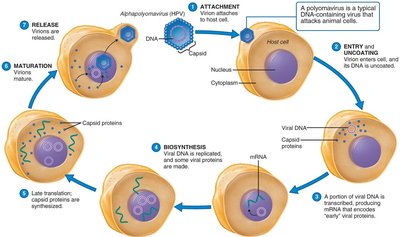
Adenoviridae: dsDNA, nonenveloped; respiratory infections, tumors in animals.
Poxviridae: dsDNA, enveloped; smallpox, vaccinia, MPOX; assembly in cytoplasm.
Herpesviridae: dsDNA, enveloped; cold sores, chickenpox, mononucleosis, cytomegalovirus, roseola, Kaposi’s sarcoma.
Papovaviricetes: dsDNA, nonenveloped; warts, some cause cancer.
Hepadnaviridae: dsDNA, enveloped; hepatitis B, uses reverse transcriptase.
RNA Viruses
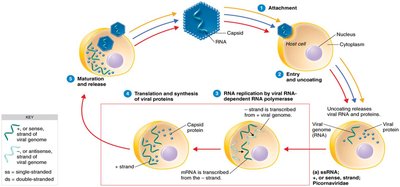
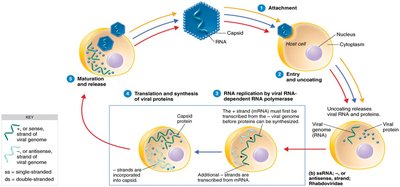
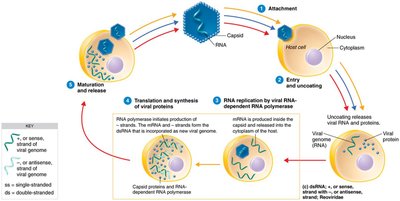
RNA viruses replicate in the cytoplasm using RNA-dependent RNA polymerase. Their genomes may be single-stranded (+ or − sense) or double-stranded.
+ (sense) strand: Viral RNA serves as mRNA for protein synthesis.
− (antisense) strand: Viral RNA is transcribed to a + strand to serve as mRNA.
dsRNA: Double-stranded RNA genome.
Coronaviridae: ssRNA (+), enveloped; includes SARS-CoV-2 (COVID-19).
Togaviridae: ssRNA (+), enveloped; includes alphavirus (encephalitis), rubivirus (rubella).
Rhabdoviridae: ssRNA (−), enveloped; includes rabies virus.
Picornaviridae: ssRNA (+), nonenveloped; includes poliovirus, rhinovirus, hepatitis A.
Reoviridae: dsRNA, nonenveloped; includes rotavirus (gastroenteritis).
Retroviruses
Retroviruses (e.g., HIV) are ssRNA viruses that use reverse transcriptase to produce DNA from their RNA genome. The DNA integrates into the host chromosome as a provirus, which is protected from the host immune system and antiviral drugs.
Viruses and Cancer
Oncogenic Viruses
Some viruses can cause cancer by integrating their genetic material into the host genome, leading to transformation of normal cells into tumor cells. Proto-oncogenes are normal genes that, when mutated, become oncogenes and drive uncontrolled cell growth.
DNA oncogenic viruses: Adenoviridae, Herpesviridae (Epstein-Barr virus), Poxviridae, Papovaviridae (HPV), Hepadnaviridae (hepatitis B).
RNA oncogenic viruses: Retroviridae (HTLV-1, HTLV-2, FeLV).
Oncolytic viruses: Used experimentally to treat cancer by infecting and killing tumor cells.
Latent and Persistent Viral Infections
Latent Infections
Latent viruses remain dormant in host cells for long periods, with no symptoms. They may reactivate due to changes in immunity. All herpesviruses are capable of latency (e.g., cold sores, shingles).
Persistent Infections
Persistent viral infections progress slowly over a long period and are often fatal (e.g., subacute sclerosing panencephalitis caused by measles virus).
Disease | Primary Effect | Causative Virus |
|---|---|---|
Cold sores | Skin and mucous membrane lesions | HHV-1, HHV-2 |
Leukemia | Increased white blood cell growth | HTLV-1, HTLV-2 |
Shingles | Skin lesions | Varicellovirus |
Cervical cancer | Increased cell growth | Human papillomavirus |
HIV/AIDS | Decreased CD4+ T cells | HIV-1, HIV-2 |
Liver cancer | Increased cell growth | Hepatitis B virus |
Progressive encephalitis | Mental deterioration | Rubella virus |
SSPE | Mental deterioration | Measles virus |
Viroids and Prions
Viroids
Viroids are infectious RNA molecules that cause disease in plants. They lack a protein coat and are much smaller than viruses.
Prions
Prions are infectious proteins that cause neurodegenerative diseases. They are inherited or transmissible by ingestion, transplant, or surgical instruments. Prion diseases include:
Spongiform encephalopathies (e.g., mad cow disease, Creutzfeldt-Jakob disease, fatal familial insomnia, sheep scrapie).
Normal cellular prion protein (PrPc) is converted into the infectious misfolded form (PrPSc), which accumulates in brain cells and forms plaques.
Additional info: The Baltimore classification system is widely used in virology to categorize viruses based on their genome type and replication strategy. Understanding the differences between latent and persistent infections is crucial for clinical management and epidemiology of viral diseases.
