 Back
BackViruses, Viroids, and Prions: Structure, Classification, and Multiplication
Study Guide - Smart Notes
 Tailored notes based on your materials, expanded with key definitions, examples, and context.
Viruses, Viroids, and Prions
General Characteristics of Viruses
Viruses are unique infectious agents that differ significantly from bacteria and other microorganisms. They are considered obligate intracellular parasites because they require living host cells to multiply. Unlike bacteria, viruses do not possess the cellular machinery necessary for independent life.
Genetic Material: Viruses contain either DNA or RNA, but never both. The nucleic acid can be single- or double-stranded, and may be linear or circular.
Protein Coat: The nucleic acid is enclosed in a protein coat called a capsid, composed of subunits known as capsomeres.
No Ribosomes or ATP Generation: Viruses lack ribosomes and do not generate ATP, relying entirely on the host cell for these functions.
Host Range: The spectrum of host cells a virus can infect is called its host range. Most viruses are specific to certain cell types within a single host species, determined by attachment sites and cellular factors.
Size: Viruses range from 20 nm to 1000 nm in length.
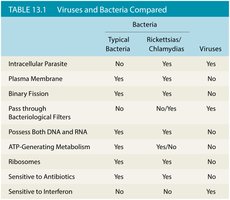
Table Purpose: The table above compares the main characteristics of typical bacteria, rickettsias/chlamydias, and viruses, highlighting differences in structure, metabolism, and sensitivity to antibiotics and interferon.
Viral Structure and Morphology
The complete, fully developed infectious viral particle is called a virion. Viruses exhibit diverse structural forms:
Helical Viruses: These have rod-shaped capsomeres forming a hollow, cylindrical capsid. Examples include Tobacco mosaic virus and Ebola virus.
Polyhedral Viruses: Many-sided, often icosahedral (20-sided). Examples: Papillomaviruses (nonenveloped), Herpesviruses (enveloped).
Enveloped Viruses: Surrounded by a lipid, protein, and carbohydrate envelope, often with surface projections called spikes.
Complex Viruses: Possess complicated structures, such as bacteriophages (with head, tail, and tail fibers) and poxviruses (lacking a true capsid).
Taxonomy of Viruses
Viruses are classified based on their genetic material, morphology, and host range. The taxonomy follows these conventions:
Genus names end in -virus
Family names end in -viridae
Order names end in -ales
Viral species: A group of viruses sharing the same genetic information and ecological niche (host). Subspecies are designated by numbers.
Examples:
Family: Herpesviridae
Genus: Herpesvirus
Species: Human herpesvirus (HHV-1, HHV-2, HHV-3)
Isolation, Cultivation, and Identification of Viruses
Because viruses are obligate intracellular parasites, they cannot be cultured on artificial media. Methods for culturing viruses include:
Bacteriophages: Grown in bacterial cultures; viral growth results in clear zones called plaques on a bacterial lawn.
Animal Viruses: Grown in living animals, embryonated eggs, or cell cultures (primary or continuous cell lines).
Identification techniques include:
Cytopathic effects (CPE): Observable changes in host cells due to viral infection.
Serological tests: Detection of viral antigens or antibodies (e.g., Western blot).
Nucleic acid tests: PCR and restriction fragment length polymorphism (RFLP) analysis.
Multiplication of Bacteriophages
Bacteriophages (viruses that infect bacteria) can multiply via two main cycles: the lytic cycle and the lysogenic cycle.
Lytic Cycle
The lytic cycle results in the destruction of the host cell and release of new phage particles. The steps are:
Attachment: Phage attaches to host cell via tail fibers.
Penetration: Phage injects its DNA into the host cell.
Biosynthesis: Phage DNA directs synthesis of viral components.
Maturation: Assembly of phage particles.
Release: Host cell lyses, releasing new virions.
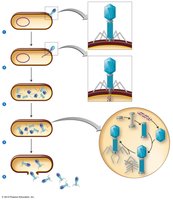
Key Terms:
Ghost: The empty phage capsid left outside the host cell after DNA injection.
Eclipse period: Time during which viral components are being synthesized but no complete virions are present.
Burst size: Number of virions released per lysed cell.
Burst time: Time from phage attachment to host cell lysis.
Lysogenic Cycle
In the lysogenic cycle, the phage DNA integrates into the host chromosome and replicates along with it, without killing the host. The integrated phage DNA is called a prophage, and the host cell is termed a lysogen. The prophage may eventually exit the host genome and enter the lytic cycle.
Phage conversion: The host cell may acquire new properties due to the presence of prophage DNA.
Specialized transduction: Specific bacterial genes are transferred to another bacterium via a phage.
Multiplication of Animal Viruses
The multiplication of animal viruses is similar to that of bacteriophages but includes additional steps:
Attachment: Virus attaches to host cell membrane.
Entry: By receptor-mediated endocytosis or fusion.
Uncoating: Viral or host enzymes remove the capsid, releasing nucleic acid.
Biosynthesis: Production of viral nucleic acid and proteins.
Maturation: Assembly of viral components.
Release: By budding (enveloped viruses) or rupture (nonenveloped viruses).
Latent and Persistent Viral Infections
Some viruses can remain in the host for extended periods:
Latent infections: Virus remains dormant in host cells and may reactivate (e.g., cold sores, shingles).
Persistent infections: Disease process occurs gradually over a long period, often fatal (e.g., subacute sclerosing panencephalitis caused by measles virus).
Viruses and Cancer
Certain viruses can cause cancer by integrating their genetic material into the host genome, leading to transformation of normal cells into tumor cells. These are called oncogenic viruses.
Oncogenes: Genes that can transform a normal cell into a cancerous cell.
Oncogenic DNA viruses: Adenoviridae, Herpesviridae, Poxviridae, Papovaviridae, Hepadnaviridae.
Oncogenic RNA viruses: Retroviridae (e.g., HTLV-1, HTLV-2).
Plant Viruses and Viroids
Plant viruses infect only plants and are transmitted by insects, nematodes, or mechanical means. Viroids are short pieces of naked RNA that cause diseases in plants, such as potato spindle tuber disease.
Prions
Prions are infectious proteins that lack nucleic acids. They cause neurodegenerative diseases known as spongiform encephalopathies, which are transmissible and fatal.
Examples: Mad cow disease, Creutzfeldt-Jakob disease (CJD), Gerstmann-Sträussler-Scheinker syndrome, fatal familial insomnia, sheep scrapie.
Mechanism: Abnormal prion protein (PrPSc) induces normal prion protein (PrPC) to misfold, accumulating in brain cells and forming plaques.
