Back
BackViruses, Viroids, and Prions: Structure, Replication, and Pathogenicity
Study Guide - Smart Notes
 Tailored notes based on your materials, expanded with key definitions, examples, and context.
Viruses, Viroids, & Prions
Introduction to Viruses
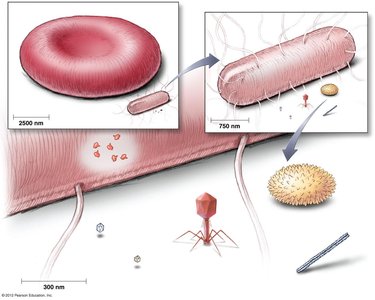
Viruses are minuscule, acellular infectious agents that contain either DNA or RNA as their genetic material. They are responsible for a wide range of infections in humans, animals, plants, and even bacteria, and are the causative agents of many significant diseases worldwide.
Acellular: Viruses lack cellular structure and do not possess cytoplasmic membranes, cytosol, or organelles (with rare exceptions).
Obligate Intracellular Parasites: They cannot carry out metabolic processes, grow, or respond to the environment independently. Instead, they rely on host cells for replication.
Virion: The extracellular state of a virus, consisting of a protein coat (capsid) surrounding the nucleic acid. The combination of nucleic acid and capsid is called the nucleocapsid. Some viruses also possess a phospholipid envelope derived from the host cell membrane.
Host Specificity: Most viruses infect only specific cell types in specific hosts due to the affinity between viral surface proteins and host cell receptors. Some, called generalists, can infect multiple cell types or species.
Genetic Material of Viruses
Viruses are classified based on their genetic material, which may be DNA or RNA, but never both. Viral genomes are much smaller than those of cells and can be single-stranded or double-stranded, linear or circular.
Types: dsDNA, ssDNA, dsRNA, ssRNA
Classification: The nature of the nucleic acid is the primary criterion for virus classification.
Viral Structure and Morphology
Viruses exhibit a variety of shapes and structural features that are important for their classification and function.
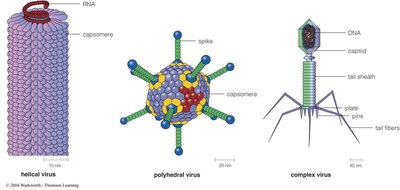
Capsid: The protein shell that protects viral nucleic acid and facilitates attachment to host cells. Composed of protein subunits called capsomeres.
Shapes: Three basic shapes are recognized: helical, polyhedral, and complex.
Viral Envelopes
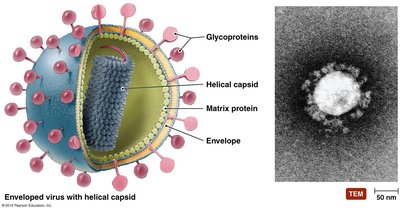
Some viruses possess an envelope, which is a lipid bilayer derived from the host cell membrane during viral replication or release. This envelope contains viral proteins and glycoproteins (spikes) that play a crucial role in host cell recognition and attachment.
Viral Replication Cycles
Viruses replicate by hijacking the host cell's machinery. The two main replication cycles are the lytic and lysogenic cycles (for bacteriophages), with animal viruses exhibiting similar but distinct processes due to differences in host cell structure.
Lytic Cycle: Involves attachment, entry, synthesis, assembly, and release, resulting in host cell lysis and death.
Lysogenic Cycle: The viral genome integrates into the host chromosome as a prophage, replicating passively with the host until induced to enter the lytic cycle.
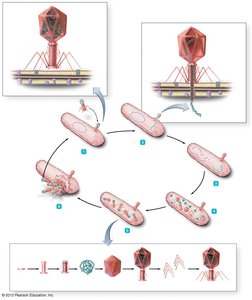
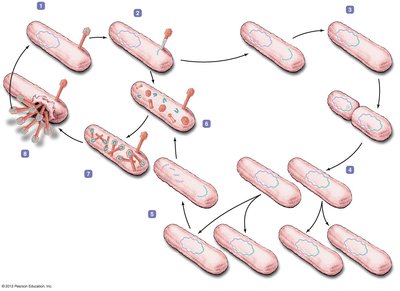
Replication of Animal Viruses
Animal viruses follow similar steps as bacteriophages but differ due to the presence of envelopes, the eukaryotic nature of host cells, and the absence of a cell wall. Attachment is mediated by glycoprotein spikes or other molecules. DNA viruses typically replicate in the nucleus, while RNA viruses replicate in the cytoplasm. Enveloped viruses are released by budding, causing persistent infections, while naked viruses are released by lysis or exocytosis.
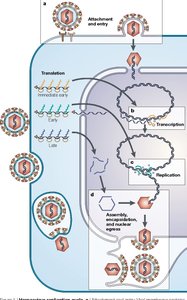
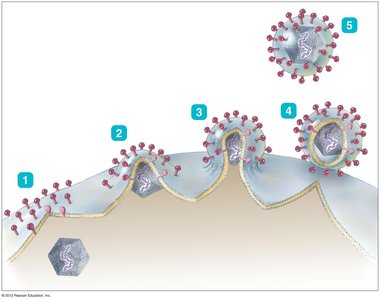
Viral Pathogenicity and Cancer
Some viruses can induce uncontrolled cell division (neoplasia), leading to tumor formation. Viral oncogenes or interference with tumor suppressor genes can result in cancer. Environmental factors such as UV light, radiation, and carcinogens can also activate oncogenes. Viruses are implicated in 20-25% of human cancers, including Burkitt’s lymphoma, Hodgkin’s disease, Kaposi’s sarcoma, and cervical cancer.
Culturing Viruses
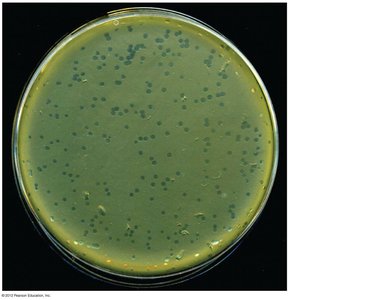
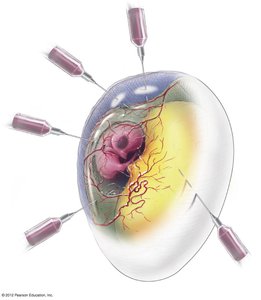
Viruses are cultured using living hosts such as bacteria (bacterial lawns), plants, animals, embryonated chicken eggs, or cell (tissue) cultures. Plaques in bacterial lawns indicate viral infection and lysis.
Are Viruses Alive?
The debate continues as to whether viruses are living entities. They possess genetic material and can replicate, but only within host cells, and lack independent metabolism.
Viroids
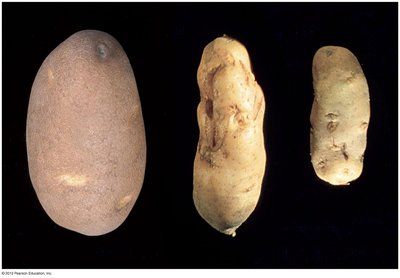
Viroids are extremely small, circular pieces of RNA that are infectious and pathogenic in plants. They lack a capsid and membrane, distinguishing them from viruses. Discovered in 1971, viroids can cause significant agricultural damage.
Prions
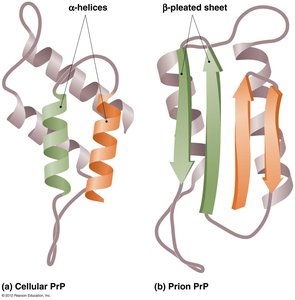
Prions are infectious proteins that cause fatal neurodegenerative diseases. The normal cellular PrP protein (with alpha-helices) is converted into the disease-causing prion PrP (with beta-pleated sheets), leading to spongiform encephalopathies. Prions are highly resistant to standard decontamination methods and require incineration or autoclaving in strong alkali for destruction.
Families of Human Viruses
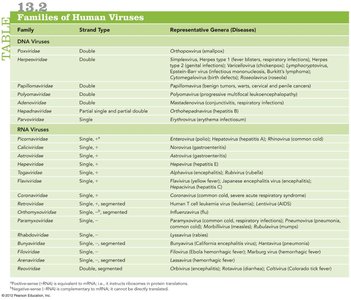
Viruses are classified into families based on their nucleic acid type, strand type, and representative genera or diseases. The following table summarizes major families of human DNA and RNA viruses:
Family | Strand Type | Representative Genera (Diseases) |
|---|---|---|
DNA Viruses | Double | Orthopoxvirus (smallpox), Simplexvirus (herpes), Cytomegalovirus (birth defects), Papillomavirus (warts, cervical cancer), Adenovirus (respiratory infections), Hepadnavirus (hepatitis B) |
RNA Viruses | Single (+/-) | Enterovirus (polio), Rhinovirus (common cold), Rubivirus (rubella), Lentivirus (HIV), Influenzavirus (influenza), Rotavirus (diarrhea), Filovirus (Ebola), Hantavirus (hemorrhagic fever) |