 Back
BackWater as the Essential Medium of Life: Structure, Properties, and Biological Relevance
Study Guide - Smart Notes
 Tailored notes based on your materials, expanded with key definitions, examples, and context.
Molecules and Their Environment
Molecular Dynamics in the Cellular Environment
The cellular environment is a complex solution containing ions, macromolecules, hydrophilic and hydrophobic substances, and gases. The interactions among these components are crucial for maintaining cellular functions such as solubilization, dilution, transport, lubrication, reaction, stabilization, signaling, structuring, and distribution. Water is the most important solvent in biological systems, providing the medium for these processes.
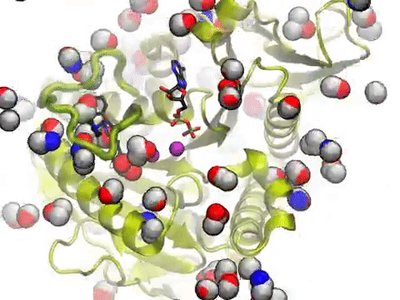
Water: Structure and Properties
Electronic Structure and Bonding in Water
The unique properties of water arise from its molecular structure. The oxygen atom in water forms two covalent bonds with hydrogen atoms, and possesses two lone pairs of electrons. The electronic configuration and hybridization of orbitals in water can be explained using valence bond theory and molecular orbital theory. The bond angle in water is approximately 104.5°, reflecting sp3 hybridization.
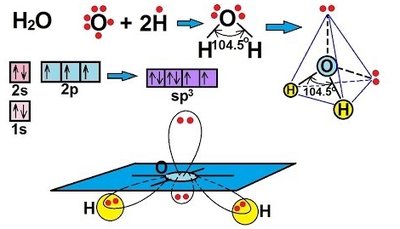
Molecular Orbitals of Water
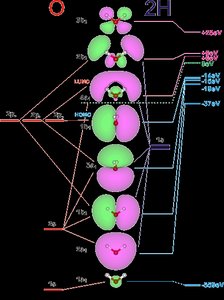
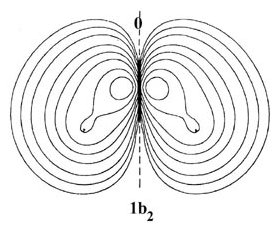
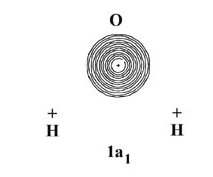
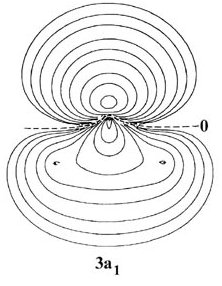
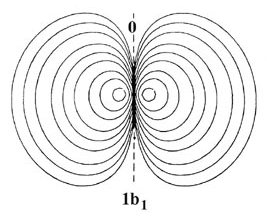
Molecular orbital theory describes the distribution of electrons in water. The highest occupied molecular orbitals (HOMO) are primarily localized on the oxygen atom, with significant contributions from the 2p orbitals. These orbitals are responsible for the chemical reactivity and polarity of the water molecule.

Charge Distribution and Polarity
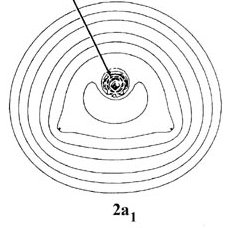
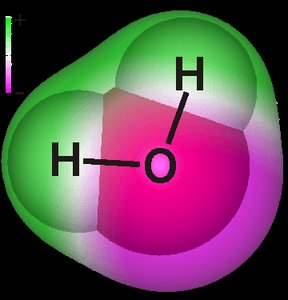
Water is a polar molecule due to the difference in electronegativity between oxygen and hydrogen, and the bent geometry of the molecule. The electron density is much higher around the oxygen atom, resulting in a partial negative charge (δ-) on oxygen and partial positive charges (δ+) on the hydrogens. This polarity is fundamental to water's solvent properties and its ability to form hydrogen bonds.
Electronegativity and Bond Character
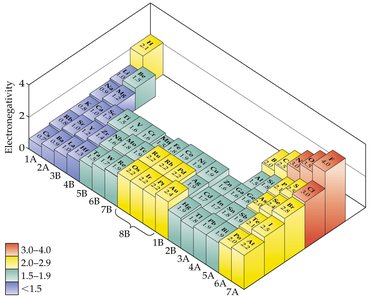
The difference in electronegativity between oxygen (3.5) and hydrogen (2.1) leads to a polar covalent bond in water. The bond has approximately 39% ionic character and 61% covalent character, making water a polar covalent molecule. This property is essential for its role as a universal solvent in biological systems.
Hydrogen Bonding and Structure of Water
Hydrogen Bonds in Water
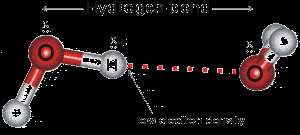
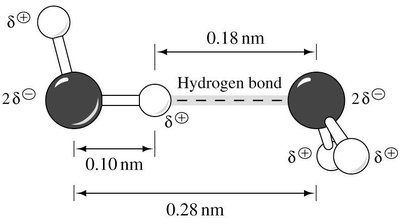
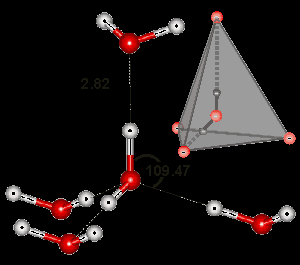
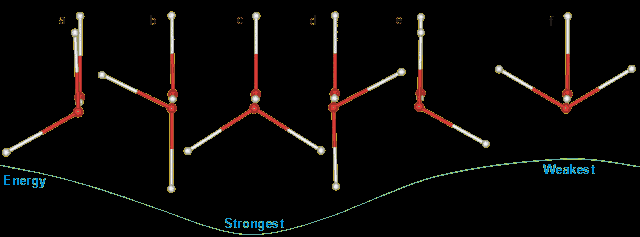
Hydrogen bonds are weak interactions (about 21 kJ/mol) compared to covalent bonds (about 492 kJ/mol), but they are crucial for the structure and properties of water. Each water molecule can form up to four hydrogen bonds: two as a donor and two as an acceptor. This leads to a dynamic, tetrahedral network in liquid water and an ordered structure in ice.
Hydrogen Bond Network and Water Structure
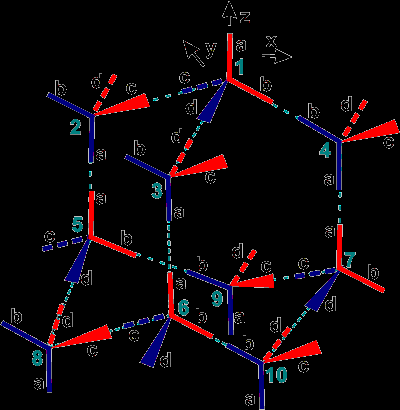
The hydrogen bond network in water is responsible for its high boiling and melting points, surface tension, and solvent capabilities. In ice, the network is fully tetrahedral, while in liquid water, thermal motion distorts and breaks some hydrogen bonds, but the local structure remains similar.
Solubility and Water as a Solvent
Solubility of Substances in Water
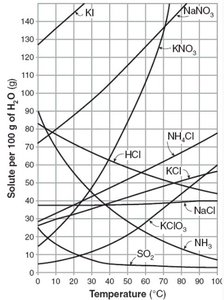
Water dissolves a wide range of substances due to its polarity and hydrogen bonding ability. The solubility of solids generally increases with temperature, while the solubility of gases decreases. The process of dissolution involves breaking solute-solute and solvent-solvent interactions and forming new solute-solvent interactions.
Radial Distribution Function
The radial distribution function describes the probability of finding a particle at a certain distance from a reference particle, relative to an ideal gas. In water, this function reveals the structured arrangement of water molecules around ions and other solutes.
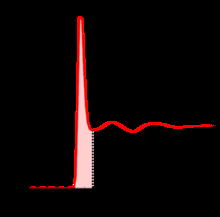
Water Structure Around Ions and Macromolecules
Hydration Shells and Ion Effects
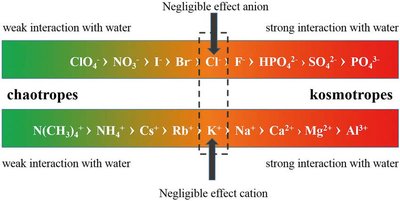
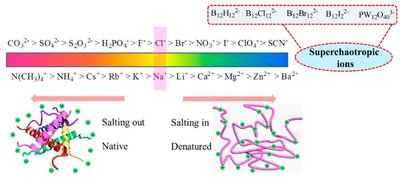
Ions in solution are surrounded by hydration shells, where water molecules are oriented by electrostatic interactions. The structure and dynamics of these shells depend on the ion's charge and size. Strongly hydrated ions (kosmotropes) stabilize water structure, while weakly hydrated ions (chaotropes) disrupt it. This has significant effects on protein stability and solubility (Hofmeister series).
Water Activity and Microbial Life
Water Activity (aw) and Microbial Growth
Water activity (aw) is a measure of the availability of water for biological processes. It is defined as the ratio of the vapor pressure of water in a solution to that of pure water at the same temperature. Microorganisms require a minimum water activity for growth, and different species are adapted to different aw levels (halophiles, xerophiles, osmophiles). Water activity also influences the stability of macromolecules and the rates of biochemical reactions.
Summary Table: Solubility Classification
Term | Range (g/dL) | Example |
|---|---|---|
Very soluble | <1 | calcium nitrate |
Freely soluble | 1 to 10 | calcium chloride |
Soluble | 10 to 30 | sodium oxalate |
Sparingly soluble | 30 to 100 | calcium sulfate |
Slightly soluble | 100 to 1000 | dicalcium phosphate |
Very slightly soluble | 1000 to 10,000 | barium sulfate |
Practically insoluble or insoluble | ≥10,000 | barium sulfate |
Key Equations
Gibbs Free Energy of Dissolution:
Henry's Law (Gas Solubility):
Solubility Product (Ksp):
Water Activity:
Conclusion
Water's unique structure and properties make it indispensable for life. Its ability to form hydrogen bonds, dissolve a wide range of substances, and mediate biochemical reactions underpins all cellular processes. Understanding water's behavior at the molecular level is essential for microbiology, biochemistry, and related life sciences.
