Consumer Surplus and Willingness to Pay quiz #9 Flashcards

Consumer Surplus and Willingness to Pay quiz #9
Control buttons has been changed to "navigation" mode.
1/40
  • When you buy in bulk, the price per individual item does what?
    Decreases.
  • Consumers create demand for what?
    Goods and services.
  • Higher prices for sports jerseys can result in what?
    Lower quantity demanded and potential decrease in consumer surplus.
  • The cost of 50 pounds of beans is what?
    The price per pound multiplied by 50.
  • Age, education level, income, and taste are all examples of how consumer groups:
    Can be segmented for marketing purposes.
  • Using the same products and promotions to appeal to large groups of people is called what?
    Mass marketing.
  • Charging for the believed worth of a product or service is called what?
    Value-based pricing.
  • Charging for the believed worth of a product or service is called what?
    Value-based pricing.
  • When consumers seek to maximize their total utility, they are engaging in which of the following?
    Rational decision making.
  • Typically, as customers grow older, which total product offer becomes increasingly important?
    Service and support features.
  • The pricing objective known as unit volume is based on what?
    Maximizing the number of units sold.
  • All else held constant, which one of the following will decrease if a firm increases its net income?
    The firm's cost-to-income ratio.
  • What is the best example of impulse buying in a supermarket?
    Grabbing a candy bar at the checkout counter.
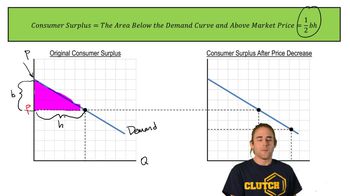
  • All else equal, what happens to consumer surplus if the price of a good increases?
    Consumer surplus decreases.
  • In the immediate environment, what is the first factor that affects the consumer?
    The product's price and availability.
  • Modern portfolio theory (MPT) is designed to achieve which one of these?
    Optimal risk-return balance through diversification.
  • How do market demands relate to needs and wants?
    Market demand reflects the aggregate willingness to pay for goods that satisfy needs and wants.
  • The purchase of a computer by a person for household use would be counted in what category of GDP?
    Personal consumption expenditures.
  • A likely example of substitute goods for most people would be what?
    Butter and margarine.
  • The utility from a specific product is what?
    The satisfaction or benefit a consumer receives from consuming it.
  • An increase in income will have what effect on normal goods?
    Increase demand for normal goods.
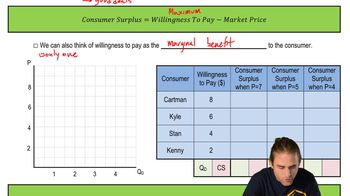
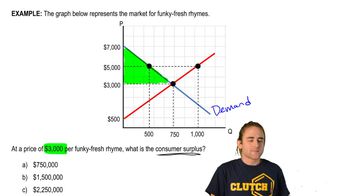
  • Consumer surplus is equal to the difference between what?
    Willingness to pay and the market price.
  • The rationing function of prices refers to what?
    Allocating goods to those who value them most, as shown by willingness to pay.
  • Prices of related goods, complements and substitutes, are:
    Determinants of demand.
  • An investor wanting large returns will be interested in companies that have what?
    High growth potential and profitability.
  • The demand for a luxury good whose purchase would exhaust a big portion of one's income is what?
    Elastic; demand is sensitive to price changes.
  • Mia wants to buy a book. The economic perspective suggests that Mia will buy the book if the
    Benefit (willingness to pay) exceeds the price.
  • The amount of revenue produced per unit of an output sold is the what revenue?
    Average revenue.
  • Suppose disposable income increases by 2000. What is the likely effect on consumption?
    Consumption spending will increase, but by less than $2,000.
  • Testing reveals how frequently a customer will buy a product and at what price, among other things. Why is this important?
    It helps firms estimate demand and set optimal prices.
  • The market value of an item is:
    The price at which it is bought and sold in the market.
  • One popular pricing objective is to do what?
    Maximize profit or market share.
  • Last year the average price for an airline ticket was 450. What does this represent?
    The market price for airline tickets.
  • A consumer holds money to meet spending needs. This would be an example of the what?
    Transaction demand for money.
  • When consumers decide to purchase a particular product, they do what?
    Compare the product's value to its price.
  • When people consider purchasing a good, they do what?
    Weigh the benefits against the cost.
  • Identify markets in which you act as a buyer/demander.
    Examples include the grocery market, housing market, and entertainment market.
  • The percentage of total market sales accruing to one specific firm is called the what share?
    Market share.
  • The ratio of perceived benefits to price is a product's what?
    Value.
  • Consumer expectations are a determinant of (one word).
    Demand.