Skip to main content
Microeconomics
My Course
Learn
Exam Prep
AI Tutor
Study Guides
Flashcards
Explore
Try the app
My Course
Learn
Exam Prep
AI Tutor
Study Guides
Flashcards
Explore
Try the app
Back
Factors of Production quiz #2
1 student found this helpful
You can tap to flip the card.
What is an advantage of a firm in organizing economic activity?
You can tap to flip the card.
👆
What is an advantage of a firm in organizing economic activity?
Firms can achieve efficiency and specialization by organizing resources.
Track progress
Control buttons has been changed to "navigation" mode.
1/36
Related flashcards
Related practice
Recommended videos
Factors of Production quiz #1
Factors of Production
35 Terms
Factors of Production quiz #3
Factors of Production
39 Terms
Factors of Production quiz #4
Factors of Production
39 Terms
Factors of Production
0. Basic Principles of Economics
10 problems
Topic
Circular Flow Diagram
0. Basic Principles of Economics
10 problems
Topic
0. Basic Principles of Economics
13 topics
14 problems
Chapter
Guided course
02:08
Human Capital and Entrepreneurship
4484
views
152
rank
Guided course
03:09
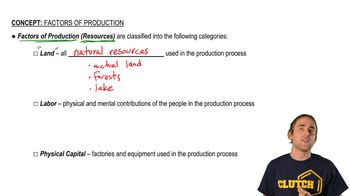
Land, Labor, and Physical Capital
5626
views
107
rank
Terms in this set (36)
Hide definitions
What is an advantage of a firm in organizing economic activity?
Firms can achieve efficiency and specialization by organizing resources.
What type of resource is a horse considered by economists?
A horse is not considered a capital resource; it is a land resource.
What factors typically motivate entrepreneurs as they start a business?
Innovation, profit, and risk-taking typically motivate entrepreneurs.
What is an example of labor specialization?
Assembly line workers each performing a specific task are examples of labor specialization.
Why is a resource or capability considered valuable?
A resource is valuable if it increases productivity or efficiency in production.
What is an example of a capital input?
Industrial machinery is an example of a capital input.
Which is the best description of labor utilization?
Labor utilization is the extent to which the workforce is effectively used in production.
A clothing manufacturing plant would most likely be classified as?
A clothing manufacturing plant is classified as a capital resource.
What economic conditions can affect career opportunities?
Changes in technology, resource availability, and consumer demand can affect career opportunities.
What does the concept of resource immobility imply?
Resource immobility means resources cannot easily move from one use or location to another.
What can shift the resource demand curve?
Changes in productivity, technology, or output prices can shift the resource demand curve.
What types of transactions take place in the resource market?
Hiring workers or purchasing machinery are transactions in the resource market.
What does human capital refer to?
Human capital refers to the skills, education, and training of workers.
What is the term for all of the people who are willing to work and are able to?
The labor force is the term for all people willing and able to work.
What acquires raw materials and resources and distributes them to manufacturing as required?
A supply chain or procurement department acquires and distributes resources.
What is a likely reason that a company would move its facility from one location to another?
A company may move to access better resources or reduce costs.
What are the two major types of agents used by producers?
Producers use suppliers and distributors as major types of agents.
What is a factor that increases the volatility of demand in industrial markets?
Rapid technological change increases demand volatility.
What is true about the relationship between output-per-worker and capital-per-worker?
Higher capital-per-worker generally leads to higher output-per-worker.
Which of the factors of production includes internet and transport network infrastructures?
Physical capital includes internet and transport network infrastructures.
Which type of protein production requires the least land and water per kilogram?
Poultry requires the least land and water per kg of protein produced.
What is the difference between the factor market and the product market?
The factor market is where resources are bought and sold; the product market is for finished goods and services.
Which determinant of productivity do we have the least control over?
Natural resources (land) are the determinants we have the least control over.
What two factors are the keys to determining labor productivity?
Education and training are key to determining labor productivity.
What is the largest contributor to productivity growth?
Improvements in human capital are the largest contributor to productivity growth.
What is not considered a land resource in economics?
Machinery is not considered a land resource; it is capital.
What is bought and sold in factor markets?
Resources such as labor, land, and capital are bought and sold in factor markets.
What are included in Janet's human capital as a farmer?
Janet's education, training, and farming experience are part of her human capital.
With respect to factors of production, what does entrepreneurship do?
Entrepreneurship organizes and manages the other factors of production.
What are the four factors of production?
Land, labor, capital, and entrepreneurship are the four factors of production.
Which workers are most likely to be in demand in the future?
Workers with high levels of education and specialized skills are most likely to be in demand.
What are factors of production?
Factors of production are resources used to produce goods and services: land, labor, capital, human capital, and entrepreneurship.
What are the 4 factors of production?
Land, labor, capital, and entrepreneurship.
Which of the factors that affect profit are usually able to be controlled?
Labor and capital costs are usually controllable by producers.
What do producers do?
Producers combine factors of production to create goods and services.
What kind of economy offers uniformity in wages regardless of individual productivity?
A command economy offers uniform wages regardless of productivity.
 BackBack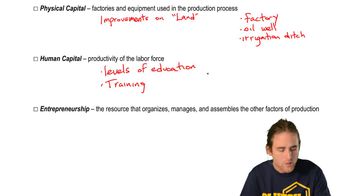
 02:08
02:08