Skip to main content
Microeconomics
My Course
Learn
Exam Prep
AI Tutor
Study Guides
Flashcards
Explore
Try the app
My Course
Learn
Exam Prep
AI Tutor
Study Guides
Flashcards
Explore
Try the app
Back
Positive and Normative Analysis quiz #2
You can tap to flip the card.
Why do you think economic freedom is essential for political freedom?
You can tap to flip the card.
👆
Why do you think economic freedom is essential for political freedom?
This is a normative question, expressing an opinion about the relationship between economic and political freedom.
Track progress
Control buttons has been changed to "navigation" mode.
1/39
Related flashcards
Related practice
Recommended videos
Positive and Normative Analysis quiz #1
Positive and Normative Analysis
37 Terms
Positive and Normative Analysis quiz #3
Positive and Normative Analysis
10 Terms
Positive and Normative Analysis definitions
Positive and Normative Analysis
14 Terms
Positive and Normative Analysis
0. Basic Principles of Economics
8 problems
Topic
Microeconomics vs. Macroeconomics
0. Basic Principles of Economics
10 problems
Topic
0. Basic Principles of Economics
13 topics
14 problems
Chapter
Guided course
02:48
Identifying Statements
5103
views
253
rank
Guided course
04:35
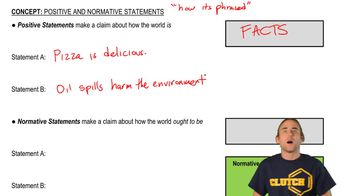
Positive Statements vs. Normative Statements
7251
views
146
rank
Terms in this set (39)
Hide definitions
Why do you think economic freedom is essential for political freedom?
This is a normative question, expressing an opinion about the relationship between economic and political freedom.
Which term implies the least degree of confidence in an economic generalization?
A hypothesis implies less confidence than a tested positive statement.
How does the market system promote progress?
The market system promotes progress through positive incentives and factual increases in efficiency.
What requirement ensures that economic data is recorded in dollars in the United States?
The use of a common currency, such as the dollar, is a positive fact in U.S. economic data.
What is one assumption of the prevailing rational-world paradigm?
Individuals act rationally based on available information, a positive assumption.
Why do centrally planned economies have difficulty meeting consumer needs?
Centrally planned economies often lack accurate positive information about consumer preferences.
Which is the most reasonable prediction in economic analysis?
A prediction based on positive, testable statements is most reasonable.
What leads to a rational answer in economic analysis?
Using positive analysis and factual information leads to rational answers.
What are the rules of conduct enacted and enforced by governments?
Laws and regulations are positive facts enacted and enforced by governments.
What might happen to a country’s economy and standard of living without property rights?
Without property rights, economic growth and living standards may decline, a positive statement.
What does it mean to say that two variables are positively associated?
It means that as one variable increases, the other also increases, a positive relationship.
According to the concept of bounded rationality, how do managers make decisions?
Managers make decisions based on limited information, which is a positive statement about behavior.
What does it mean to say that two variables are positively associated?
It means both variables move in the same direction, a factual relationship.
Economic policy must strike a balance between ideals and what?
Economic policy must balance normative ideals with positive facts.
An important part of a cost-benefit analysis is identifying what?
Identifying all relevant positive costs and benefits is crucial.
An extreme result of free-market capitalism without government regulation is referred to as what?
It is referred to as market failure, a positive outcome.
A benefit of informed decisions is that they...
They are based on positive analysis and lead to better outcomes.
Belief that the British should have colonists’ permission to pass taxes is an example of what type of statement?
It is a normative statement, expressing an opinion.
A potential benefit for a government leader using a cost-benefit analysis is what?
Making decisions based on positive, factual information.
Isolating relevant costs is desirable because...
It allows for accurate positive analysis in decision-making.
What is it called when you make predictions about data not yet recorded?
It is called forecasting, based on positive analysis.
Give an example of a normative statement.
'Healthcare should be free for everyone.'
Which of these is not a characteristic of a command economic system?
Reliance on positive market signals is not a characteristic of a command system.
Give another example of a normative statement.
'The government ought to lower taxes.'
Give an example of a positive statement.
'Lowering taxes increases disposable income.'
True or false: The efficient markets hypothesis holds only if all investors are rational.
False. The hypothesis relies on positive analysis of market information, not just investor rationality.
Two major virtues of the market system are that it...
It efficiently allocates resources and responds to positive incentives.
Classify each of the following statements as positive or normative.
Positive statements describe facts; normative statements express opinions about what should be.
If the financial markets are efficient then:
Prices reflect all available positive information.
In constructing models, economists...
Economists use positive statements and assumptions to simplify reality.
A knowledge problem exists when...
Decision-makers lack sufficient positive information to make informed choices.
Suppose that for a particular business there are no implicit costs. Then...
All costs are explicit and can be analyzed positively.
Economic models are ________.
Simplified representations using positive statements to explain economic phenomena.
What does the term money neutrality mean?
Money neutrality is a positive concept stating that changes in the money supply only affect prices, not real output.
A positive statement is concerned primarily with what?
Describing facts about how the world is.
True or false: Positive economics encourages value judgments.
False. Positive economics avoids value judgments and focuses on facts.
Identify whether these statements are normative or positive.
Normative statements express opinions; positive statements describe facts.
A positive statement is always...
A factual claim about the world, regardless of its truth.
What is Gordon's bird in the hand fallacy?
It refers to a mistaken belief based on normative reasoning rather than positive analysis.
 BackBack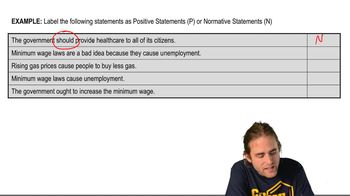
 02:48
02:48