The Demand Curve quiz #1 Flashcards

The Demand Curve quiz #1
Control buttons has been changed to "navigation" mode.
1/40
  • Which of the following are determinants of demand?
    Determinants of demand include factors such as consumer income, prices of related goods, tastes and preferences, expectations, and the number of buyers.
  • Which of the following specifically refers to demand?
    Demand refers to the entire relationship between prices and the quantity of a good that consumers are willing and able to buy at each price.
  • Which statement best explains the law of demand?
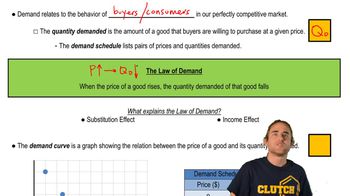
    The law of demand states that as the price of a good rises, the quantity demanded falls, and as the price falls, the quantity demanded rises.
  • What is the difference between a change in demand and a change in quantity demanded?
    A change in demand means the whole demand curve shifts due to non-price factors; a change in quantity demanded is movement along the curve due to a change in price.
  • Which best summarizes how consumer demand changes?
    Consumer demand changes when factors like income, preferences, or the prices of related goods change, shifting the demand curve.
  • What are the characteristics of demand?
    Demand is characterized by the relationship between price and quantity demanded, its downward slope, and its dependence on non-price determinants.
  • What is the difference between a change in quantity demanded and a change in demand?
    A change in quantity demanded is a movement along the demand curve due to price changes; a change in demand is a shift of the entire curve due to other factors.
  • What are the determinants of demand?
    Determinants of demand include consumer income, tastes, prices of related goods, expectations, and the number of buyers.
  • Which statement about demand and supply is true?
    Demand relates to buyers' behavior, while supply relates to sellers' behavior; both interact to determine market prices and quantities.
  • Which best explains how the law of demand affects consumers?
    As prices rise, consumers buy less of a good; as prices fall, they buy more.
  • Why is a demand curve downward sloping?
    The demand curve slopes downward due to the substitution effect and the income effect.
  • Which of the following changes would not shift the demand curve for a good or service?
    A change in the price of the good itself does not shift the demand curve; it only moves along the curve.
  • Which factors illustrate that the demand curve for a purely competitive firm is perfectly elastic?
    In perfect competition, the firm's demand curve is perfectly elastic because it can sell any quantity at the market price.
  • Which of the following explain the reasons for the downward slope of the aggregate demand curve?
    The downward slope is explained by the substitution effect and the income effect.
  • What does this demand curve demonstrate?
    A demand curve demonstrates the relationship between the price of a good and the quantity demanded at each price.
  • What is a market demand curve?
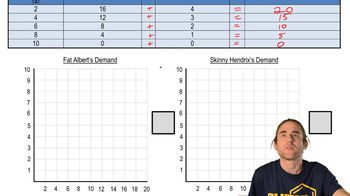
    The market demand curve is the sum of all individual demand curves in the market at each price.
  • Which statement is generally true according to the law of demand?
    When the price of a good increases, the quantity demanded decreases.
  • What is a basic principle of the law of demand?
    A basic principle is that price and quantity demanded are inversely related.
  • Which of the following will not cause the demand for product k to change?
    A change in the price of product k will not change demand, only quantity demanded.
  • What are the two variables needed to calculate demand?
    The two variables are price and quantity demanded.
  • Which of the following statements is true about the impact of an increase in the price of lettuce?
    An increase in the price of lettuce will decrease the quantity demanded, according to the law of demand.
  • Which of the following is consistent with the law of demand?
    As the price of a good rises, the quantity demanded falls.
  • Which of the following best describes the law of demand?
    The law of demand states that higher prices lead to lower quantity demanded.
  • Which statements are true according to the law of demand? (choose every correct answer.)
    As price increases, quantity demanded decreases; as price decreases, quantity demanded increases.
  • What does a demand curve look like for an oligopolistic firm?
    A demand curve for an oligopolistic firm is typically downward sloping, but may have segments with different elasticities.
  • Which statement best describes the demand curve for most goods and services?
    Most demand curves are downward sloping, showing an inverse relationship between price and quantity demanded.
  • Which of the following generalizations is correct? Demand tends to be
    Demand tends to be higher at lower prices and lower at higher prices.
  • Which of the following would result in the greatest rightward shift of the demand curve for good j?
    An increase in consumer income (if good j is normal) or a rise in the number of buyers would shift the demand curve rightward.
  • Which of the following is not held constant in a demand schedule?
    Price is not held constant in a demand schedule; it varies to show quantity demanded at each price.
  • Why do marketers want to see and understand demand curves?
    Marketers use demand curves to predict how changes in price will affect sales and revenue.
  • How is a decrease in the price of a good illustrated on a demand graph?
    A decrease in price is shown as a movement down along the demand curve, increasing quantity demanded.
  • The horizontal axis of a diagram of the AD and AS curves measures which of the following?
    The horizontal axis measures quantity (such as output or real GDP).
  • Which of these is considered a demand factor that will impact the demand curve for a product?
    Consumer preferences are a demand factor that can shift the demand curve.
  • Which of the following statements best represents the law of demand?
    When the price of a good increases, the quantity demanded decreases.
  • Which of the following will cause the demand for a normal good to increase?
    An increase in consumer income will increase demand for a normal good.
  • Which of the following correctly states the three main reasons the demand curve is downward sloping?
    The demand curve slopes downward due to the substitution effect, the income effect, and diminishing marginal utility.
  • Which of the following is true about the demand curve?
    The demand curve shows the inverse relationship between price and quantity demanded.
  • Which of the following are reasons for the demand curve sloping downward?
    The substitution effect and the income effect are reasons for the downward slope.
  • Which is consistent with the law of demand?
    A higher price leads to a lower quantity demanded.
  • Which of the following is not held constant in a demand schedule for coffee?
    Price is not held constant; it varies in the demand schedule.