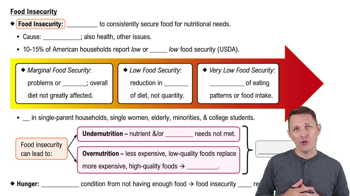
Food insecurity is the inability to consistently secure food for nutritional needs.
What is the primary driver of food insecurity in the United States?
Poverty is the main cause of food insecurity in the U.S.
What percentage of American households report food insecurity each year?
About 10-15% of American households report food insecurity annually.
What distinguishes marginal food security from low food security?
Marginal food security involves anxiety about food access but no significant diet impact, while low food security means reduced diet quality but not quantity.
Who are the most vulnerable groups to food insecurity?
Single-parent households, minorities, the elderly, and college students are most vulnerable to food insecurity.
How can food insecurity lead to both undernutrition and overnutrition?
Food insecurity can cause undernutrition from insufficient food and overnutrition from reliance on low-quality, calorie-dense foods.
What is the physiological condition resulting from not having enough food called?
Hunger is the physiological condition caused by not having enough food.
What federal program provides funds for low-income individuals to buy food using an EBT card?
The Supplemental Nutrition Assistance Program (SNAP) provides funds for low-income individuals to buy food with an EBT card.
Who does the WIC program specifically serve?
WIC serves low-income pregnant women, infants, and children up to age five.
Which federal program supplements food for low-income individuals aged 60 or older?
The Commodity Supplemental Food Program serves low-income individuals who are 60 years or older.
What is the purpose of the National School Lunch Program and related programs?
These programs provide free or reduced meals to low-income children at schools and community sites.
How do food banks and pantries typically obtain food for distribution?
Food banks and pantries use donated food or funds to distribute food to those in need.
What is the role of emergency kitchens or soup kitchens in addressing food insecurity?
Emergency kitchens or soup kitchens provide full meals to people who otherwise couldn't get them.
What do food recovery programs do to help people experiencing food insecurity?
Food recovery programs collect surplus food from stores or restaurants and distribute it to people in need.
Why do food banks often prefer monetary donations over canned goods?
Monetary donations allow food banks to buy the exact food needed rather than relying on random donated items.
 Back
Back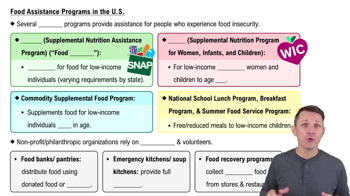
 05:41
05:41