 Back
BackCarbohydrates: Plant-Derived Energy Nutrients – Structured Study Notes
Study Guide - Smart Notes
 Tailored notes based on your materials, expanded with key definitions, examples, and context.
Carbohydrates: Plant-Derived Energy Nutrients
Introduction to Carbohydrates
Carbohydrates are organic compounds composed of carbon, hydrogen, and oxygen (abbreviated as CHO). They are primarily found in plant foods and serve as a crucial energy source for all cells, with a particular importance as the preferred energy source for the brain. Carbohydrates are classified as a macronutrient, providing 4 kcal per gram, and are divided into simple and complex forms.
Definition: Organic molecules consisting of carbon, hydrogen, and oxygen.
Primary Sources: Plant-based foods such as grains, fruits, vegetables, and legumes.
Energy Value: 4 kcal/g.
Classification: Simple (sugars) and complex (starches and fibers).

Classification of Carbohydrates
Simple Carbohydrates
Simple carbohydrates consist of one or two sugar molecules and are quickly digested and absorbed by the body. They are further divided into monosaccharides and disaccharides.
Monosaccharides: Single sugar units, including glucose, fructose, and galactose.
Disaccharides: Composed of two monosaccharide units. The main types are:
Lactose: Glucose + Galactose (found in milk)
Maltose: Glucose + Glucose (formed during starch digestion)
Sucrose: Glucose + Fructose (found in sugar cane, sugar beets, honey)

Complex Carbohydrates
Overview of Complex Carbohydrates
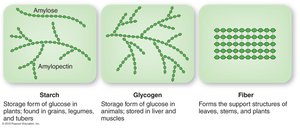
Complex carbohydrates are composed of long chains of glucose molecules. They include starch, glycogen, and fiber, each with distinct roles in nutrition and physiology.
Starch: The storage form of glucose in plants. Major sources include grains, legumes, and tubers. Starch must be broken down into glucose before it can be used by the body.
Glycogen: The storage form of glucose in animals and humans, primarily found in the liver and muscles. Glycogen can be rapidly metabolized to meet energy needs.
Fiber: A long-chain polysaccharide that is not easily broken down by human digestive enzymes. Most fiber passes through the gastrointestinal tract undigested.
Types of Fiber
Dietary fiber is classified based on its solubility in water, which influences its physiological effects and health benefits.
Dietary Fiber: The nondigestible part of plants.
Functional Fiber: Nondigestible carbohydrates extracted from plants or manufactured and added to foods for health benefits.
Total Fiber: The sum of dietary and functional fiber.

Soluble vs. Insoluble Fiber
Fibers are further classified by their solubility, which determines their effects in the body and their food sources.
Type of Fiber | Properties | Health Benefits | Food Sources |
|---|---|---|---|
Soluble Fiber | Dissolves in water, forms gels, fermentable | Lowers blood cholesterol and glucose levels | Citrus fruits, berries, oats, beans |
Insoluble Fiber | Does not dissolve in water, not typically fermented | Promotes bowel regularity, reduces risk for diverticulosis | Whole grains, vegetables |

Summary Table: Carbohydrate Types and Functions
Carbohydrate Type | Structure | Function | Examples |
|---|---|---|---|
Monosaccharides | Single sugar unit | Basic energy source | Glucose, Fructose, Galactose |
Disaccharides | Two sugar units | Energy, sweetener | Lactose, Maltose, Sucrose |
Starch | Polysaccharide (plant) | Energy storage in plants | Grains, legumes, tubers |
Glycogen | Polysaccharide (animal) | Energy storage in animals | Liver, muscle tissue |
Fiber | Polysaccharide (nondigestible) | Digestive health, cholesterol regulation | Fruits, vegetables, whole grains |
Key Equations
Energy Provided by Carbohydrates:
Additional info: Fiber is not digested for energy but plays a critical role in digestive health and disease prevention. Soluble fiber can help regulate blood glucose and cholesterol, while insoluble fiber aids in maintaining bowel health.
