 Back
BackComprehensive Study Notes: Proteins, Water, Alcohol, Lipids, Carbohydrates, and Vitamins
Study Guide - Smart Notes
 Tailored notes based on your materials, expanded with key definitions, examples, and context.
Proteins
Protein Structure and Function
Proteins are essential macromolecules composed of amino acids, which serve various functions in the body including transport, regulation, structural support, and energy. - Monomers of proteins: Amino acids are the building blocks of proteins. - Primary structure: The sequence of amino acids; unaffected by acids and bases. - Secondary structure: Defines folded shapes (e.g., alpha helices, beta sheets). - Quaternary structure: Involves multiple subunits. - Denaturation: Caused by agitation, acids, salts, or heat; affects all structures except primary. - Protein functions: Transport, regulation, structural support, energy. Example: Hemoglobin transports oxygen in the blood. Additional info: The body uses 20 amino acids to create proteins; 9 are essential and must be obtained from the diet.
Protein Digestion and Absorption
Protein digestion begins in the stomach and continues in the small intestine. - Stomach: Pepsin and hydrochloric acid initiate digestion. - Small intestine: Amino acids are absorbed. - Cholecystokinin: Hormone stimulating release of proteases from the pancreas. - Hydrochloric acid: Converts pepsinogen to pepsin. Example: Protein digestion relies on both pepsin and hydrochloric acid.
Protein Requirements and Health
Adequate protein intake is crucial for health and metabolism. - Recommended intake: 10-35% of calories should come from proteins. - Calories: Proteins provide 4 calories per gram. - Limiting amino acid: An amino acid in short supply restricts protein synthesis. - Conditionally essential amino acids: Become essential during illness. - Wasted amino acids: Converted into calories if not used for protein synthesis. Example: Eating too little protein affects digestion, absorption, immunity, and energy malnutrition.
Nitrogen Balance
Nitrogen balance reflects protein metabolism. - Positive nitrogen balance: Occurs during pregnancy, growth, or recovery.
Water and Minerals
Water: Properties and Functions
Water is the most abundant nutrient in the body and is vital for physiological processes. - Universal solvent: Due to polar charges, water dissolves many substances. - Fluid compartments: Extracellular fluid is outside cells; water moves toward higher solute concentrations. - Consumption: Water is consumed when amino acids split apart, not created. - Dehydration: Reduces ability to maintain body temperature. - Edema: Accumulation of fluid in tissues. Example: Water is not gained through skin; dehydration impairs thermoregulation.
Minerals
Minerals are inorganic nutrients required for various bodily functions. - Cations: Positively charged ions.
Alcohol
Alcohol Metabolism and Effects
Alcohol is not a nutrient, though it provides calories. - Standard drink: 12 oz beer, 5 oz wine, 1.5 oz shot. - Calories: Alcohol provides 7 calories per gram. - Metabolism: Liver is primarily responsible; most alcohol absorbed in stomach and small intestine. - Blood alcohol levels: Influenced by gender, ethnicity, genetics. - Proof: Proof is double the percentage of alcohol (e.g., 40% alcohol = 80 proof). Example: Alcoholic beverages contain ethanol.
Health Effects of Alcohol
Alcohol has both potential benefits and risks. - Potential benefits: Reduced risk of diabetes and cardiovascular disease. - Long-term effects: Impaired absorption of water, interference with digestion, decreased enzyme production, thiamin deficiency, Wernicke-Korsakoff Syndrome. - Alcohol and pregnancy: Pregnant individuals should avoid alcohol due to negative health impacts.
Carbohydrates
Types and Functions
Carbohydrates are a primary energy source and are classified as simple or complex. - Simple carbohydrates: Monosaccharides and disaccharides (e.g., sucrose, maltose, lactose). - Complex carbohydrates: Disaccharides and polysaccharides; long chains of sugar units. - Glycogen: Stored in liver and muscles; converted to glucose when blood sugar is low. - Starch: Chemical digestion begins in the mouth (amylase). Example: Sucrose is table sugar; muscle glycogen provides energy.
Carbohydrate Digestion and Regulation
- Enzymes: Amylase (salivary enzyme), pancreas regulates blood sugar. - Hormones: Insulin decreases blood glucose and increases stored glycogen; glucagon increases blood sugar.
Health Implications
- Dental caries: Caused by excess carbs. - Fiber: Reduces risk for diabetes, constipation, cardiovascular disease; insoluble fiber prevents diverticulitis.
Lipids
Types and Functions
Lipids are a diverse group of molecules, including triglycerides, phospholipids, and sterols. - Triglycerides: Most common lipid in body and food. - Sterols: Cholesterol is the best-known sterol. - Phospholipids: Start lipid transport process. - Calories: Lipids provide 9 calories per gram. Example: Chylomicrons are created by intestinal lining cells for lipid transport.
Health Implications
- Saturated fats: Affect VLDL the most; recommended maximum is 10% of calories. - Polyunsaturated fats: Best kind; go rancid quickly. - LDL: Not considered 'good' cholesterol. - Atherosclerosis: Caused by fatty buildup in blood vessels.
Vitamins
Vitamin Classification and Functions
Vitamins are organic compounds essential for health, classified as water-soluble or fat-soluble. - Water-soluble: B vitamins, vitamin C; absorbed in small intestine, often attached to proteins. - Fat-soluble: Vitamins A, D, E, K; stored in body fat. - Functions: Support vision, skin, bones, teeth, energy metabolism, blood clotting, and immune function. Example: Vitamin C prevents scurvy; vitamin D supports bone health. 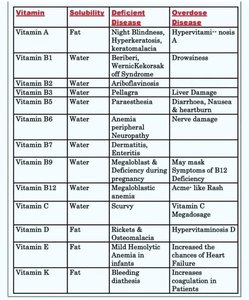
Vitamin Deficiency and Overdose
Deficiency and overdose of vitamins can lead to specific diseases and symptoms.
Vitamin | Solubility | Deficient Disease | Overdose Disease |
|---|---|---|---|
Vitamin A | Fat | Night Blindness, Hyperkeratosis, keratomalacia | Hypervitaminosis A |
Vitamin B1 | Water | Beriberi, Wernicke-Korsakoff Syndrome | Drowsiness |
Vitamin B2 | Water | Ariboflavinosis | Liver Damage |
Vitamin B3 | Water | Pellagra | Diarrhea, Nausea & heartburn |
Vitamin B6 | Water | Anemia, neuropathy | Nerve damage |
Vitamin B7 | Water | Dermatitis | None |
Vitamin B9 | Water | Megaloblastic anemia, neural tube defects | May mask symptoms of B12 deficiency |
Vitamin B12 | Water | Deficiency: Anemia, nerve damage | Acne-like rash |
Vitamin C | Water | Scurvy | Vitamin C Megaloblastic |
Vitamin D | Fat | Rickets & Osteomalacia | Hypervitaminosis D |
Vitamin E | Fat | Mild hemolytic anemia | Increased risk of heart failure |
Vitamin K | Fat | Anemia, diarrhea | Increased clotting in patients |
Vitamin Sources and Uses
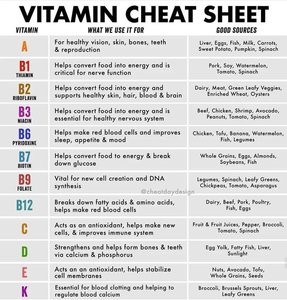
Vitamins are found in a variety of foods and serve distinct physiological roles.
Vitamin | What We Use It For | Good Sources |
|---|---|---|
A | Healthy vision, skin, bones, teeth, reproduction | Liver, Egg, Fish, Milk, Carrots, Sweet Potato, Pumpkin, Spinach |
B1 | Convert food into energy, nerve function | Dairy, Meat, Whole Grains, Nuts, Veggies |
B2 | Convert food into energy, support healthy skin, hair, blood, brain | Dairy, Meat, Green Leafy Veggies |
B3 | Convert food into energy, essential for healthy nervous system | Beef, Chicken, Shrimp, Watermelon, Fish, Tomatoes, Avocado |
B6 | Make red blood cells, improve sleep, appetite, mood | Chicken, Fish, Banana, Watermelon, Potato |
B7 | Convert food to energy, break down glucose | Whole Grains, Egg, Grapes, Strawberries |
B9 | Cell creation, DNA synthesis | Legumes, Spinach, Pear, Grapes, Avocado |
B12 | Break down fatty acids, amino acids, make red blood cells, bones, teeth | Dairy, Beef, Pork, Fish |
C | Antioxidant, immune system, helps heal wounds | Fruit & Veggies, Peppers, Broccoli, Tomatoes |
D | Acts on calcium, helps bones & teeth | Egg, Fish, Dairy, Sunlight |
E | Antioxidant, helps stabilize cell membranes | Peanut, Sunflower, Spinach, Broccoli |
K | Blood clotting, bone health | Broccoli, Leafy Greens, Liver, Egg |
Energy Balance and Nutrition
Energy Balance
Energy balance is the relationship between calories consumed and calories expended. - Proteins: 4 calories per gram. - Lipids: 9 calories per gram. - Alcohol: 7 calories per gram. Example: 104 calories in a drink with 8g alcohol and 12g carbs.
Food Safety and Regulation
Food Labels
Food labels list ingredients in order of weight and provide nutritional information.
Nutrition Across the Lifespan
Pregnancy and Infancy
Pregnant individuals have a positive nitrogen balance and require adequate nutrients for fetal development.
Additional Information
Phytochemicals
Phytochemicals are found in green foods and may provide health benefits.
Supplements
Supplements are most beneficial when taken during illness. ----------------------------------------
