- Download the worksheet to save time writing
- Start solving the practice problems
- If you're stuck, watch the video solutions
- See your summary to get more insights

Write the IUPAC name for the compound given below.
Provide the IUPAC name of the following compounds.

Name the following compound. Give both an IUPAC and a common name if possible.
Rationalize why the carbonyl oxygen of the ester attacks the aluminum of DIBAL-H instead of the alkoxy oxygen in the following reaction.

(i) Predict the main product obtained when the molecule below reacts with DIBAl-H.
(ii) Based on your answer, is there a need to convert the ester to another ester to accomplish what DIBAl-H is intended to do?

Sort the following compounds in descending order of nucleophilic addition reactivity:

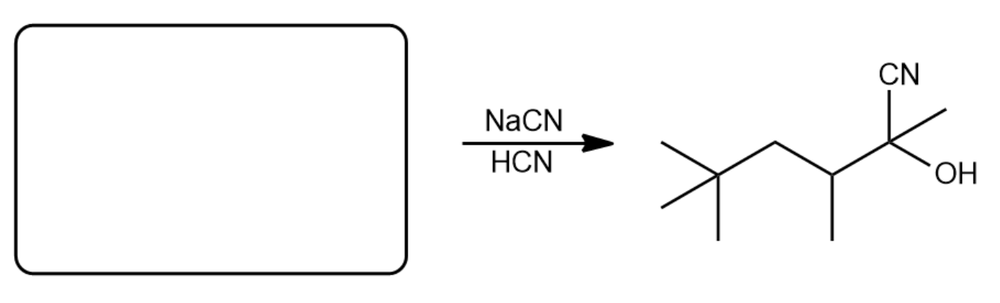
Determine the carbonyl compound to react with NaCN/HCN to yield the cyanohydrin below.
i) Draw a mechanism for each of the reactions. ii) Which of the two reactions would be considered more sustainable? Note: Assume that the starting organic molecules are equally green.
