25. Phenols
- Download the worksheet to save time writing
- Start solving the practice problems
- If you're stuck, watch the video solutions
- See your summary to get more insights

25. Phenols
12 problems
Problem 1Multiple Choice
Phenol is weakly acidic and can be deprotonated in basic solutions compared to cyclohexanol. The pKa of phenol is 10, while the pKa of cyclohexanol is 16. Explain why the pKa of phenol is lower than the pKa of cyclohexanol.

Problem 2Multiple Choice
Consider the following pair of compounds:

Compounds A and B are both sparingly soluble water. In dilute potassium hydroxide solution, compound B is very soluble but compound A is still sparingly soluble. Show how you can exploit this difference in solubility to separate these two compounds from a mixture.
Problem 3Multiple Choice
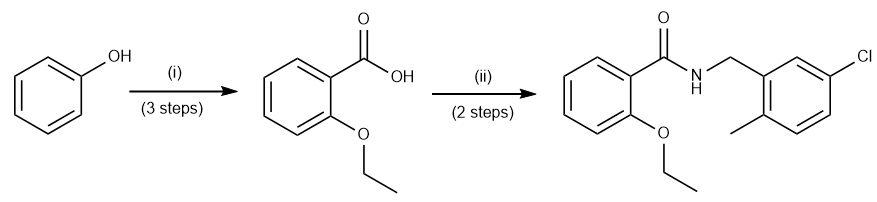
Give the reagents that will complete the synthesis shown below: